

By Ray Birch
LAKE FOREST, Ill.—The number of checking accounts in the U.S. soared to 391.5 million during the second quarter, a 9.4% annual increase in only a few months—the largest surge in U.S. history, according to a new study that suggests the coronavirus pandemic may be having a bigger financial impact on checking than the Great Recession.
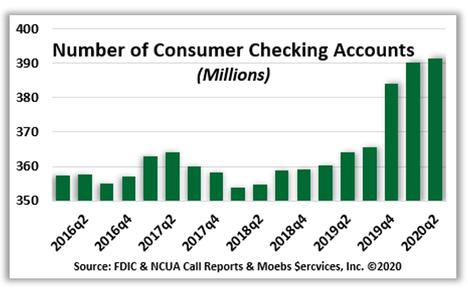
The report from Moebs $ervices shows checking balances also hit a milestone—$3.363 trillion, fueled in part by small businesses shifting more money to the liquid account at a greater rate than consumers.
At the same time, the unbanked adult population fell to a low of 15 million as many sought financial shelter.
“Fearful of the coronavirus and a very uncertain financial future, consumers increased dollars held in checking accounts, which offers greater liquidity and the ability to access funds quickly,” said Michael Moebs, economist and CEO at Moebs $ervices.
The surge in checking balances is comprised of both new dollars and a shift of funds from less liquid deposits, such as CDs and MMDAs, the report shows.
“The dread of the infectious disease created a panic with financial holdings,” stated Moebs. “The unmatched rush to checking rose rapidly upon Americans learning of the virus in China late in 2019.”
Small Biz Drive Volume
Moebs emphasized consumers were not alone flooding the checking market, as small businesses moved as much funds as possible into their checking accounts.
“Businesses moved from 37% of their deposits in checking to 43.9%, many trying to save their companies,” said Moebs.
The average consumer checking balance increased 30.5% to $4,800 within weeks, emphasized Moebs. In 2020, checking balances have increased across the board at all depositories—53% at thrifts, 27% at banks and 25% at credit unions.
Moebs said banks have grown checking at a faster pace due to municipalities and counties being required to leave money at banks, and also because banks have more business accounts than credit unions.
“Interestingly, the checking market saw a similar surge in dollars during the Great Recession in 2008 when checking balances increased 22.5%,” said Moebs.
A Bigger Effect
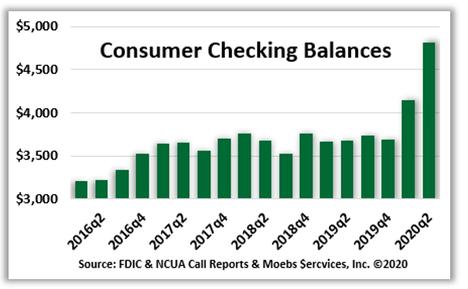
Moebs said the coronavirus pandemic may be having a bigger financial impact on checking than the Great Recession.
“The uncertainty of these two tragic events has moved the consumer to keep money liquid with quick access in case times got worse,” reminded Moebs. “There are enough great-grandparents still around to talk of the impact of the Great Pandemic of 1918-20 followed soon after by the Great Depression. Was the Great Pandemic a cause of the Great Depression? The Great Pandemic of 1918-20 started during the end of World War I and was followed by Prohibition, which banned the consumption and production of alcohol. All three of these events had tremendous negative effects on the U.S. economy spanning the years from 1917 to 1939.”
Will coronavirus have the same impact as the Great Pandemic until a vaccine can be created?
The Moebs Checking Study indicates the probability is low, said Moebs.
“The federal government, the Federal Reserve, Congress, state governments are responding quite differently than 100 years ago with unprecedented monetary policies and economic stimulus payments directly to consumers and businesses,” he said.
The Forecast

Michael Moebs
Based on the state of checking and major past economic events, the Moebs study forecasts:
- The massive movement of money into checking “does reinforce, once again, checking is key to financial services.”
- Businesses and consumers alike are warehousing money, seeking financial certainty to move. It’s a “key trend,” said Moebs
- “The historic low number of unbanked individuals signals another key trend—pricing will be key to keeping all new checking accounts,” Moebs said
- Checking accounts with higher balances will be more important than retaining lots of accounts
- Checking funds move quickly. "Depositories need new deposit designs and creative pricing to retain this money,” said Moebs
- Deposit interest rates related to balances and fees on all accounts will be crucial
“Is it time to offer higher rates hinged to higher balances along with reduced fee prices? Yes,” said Moebs.