

COLORADO SPRINGS, Colo.—Credit unions as “hip and sexy?”
At least one person thinks so, arguing CUs are in vogue because “sharing” is going to be the great theme of the 21st century. But that same person also cautioned credit unions they need to get prepared to meet the needs of the “pathologically delighted” consumer.
Lisa Gansky, founder and chief instigator of Mesh Labs, and author of the book, “The Mesh: Why the Future of Business is Sharing,” said there is a dramatic shift occurring that should bode well for credit unions if they leverage the opportunity.

Lisa Gansky speaking to THINK 15 conference.
“The 20th century is what I call the ‘Century of the Generals,” said Gansky in remarks to CO-OP Financial Services’ THINK 15 Conference here. “There was General Dynamics. General Electric. General Mills. General Motors. It was using a lot of military principals and applying to business. You are a cog in the wheel. And it worked in the 20th century.”
But in the second decade of the 21st century, the world is experiencing something the world has not seen in a while, said Gansky. “We have a very different operating system. At least the first half of this concept is organized around a very fundamental concept called sharing. Sharing isn’t new to us. But what is new is we are moving from an organized kind of mindset in the last century where most of us as individuals and businesses aspired to own things. We are shifting to a world in which access to talent, goods and services will triumph over owning them.”
The reasons, said Gansky, are a global population growing to 9.6 billion people by 2050, which is driving collaboration; climate change, which is forcing people to rethink their world, and the recession, which forced people to rethink spending.
“It caused us to really align or newly align the true cost and the true value of things,” said Gansky. “We are more connected to each other than ever before.”
Technology is also an obvious driver of the move toward sharing, as it “makes sharing more convenient and more sexy than ownership.”
“Being connected to each other is where the value lies,” she said. “This is one of the huge opportunities in the way that all of you are organized.”
'Unused Value Equals Waste'
One of the tenets of the sharing economy, according to Gansky, is that “unused value equals waste. We can see when something is being wasted now.”
Waste isn’t just that which is thrown away; it’s also assets that go largely unused. As an example, Gansky pointed to personal automobiles, which are most people’s second largest expense but which are used just 8% of the time. That’s why apps such as RelayRides (which allow the rental of personal vehicles) and Uber have become popular.
The current sharing economy, as estimated by Price Waterhouse Coopers, is $15 billion, said Gansky. By 2025 that’s expected to grow to $335 billion.
In the Sharing Economy brands will remain important, said Gansky.
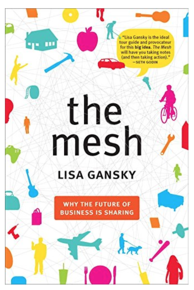
Lisa Gansky's book examines the 'Sharing Economy'
“A brand is a voice, its product is the souvenir,” she said. “Brands are really meaningful to people. I think it’s really important as a first step to innovation what is your brand voice, what is your souvenir, and to they match? What are people left with, does it match your brand promise? Does your website? This is really fundamental.”
Another big issue in innovation, said Gansky, is recognizing at what point does the value become greater than effort, because it’s at that point it’s going to move into the mass market.
“When value becomes greater than effort, friction goes away,” said Gansky. “How to you increase the value without increasing the effort?
Credit unions may benefit from the Sharing Economy, but they will still need to understand the shifting expectations of consumers. Gansky used ride-sharing services as an example, noting that people used to wait forever for a cab, and when Uber came along and said a car could be there in 10 minutes, it seemed terrific. That shorter wait time has become the expectation, and now if a person has to wait four or five minutes they begin to become impatient and look to other apps, such as Lyft, for a faster pick-up.
“We are training customers to be pathologically delighted,” said Gansky. “ It’s this insatiable expectation of delight. As soon as we raise the bar, people expect and demand it.”
Gansky, who said she has done a lot of work with global banks over the past five years, said she sees a structural advantage in CUSOs such as CO-OP Financial ervices in that they have local touchpoints, member-ownership, and a national face.
Other thoughts shared by Gansky at THINK 15:
- The best people to work at credit unions will probably never work there, so CUs should look online to find the talent they need when they need it.
- Peer-to-peer networks have become popular in the Sharing Economy, and that includes credit unions, she said. “You’re all the rage guys. This is a great time to promote the fact you have that background. It’s a huge opportunity from a branding perspective.”
- Banking is being picked off by technology companies and the value chain is being taken apart.
In closing, Gansky shared an African proverb she said aligns with the idea of the new Sharing Economy: “If you want to go fast, go alone. If you want to go far, go together.”