

WASHINGTON—The director of the CFPB has offered direction to credit unions on what could land them in the Bureau’s crosshairs on overdrafts, thoughts on fintech regulation, his views on credit card fees, and more.
Rohit Chopra, director of the Consumer Financial Protection Bureau, outlined some areas of concern regarding those issues and others during NAFCU’s Congressional Caucus here.
As CUToday.info reported, Chopra appeared before the Caucus after earlier speakers from Capitol Hill blasted the agency during their remarks, with several Republican House members promising much stronger oversight should the GOP retake the House in November’s elections.
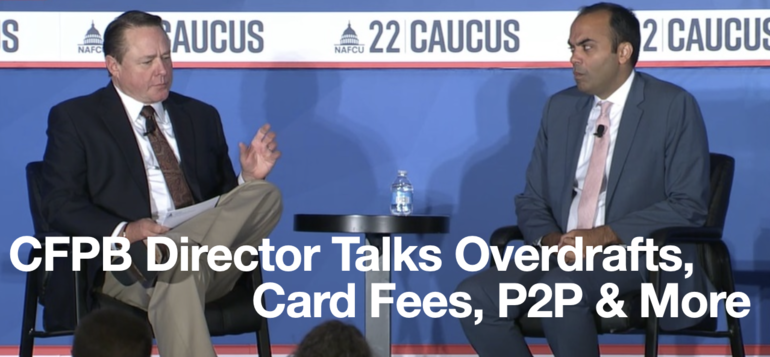
NAFCU President and CEO Dan Berger interviewed Chopra during the meeting in which the CFPB director candidly shared his perspectives on several topics impacting credit unions.
Here is a look at what was discussed:
Berger: What are your thoughts on overdrafts?
Chopra: It's important to treat overdrafts as a service and not as a penalty to drive up revenue. We encourage this (thinking) and a lot of boards and CEOs are saying, ‘OK, where am I on overdrafts relative to my peers?’ We're looking at the institutions that are most reliant on overdrafts, and many of them are very different from industry norms.
If you're in an aberrant place, you would want to do a gut check. The market has moved in a more competitive direction. I think we want to make sure that people are not surprised (by an overdraft charge). They don’t suspect there's payment processing and transaction shenanigans behind the scenes—that the financial institution is treating this as a service, and getting compensated for a service they are providing.
Where it gets problematic is when it's a shock to the consumer, or when there's a sense of the consumer thinking they had the money and don't understand how the transaction is being processed. I also encourage you not to equate overdrafts with NSF. NSF is not a service, and we understand that there needs to be a different type of thinking on it. We're actually quite happy and we hear many credit unions are already going through the process to do that gut check.
Berger: With P2P, NAFCU members are concerned about the current error resolution responsibilities, which place a disproportional burden on financial institutions instead of the P2P providers.
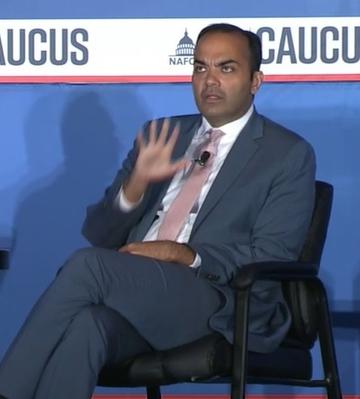
Rohit Chopra
Chopra: In many ways consumers, when something goes wrong on a P2P app, they don't get much customer care from the P2P provider. So, they go to the bank or credit union. We are looking at a host of issues related to that. I think there's a lot of smaller financial institutions that can't even get answers from the P2P apps or they can't really figure out what should do in this situation and they bear the reputational harm with the customer. We're looking at a whole host of things.
It's going to take some time to really work through this. In every credit union meeting I've had we have tried to determine what do we think should be some of the changes…What's the right way for us to be generally prepared for real-time payments.
So, we have ordered Google, Facebook, Amazon, Square, Venmo—all of the P2P apps as well as those who have digital wallets—to actually provide us significant information about how existing consumer protections, including Reg E, are being administered from their end. I think that's going to be very helpful to us in charting a path forward.
Berger: Any timeline set?
Chopra: I don't know. We're going to have to see. It's going to require some thought in terms of how the ecosystem collectively can reduce fraud, and then there's the question of where you assign the right type of liabilities and protections. We have a system and consumers do expect some reasonable equivalent, whether that’s based on what they're swiping or using. I want to be direct, we don't have a clock, but we want to move on it.
Berger: There's the supervision of non-depository institutions as well as big tech and fintech. What do you envision about making sure they're part of the schematic? We have a tremendous amount of regulatory oversight of financial institutions and credit unions have a lot of regulatory burden; how are you going to make sure that those non-depository folks also have some oversight?
Chopra: I think what we can do is make sure at a minimum, in compliance with existing law, there is some degree of parity. We are shifting some of the supervisory resources towards non-banks. We are trying to see where the risk is in the system, because a lot of these (fintechs/big tech) are fast growing and are acquiring consumers quickly…We can do a couple categories of non-bank supervision. We can supervise any mortgage lender, any mortgage servicer, payday lender, private student lender…This authority might help us identify and start that supervision process (with fintech/big tech) before problems metastasize.
Berger: We have found many of these providers have poor customer service operations, relative to the volume of transactions they process. We see complaints that you can't get through. Is there any way to require that or force these providers to get back to these customers when there's a complaint?
Chopra: I wouldn't want to over-promise anything. We're starting to see big tech firms really champing at the bit to get into financial services. I think in some ways it's the Holy Grail for them. They're already collecting payment data. Even in this room right now they are getting our geolocation and web browsing data. They know who's in our contact list.
Being able to know all of our transaction data, and in some cases not unlike what a bank knows when you are completing a debit card transaction—SKU-level data, what products we are buying at what time--really being able to get a level of behavioral insight and maybe move into personalized pricing to curate individualized virtual malls. That is something that is a totally different mindset in the history of banking.
Berger: Credit card late fees—credit unions typically have the lowest. Where is the CFPB going here and where is the focus?
Chopra: The law requires the penalties on credit cards to be proportional to the violation, and reasonable…As a general matter, we want the credit card market to be one where people really understand how they can shop on price, rate and rewards. I think when a business model is heavily dependent on penalty fees, that's where you start questioning is that a distortion of the competitive process.