

By Lisa Freeman Mohler
WASHINGTON–CUNA and NAFCU may have just announced a plans to merge, but the idea of the two sharing “one big tent” isn’t new, as one person recalls all too well. Indeed, had they not earlier shared that tent, it’s possible one or both of the organizations might not be around today.
Just days before the two trade groups’ big announcement, CU Today talked with Larry Blanchard, currently public affairs consultant for TruStage (formerly CUNA Mutual Group), who helped unite the two trade groups back in 1997 when he was SVP-Communications and PR for CUNA Mutual Group and credit unions were facing an existential threat.
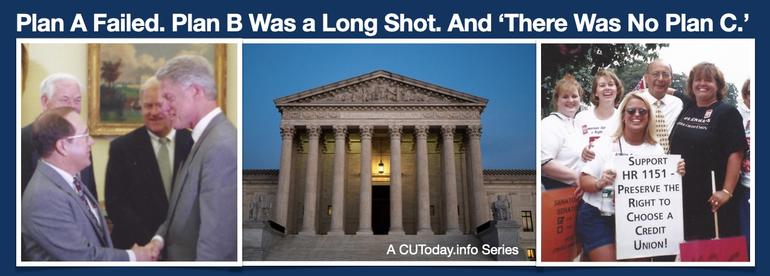
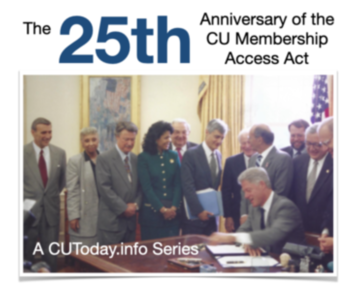
Blanchard would eventually helm the massive effort to pass the Credit Union Membership Access Act, often better known as HR 1151, which was signed into law in August of President Clinton in 1998.
But that signing only took place after two of the most extraordinary years in U.S. credit union history as the CU community responded to a series of court decisions that had gone against credit unions on field of membership, culminating in a loss in the Supreme Court.
“NAFCU and CUNA each had separate campaigns to try to deal with this,” Blanchard said. “But it was clear that we all needed to work together. Not everyone liked the idea of having one big tent, and I always knew there would be leaks in the system. Somebody’s always going to blab. But it was imperative that we all work together.”
After all, as Blanchard noted, there wasn’t much of an alternative. “Plan A was to win in the Supreme Court, and then that didn’t happen,” he said. “Plan B was 1151. There was no Plan C.”
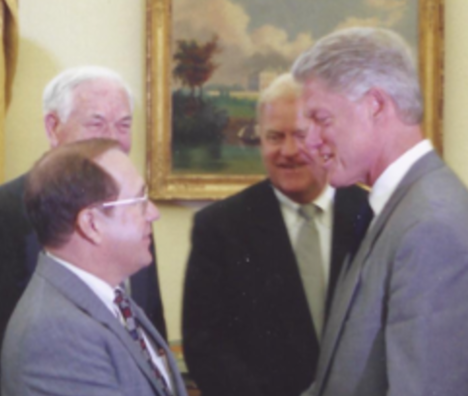
Larry Blanchard, left, shaking hands with President Clinton in the Oval Office.
Taking the Blame
And if fingers were to be pointed should Plan A and B both fail, Blanchard knew exactly where they’d be aimed.
“The executive committee of the Credit Union Campaign for Consumer Choice was made up of the CEOs and chairmen of CUNA and NAFCU…and me,” he said, referencing the name of the organization the two organizations eventually formed. “I chaired the executive committee because I was neutral ground. I was loaned by -- and paid by -- CUNA Mutual Group. I sat down with (CUNA President) Dan Mica and (NAFCU President) Ken Robinson, and I said, ‘Let’s get one thing clear: when we win this -- not if, mind you, when -- when we win this, you will get the credit. But I get the blame if we lose.’ Things were very tense at the time, but we found our way forward together.”
The key was focusing on the consumers, not the institutions seeking to serve them.
It’s Not About Banks or Credit Unions
“One of the first things we did was to make it about people, not about banks or even credit unions. This was about people’s right to choose. By making it about people we could make our message resonate with people, and then those people will be willing to do things like attend rallies, write to their members of Congress and call them.”
And the sheer number of people potentially affected was huge.
“Credit unions had 72 million members at the time of the Supreme Court ruling,” Blanchard recalled, referring to a decision by the court that NCUA had misinterpreted the Federal Credit Union Act and CUs could not serve multiple groups. “We had 10 months to overturn that decision, or credit unions were going to have to shed some 25-million of those members.”
In a world where it’s grow or die, the credit union movement was facing being stripped down by more than one-third of its members.
‘We Would Be Dying’
“There’s no question we would be dying if not for the Credit Union Membership Access Act,” Blanchard offered. “Instead, today we are at 138 million members.”
Getting there, however, was more than half the battle.
“I wish I’d known how to pace myself,” Blanchard laughed. “We were putting in 18-hour days seven days a week, building joint teams for legal, PR, communications. We had to build that big tent.”
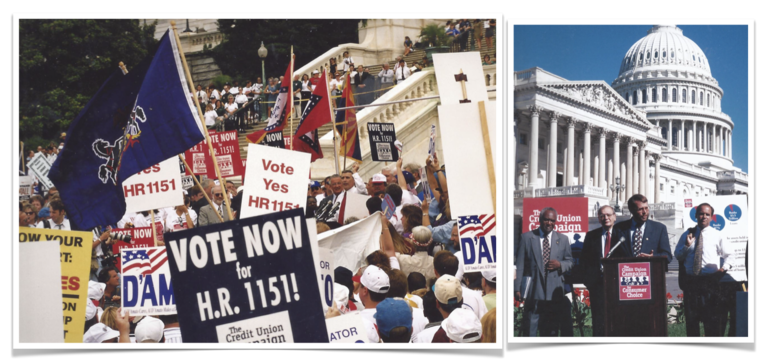
And once the tent was built, it was time to fill it with all those people who would write and call their members of Congress and show up on Capital Hill for a rally with just a few days’ notice.
“When we were told we needed to have a rally, there was one staffer who was telling us how we had to get the people there, how to make it happen, and I knew that wouldn’t work,” Blanchard said. “I told her, ‘Just tell us where and when we had to be there, and we’d figure out the rest’.”
Turning Out in Force
Sure enough, credit union representatives turned out in force in Washington, a visible and audible presence ensuring lawmakers would know that this was, indeed, about consumers, not just financial institutions. Credit unions held large rallies at the capitol, while across the country they also had paper, stamps, pens and tables in their lobbies for members to write to their members of Congress.
One story often told is of a congressman who said he had been unable to push open his front door because so many credit union letters had been shoved through the slot.
“It typically takes about seven years to cross the finish line; we had just months,” Blanchard said of the effort to get legislation introduced, passed out of committee, passed by Congress and put on President Clinton’s desk for a signature. “One of the hardest parts was getting it through committees.”
‘We Are Stuck’
In particular, the Senate Banking Committee, where the banking industry had plenty of influence.
“Senate Banking Chair Alphonse D’Amato (R-NY) came out of committee and told us ‘we are stuck,’” Blanchard recalled. “He told us that we are going nowhere unless we agree to Prompt Corrective Action and a limit on member business lending. [CUNA Economist] Bill Hampel, [NAFCU General Counsel] Bill Donovan, [CUNA CEO] Dan Mica and [NAFCU CEO] Ken Robinson and I are there, and Hampel and Donovan are doing some quick math and figuring out just how much that’s going to hurt us. D’Amato said, ‘We’ve got to accept this, but not to worry, we’ll get it fixed next year.’ But then D’Amato couldn’t get re-elected, losing to Chuck Schumer, and we never got it fixed.”
To this day, credit unions continue to operate under those two restrictions added into HR 1151. “But there are enough workarounds,” Blanchard suggested. “Credit unions have learned to live with the capital requirements, and with loan participations they have learned to adjust to the MBL cap. We are a resilient bunch.”
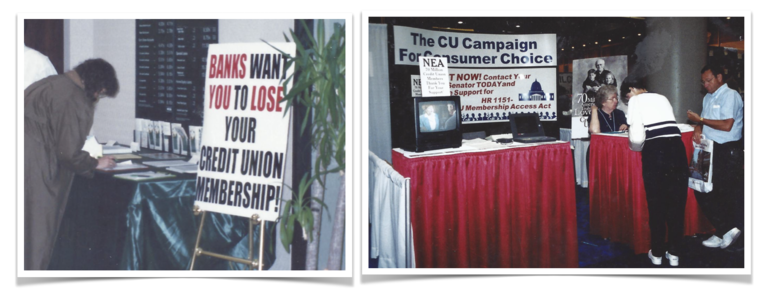
Members signing petitions in 1998.
Still Overcoming Banks
Still, a lot has changed in credit unions since that frantic and frenetic fight to pass HR 1151 a quarter of a century ago. Credit unions have grown while many of their community bank counterparts have largely been swallowed up by mega-banks, leading many former bank executives to find their way into the ranks of credit unions.
Some CU faithful have expressed concerns about credit unions becoming increasingly “bank-like” as a result, but Blanchard disagrees.
“The cooperative principles of credit unions are not only what make us different, they are literally what saved us -- our ability to come together,” he said. “Today, we are seeing more leaders go into the (National Credit Union Foundation’s) Development Educator program. Back then, we had just one DE class per year. Now we have four every year, and all of them are over-subscribed. When former bankers go through the DE program, they become our biggest advocates. They’re like reformed cigarette smokers who become the biggest anti-tobacco people.”
Another Watergate Moment
But 25 years ago it was hard to see beyond that moment when President Clinton signed 1151 into law in the Oval Office. Or at least, it was for credit unions; Clinton was a bit distracted by other things at the time.
“We were working out of the Watergate, and I could look straight across to Monica Lewinsky’s mother’s apartment,” Blanchard recalled. “Monica was staying with her mother at the time.”
The Watergate Hotel and office complex was home to Hill & Knowlton, the PR firm that had been retained by credit unions in the fight to pass HR 1151 and a war room for the CU Campaign for Consumer Choice.
For those who don’t remember, Monica Lewinsky was the White House intern who had an affair with President Clinton. And at the same time that Clinton was signing the Credit Union Membership Access Act, Lewinsky was testifying about her involvement with him.
“The night before the bill signing was also the night that Clinton told Hillary that he had an affair with Monica,” Blanchard said. “I can only imagine how that must have gone over. He looked pretty awful that day.”
But ever the politician, he still made a point of glad handing the dozen or so credit union leaders gathered in the Oval Office for the bill signing.
Taking a Memento
“There’s a photo of me talking with Clinton,” Blanchard said. “There were extra pens from the signing, and he came up to me said, ‘I’m giving you an extra pen to give to CUNA Mutual Group for their support of the campaign.’ I later gave that pen to (then CUNA Mutual Group CEO) Mike Kitchen.”
Part one is this series can be found here.