

By Ray Birch
BOSTON—Credit unions have a vast trove of member data, but if they can’t find a way to effectively consolidate it they will fall behind banks in utilizing that data—and that means not just fewer cross sales, but poorer member service than their for-profit competitors, too. And that’s especially true in a digital environment, according to one expert.
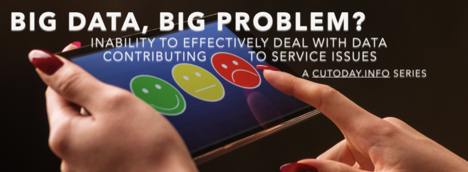
Questions and issues around what’s taking place in member service at credit unions are being highlighted in a series by CUToday.info launched in the wake of the latest American Customer Satisfaction Index (ACSI) out of the University of Michigan, in which for the first time banks were given a higher customer satisfaction score than credit unions.
There are numerous theories around what is taking place and numerous factors are likely at work. That includes the challenge to credit unions of making all of their member data accessible from one place and then orchestrating the analytics process across the enterprise using their existing solutions, said Tiffani Montez, senior analyst at Aite.
It comes down to having a “single view” of the company’s data—a common enterprise platform, Montez said.
“Too often I find the biggest issues with data at FIs is the data is organized by product and there are disconnects by department and by roles within the organization,” she explained. “These different departments, and even different roles of staff, use the data differently. The result of that is there may not be a common understanding of what the data is being used for and the definition of a particular data set.”
Big Data Getting Bigger
Montez said that without creating standards for how data is used, having it in one location and having one platform to access it can lead to unmanageable problems as the amount of data FIs have on consumers grows quickly.
“FIs continue to capture a vast amount of information on how consumers behave and interact every day,” she said. “The fact is Big Data is getting bigger. However, finding valuable insights hidden in the data is becoming more challenging for analytics executives as the number of data sources and types grows exponentially. And that is putting pressure on marketing and risk executives to find insights and to do it quickly.”

Tiffani Montez
Wrong Assumptions
Without the proper centralized approach to using data, FIs often use their information inefficiently and ineffectively, therefore making wrong assumptions, Montez said.
“I will tell you that some of the top organizations spend about 40% of their time just dealing with data issues,” Montez said. “That's their number-one challenge.”
Data hygiene issues result, as well, Montez said.
“For example, you're thinking about adding some new data to your dataset and you don’t really have a place to store the new data element,” said Montez. “So, you create another data field and give it some value. This kind of thing often leads to organizations getting extremely creative in terms of how they categorize the data. And if the data is used for multiple purposes, then it makes it really hard to get down to understanding what that data actually means.”
A Data Strategy
Montez contends the biggest step financial institutions must make is to come up with a data strategy for the entire organization.
“My belief is in order for an institution, regardless of their size, to be able to operate effectively across their enterprise they have to have to a single view of the customer and a common understanding of what the data means—a common set of definitions and descriptions—and what the data is being used for,” she said. “And more important, it's one common platform to be able to access data and to be able to create analytic models.”
The Need to Pay Attention
Montez said credit unions need to pay close attention to this issue as banks are outperforming them due to their deeper pockets.
“The biggest organizations are really getting a data strategy in place with three-to-four-year roadmaps,” she said, adding that such a trend could lead banks to eventually outperform CUs on service. “Credit unions have always had the advantage over banks with personal service. Members say my credit union knows me. But if banks are getting better with digital, and if digital becomes the more common way to interact…”

Montez said the definition of community and connectedness is no longer being defined by the physical space—a point many credit unions have made as they seek to expand their fields of membership.
“We have tons of virtual communities that we are part of, so credit unions are going to have to start to think about losing their personal service advantage as banks get better with data,” she said. “When they interact with their members in a digital environment they have to make every single one of those interactions count.”
Flipping the Model
Montez recognized it’s not an easy battle facing credit unions, especially as digital becomes a much bigger part of their world and bigger competitors have the budgets to pay for the technology and the human resources to evaluate the data. She said CUs will have to reprioritize and shift money from other budgets to digital.
“We will flip this whole service model on its head, from where the new digital delivery channels support the branch to where all of the other channels support digital,” she said.