

ALEXANDRIA, Va.–Representatives of five different credit union groups challenged NCUA’s justifications for more spending next year during the agency’s annual budget briefing, raising particular concerns around the proposed hiring of consumer compliance specialists and pointing to areas where they say the budget can be cut.
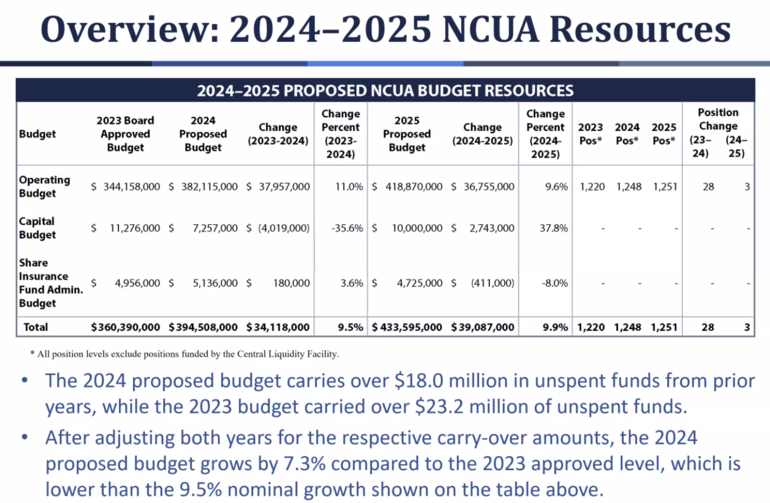
The briefing was in response to the 2024/2025 proposed budget, which represents an overall 9.5% increase year over year for 2024, and 9.9% for 2025.
The budget briefing, which included remarks from the three NCUA board members and input from the five trade group reps, also featured a Q&A with NCUA staff and questions of the trade group reps by NCUA board members, who also questioned each other.
The briefing lasted approximately two and a half hours.
Below is a look at some of what was discussed and shared.
Harper: ‘This is Just a Starting Point’
In his opening remarks, Harper said the staff draft budget is only a “starting point” for discussion, and reminded that the comment deadline on the proposed budget is Nov. 21.
Although the budget expenditure would receive push back from the credit union groups’ representatives during their remarks, Harper said a “priority” of his remains adopting consumer compliance examination and supervisory practices more in line with the other federal banking agencies.
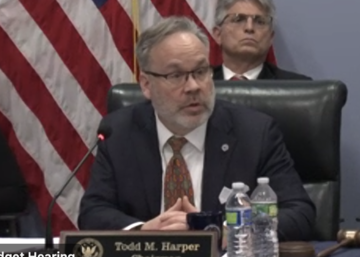
NCUA Chairman Todd Harper during budget hearing.
“While the federal banking agencies have long conducted separate consumer compliance exams and assigned a separate consumer compliance score outside of the CAMELS process, the NCUA has not,” said Harper. “We need to change that practice, so the proposed 2024 budget includes funding to establish 13 regional consumer compliance specialist positions, which will bolster the agency’s efforts to ensure compliance with consumer financial protection and fair lending laws and regulations. That change is good for credit union members. And, that change is good for those credit unions…”
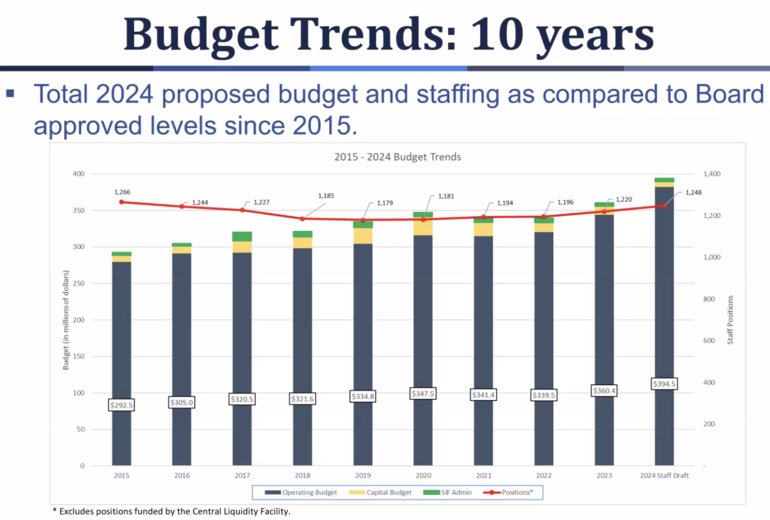
Overall, said Harper, NCUA’s proposed authorized staffing level of 1,248 full-time equivalent employees in 2024 remains below the agency’s highest staffing level in 2015. The chairman said NCUA is also experiencing the same inflationary pressures as all other organizations, including credit unions.
In addition, Harper pointed out composite CAMELS code 3 ratings increased to $131.7 billion in the third quarter, which represents approximately a 45% increase over the previous quarter’s results, and requires increased resources from the agency (see related reporting here from the NCUA board meeting held earlier in the day).
Numbers Will Rise
“And, we can expect those numbers to rise. That’s because NCUA examiners are seeing growing signs of interest rate risk, liquidity risk, and credit risk across the system,” said Harper, adding there is growing pressure on examiners to spend more time with credit unions, a budget demand exacerbated by the return to in-person exams.
Harper added the agency’s examiners have been finding record keeping deficiencies, problems with internal controls and instances of fraud, all of which are reasons for the 2024 budget increase.
Hauptman: The True North, But Not Sufficient Justification for Increase
NCUA Vice Chairman said the one “true north” at NCUA has always been protecting the insurance fund, and that remains the focus of the agency’s budget. In short, he said, no one wants to have to cut a check to cover a loss from a credit union.
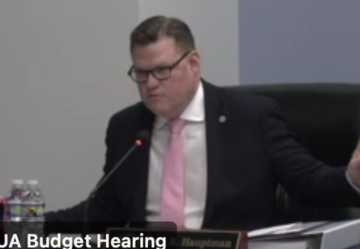
NCUA Vice Chairman Kyle Hauptman during budget hearing.
To date, there have been three losses absorbed by the NCUSIF, for just over a million dollars total.
But, that said, Hauptman also cited the degradation of CAMELS codes in credit unions, including among billion-dollar-plus CUs, and said he agrees it reinforces the need for strong examination procedures.
“There are some clouds on the horizon,” said Hauptman. “They're not as bad as I thought it might be. but there are reasons to think that ticking sound is maybe more of a concern…But I don't believe that the proposed budget has sufficient justification yet."
Hauptman said he is always concerned with government “fiefdoms,” as they always grow larger.
Hood: ‘Looking for Efficiencies’
Saying the NCUA budget forum is an example of democracy in action, NCUA Board Member Rodney Hood spoke to how the budget proposal calls for an additional 28 staff members, but clarified that 17 of those are conversions of what are known as “over-hires”; that is positions previously unfunded through the operating budget. The remaining 11 staff members are proposed to be spread between the regions to support the large credit union examination procedures, Hood explained.
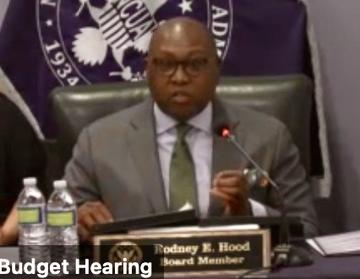
NCUA Board Member Rodney Hood during budget briefing.
Three Critical Items
Hood said the proposed budget includes three items he considers “critical”:
- An increased focus on enhancing the field examination program
- Support for small and MDI designated institutions
- Enhanced cybersecurity preparedness at the NCUA and in the credit union system.
“However, as I have said before and will say again this afternoon, I continue to champion responsible spending by the NCUA, and in looking for efficiencies wherever possible to ensure we are being faithful to our fiduciary responsibilities of managing the credit unions’ resources that have been entrusted to us,” Hood said.
CFO Provides Overview
Following the three board members’ remarks, NCUA CFO Eugene Schied provided an overview of the proposed budget.
In 2023, the NCUA board approved a 2024 funding level of $403.2 million. The proposed 2024 staff draft budget is $394.5 million, which is $8.7 million or 2.1% lower than the amount approved in December of 2022, Schied said.
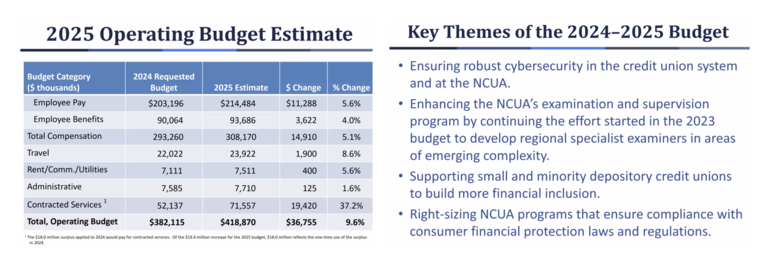
According to Schied, the key investment areas in the proposed budget are outlined in the slide below:
Looking to the budget trend line, Schied shared the slide below, in which he noted staffing (represented by the red line) remains below the 2015 level at NCUA.
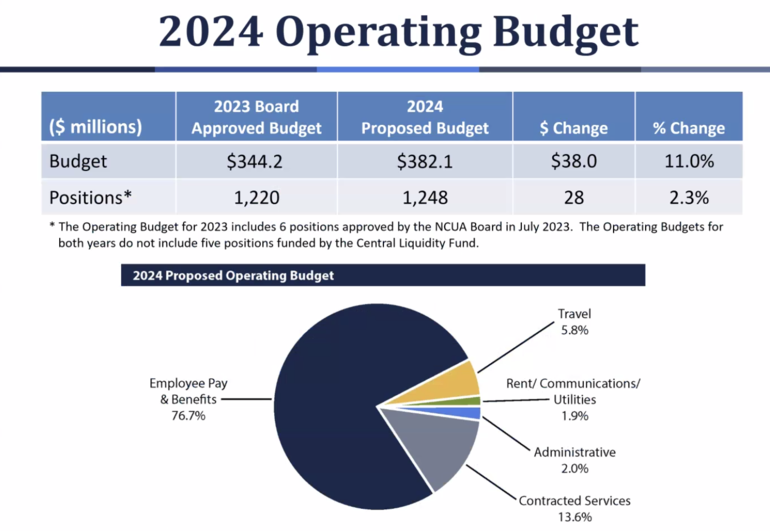
According to Schied, nearly 77% of the NCUA budget goes to employee-related expenses, as shown in the slide below.
There have been some changes in the operating budget, according to Schied, which are outlined in the graphic below.
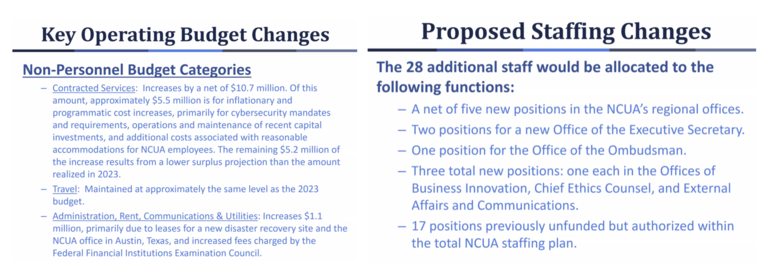
In terms of the new staffing NCUA is looking to add, Schied said they would be allocated as shown above.
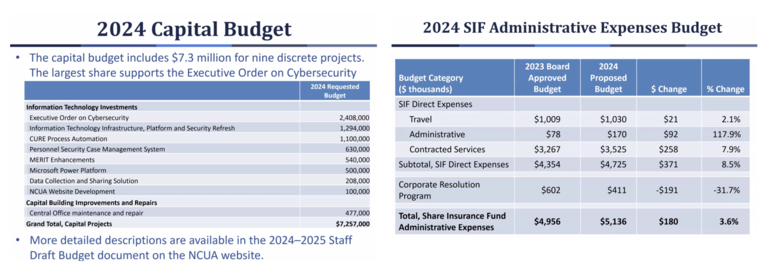
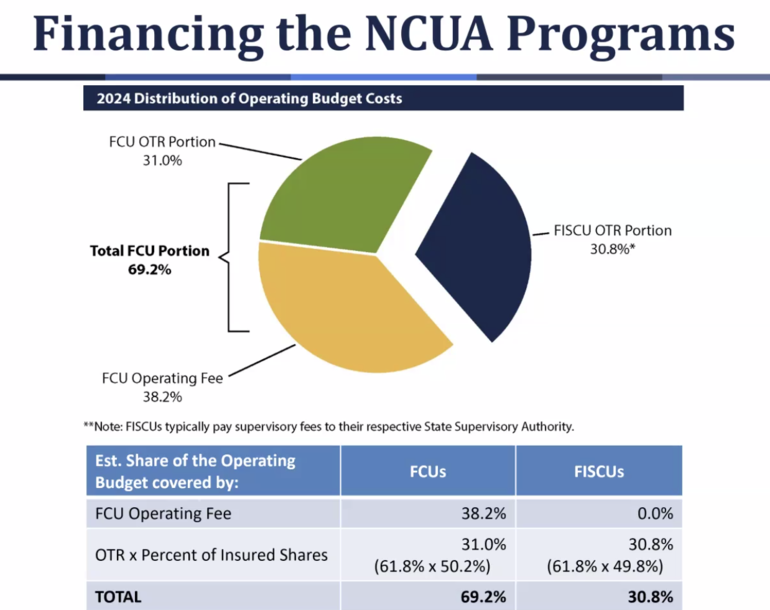
In the slide below, Schied outlined how the agency finances its operations.
Trade Groups Offer Their Input
Following Schied’s overview, representatives of five different groups shared their input on the NCUA budget proposal, including:
CUNA: Funds are Being Taken From Members
Mike Schenk, Deputy Chief Advocacy Officer, Chief Economist, CUNA
In opening his remarks, Schenk first cited analysis showing just how much wealthier the average bank customer household is when compared to that of credit unions’, and that in catering to people of more modest means CU members have responded by being 1.6 times more likely to say that a credit union has improved their financial well-being, compared to bank customers who hold that view.
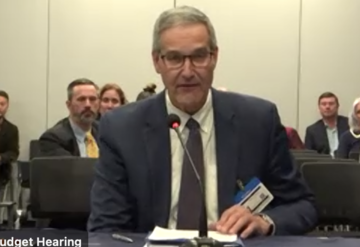
Mike Schenk
“I only point that out because our (CU) members care deeply about the budget,” said Schenk. “They're firmly focused on maximizing member benefits and they want to pass as much of their income through to members as they possibly can.”
Where Expenses Can be Cut
While CUNA agrees generally with NCUA’s strategic initiatives, Schenk added, “We’re deeply concerned about the level of the proposed increases and the reasons for many of the proposed increases.”
Schenk acknowledged NCUA lacks flexibility around pay and benefits, but the trade group also has “significant concerns with the level and focus of some proposed additional staff. We also believe that the agency could go further in controlling travel expenses. We see an even greater opportunity than proposed to utilize off-site examinations, especially for smaller, less complex credit unions.”
Compliance Specialists ‘Not Warranted’
Schenk said CUNA also is particularly concerned over the expansion of consumer protection examination activity and the hiring of 13 people to enforce those rules, which he said is “not warranted.”
He further said CUNA believes the agency should dial back its potential oversight of climate-related issues, saying NCUA should wait until Congress acts.
NAFCU: The Increases are ‘Unsustainable’
Curt Long, VP-Research, Chief Economist, NAFCU
Long told the board the NCUA budget “continues to increase and this draft budget overlooks opportunities to incorporate more efficient processes with potential cost savings.
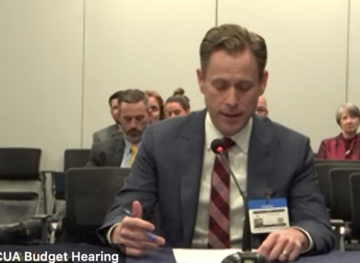
Curt Long
“Continuing this trajectory of substantially increasing budgets is unsustainable and we'll have serious consequences for the credit unions that fund the NCUA,” Long continued.
Recommendations Offered
Long offered several recommendations:
- To preserve the strength of the share insurance fund without overburdening credit unions with exorbitant operating fees, NCUA should prioritize off-site examination activities
- NCUA should revise the threshold for examination cycles and provide greater transparency for expenses related to the MERIT system
- NCUA should eliminate the proposed addition of dozens of new specialized examiners that are not “justified by a measurable industry need”
- NCUA should adopt a more transparent and accountable methodology for tracking and evaluating the efficacy of cybersecurity and IT-related expenses
‘Justifiably Concerned’
Long said NAFCU-member federal credit unions are “justifiably concerned” with the 19.6% increase in the proposed operating fee, “particularly in an environment as challenging as this one. An abrupt increase in the operating fee would place undue financial strain on these entities.”
Long called on the agency to credit the maximum surplus cash possible to the operating fee to alleviate some of the burdens CUs face.
As did the others who appeared to offer input, Long said NAFCU opposes the addition of new consumer compliance positions, as well as other planned hires.
NASCUS: Some ‘Prudent’ Examples Worth Following
John Kohlhoff, Senior VP-Policy & Supervision, NASCUS
Kohlhoff acknowledged he came to the budget hearing with a different perspective, given that NASCUS is made up of state credit union supervisors.
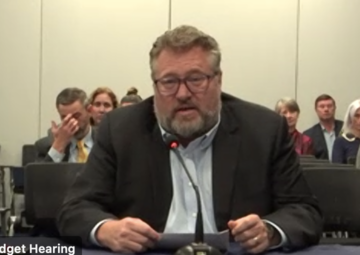
He suggested it might be “prudent,” however, for NCUA to follow some state regulatory agencies and raise the asset threshold requirements for annual examinations to preserve resources and reduce regulatory burden “without materially increasing risk for the share insurance fund.”
He also spoke to a long-time point of debate between state-chartered credit unions and NCUA, the “overhead transfer rate,” or the funds the federal agency transfers from the share insurance fund for costs related to supervising state charters.
‘Positive Improvement, But…’
Kohlhoff said the proposed change in the 2024 OTR “represents a positive improvement…but we believe the OTR should be further reduced and additional work remains to better calibrate the OTR methodology toward ensuring equitable management of the SIF for all charters.”
He said state-chartered CUs are paying $94-million in total state operating fees, compared to $109 million being paid in operating fees paid by federal credit unions to NCUA. The work being done by state regulatory agencies helps to protect the share insurance fund, he told the briefing.
“We raise this point because NCUA's budget justification illustrates what it purports to be the relative contributions by state and federal credit unions to fund supervision, which fails to represent the impact of the savings afforded the NCUA budget by the application of the aforementioned state-related resources,” said Kohlhoff.
‘One Less Dollar Available’
Kohlhoff went on to say that every dollar transferred from the SIF by the overhead transfer is one less dollar available to cover current losses and diminishes the SIF’s future earnings potential.
“At a time when some have suggested the SIF equity ratio needs to be raised, diverting funds out of the SIF could be counterproductive, particularly when credit union income is under pressure,” said Kohlhoff.
Virginia League: CUs are Disappearing, Yet NCUA Keeps Growing
Carrie Hunt, president and CEO, Virginia Credit Union League
Noting that since she spoke at the same budget briefing in 2022, Hunt pointed out the state of Virginia has lost five credit unions, and yet the agency continues to increase its headcount.
But rather than focus on the budget dollars specifically, Hunt said she instead wanted the agency to give attention to the additional regulatory burden resulting from those expenditures.
Hunt touched on a number of areas during her remarks.
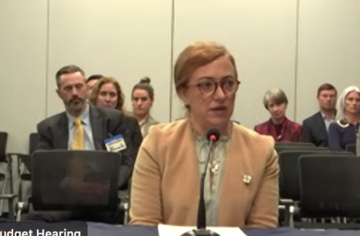
Carrie Hunt
Cybersecurity Challenges
Speaking to cybersecurity, Hunt said the Virginia league is encouraging NCUA to make data security protections on the merchant side a legislative priority.
In terms of CUs themselves, while NCUA’s cybersecurity examination focuses on credit union management of information systems and risks, sufficient expertise in information systems and technology, board IT policies and procedures, and controls and oversight of member information, Hunt said credit unions need to continue to evolve their own programs and can always use additional resources, as opposed to focusing on examination.
Resource Allocations
“Given the current tightening of economic conditions, we believe that the agency should be extremely measured in its approach to its programing,” said Hunt. “We would ask the agency to ensure their focus is not trending too heavily towards the nation’s smallest and largest credit unions, while underserving the majority of credit unions found in the middle —those with greater than $100 million in assets but below $10 billion in assets.
“We also want to ensure that the NCUA is not equating just size with complexity as it looks to hire specialized examiners for larger credit unions,” Hunt continued. “
Consumer Focused Compliance
Like several others who addressed the budget briefing, Hunt expressed concern over NCUA’s proposed addition of 13 consumer compliance examiners.
While protecting consumers is “paramount,” Hunt said the agency’s exam manual already covers 20 separate consumer regulations with which CUs must comply.
“Credit unions rarely fail or consolidate due to dissatisfied members or consumer compliance issues,” said Hunt. “However, they do struggle under the weight of an increasing compliance burden and regulatory overreach. We submit the resources devoted to funding this focus on further consumer compliance would be better utilized by credit unions. Allow them to use those resources to hire and train staff, optimize their policies and processes to ensure compliance, and help them offer a product and service mix that puts the interests of members first.”
The Beast of (Regulatory) Burden
Reiterating her point about the regulatory burden, Hunt said she does not “understand how credit unions will continue to thrive with the ever-increasing cost of doing business and additional regulatory scrutiny. “
“Credit unions need to provide services in the way that their members want those services delivered, and this costs money,” Hunt told the meeting. “Under the CFPB’s war on fees, credit unions question whether they will even be able to charge for services in the future. Fraud is skyrocketing. Staffing costs are dramatically increasing. Cyber threats are increasing, and consumers are demanding more. Additional regulation and exams will only serve to diminish what credit unions can provide. Credit unions are continually being squeezed and this is only going to serve to further reduce the number of credit unions.”
GoWest Association: Current ‘Sensitivities’ Not Being Recognized
John Trull, Vice President of Regulatory Advocacy for GoWest Credit Union Association
Like the others, Trull called the proposed 9.5% increase “concerning,” saying it doesn’t “seem to recognize current sensitivities, especially considering the economic pressures facing both the credit union industry and the people it serves.”
Trull noted NCUA has a track record of revising the overall budget downward during its annual mid- year review, and the GoWest association’s expectation is that will happen again.
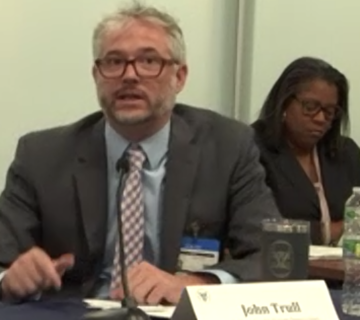
John Trull
Citing the agency’s primary mission of providing safety and soundness and its “high-quality front-line examiners and regional specialists,” Trull said, “We are concerned, then, that the proposed mission support budget, for the first time, would constitute more than 50% of spending – yet mission support represents just 35% of the agency’s overall staffing. This shift raises concerns about resource allocation and the potential impact on the agency’s operational efficiency.”
‘Contrast’ Cited
Trull called the request for a “modest increase” of nine authorized positions over the next biennium by the Regional Offices and the Office of National Examination and Supervision (ONES) a “testament to their commitment to fiscal management and restraint.
“In contrast, the Administrative Mission Support proposal to authorize an additional 20 positions within the same period presents a significantly higher financial burden,” Trull stated. “Concerns from credit unions have been raised, particularly regarding the establishment of the new Office of the Executive Secretary, which was not included in the October 2022 budget justification for FY 2024.”
He further said the proposed 66% increase in staffing for the Ombudsman’s Office and the authorization of three new positions for the Office of Business Innovation “warrant scrutiny.”
Issue Related to State Charters Raised
Trull also joined with the others offering feedback in saying the GoWest association objects to the expanded focus on consumer compliance, saying the “primary role of the NCUA in relation to state-chartered institutions is that of an insurer, with consumer compliance oversight more appropriately falling under the jurisdiction of state regulators. Consequently, from a budgetary standpoint, it is our view that the costs associated with these additional compliance resources should not be financed by the Share Insurance Fund through the overhead transfer rate.”