


SEATTLE—Worried about merchants’ slow migration to EMV, Visa is taking steps to help speed the chip card transition at the point of sale.
Steve Ruwe, PSCU chief risk officer, told attendees at CUNA’s America’s Credit Union Conference that Visa said it plans to streamline the merchant certification process and possibly address merchant chargebacks.
“Visa explained that they are concerned about chip card adoption and said in a recent letter that they will make it easier for merchants to get certified for EMV,” Ruwe said.
Ruwe explained that Visa, while not publicly stating its intentions, has suggested it may make some changes around chargebacks. Merchants have been complaining loudly that they are getting hit with too many chargebacks as a result of EMV, many for small amounts.
Ruwe said that he thinks Visa may make the minimum chargeback $25, and possibly make 10 chargebacks the maximum on any one account.
“I don’t think this will have a big impact on credit unions, said Ruwe. “I don’t think you charge-back small amounts, and to have more than 10 chargebacks on one account is unusual. Visa is trying to get along with the merchants.”
The move to speed merchant certification is needed as retailers are lagging behind issuers in the U.S. conversion to EMV. Ruwe shared that currently 47% of credit cards are EMV, 30% of debit, yet only 22% of merchants are chip enabled.
He said by the end of the year those numbers will move to 66%, 49% and 38%, respectively, and then 89%, 73% and 57% by the close of 2017.
‘You Have To Get Going’
Ruwe polled CUs in the audience of more than 100 and asked how many had completely converted to EMV, and about four raised their hands. When asked how many were in the process of converting, about two-thirds acknowledged that chip cards were being issued.
“If you have not started by now, you have to get going,” said Ruwe.
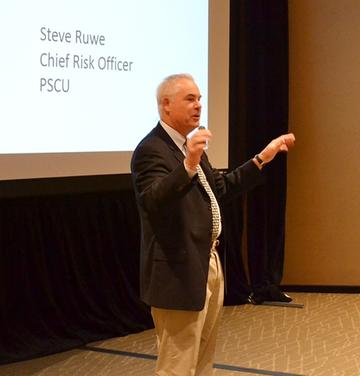
Steve Ruwe
Last year’s liability shift deadline shifted the cost of the fraud to the weakest link in the payments chain. Reports this year have shown that issuers that still have a large percentage of their cardholders using mag stripe are seeing their fraud costs rise. Ruwe, too, said counterfeit fraud is moving away from merchants with EMV, whose chargebacks have fallen since January.
What To Watch
Beyond EMV, what should credit unions be paying attention to in the coming years to fight fraud? Ruwe addressed what he thinks will be important.
- Authentication: “I am who I say I am. I am worried about authentication techniques within your call centers—is that member calling in who he says he is? A lot of crooks are turning to social engineering. Authentication is going to be big,” said Ruwe.
- Biometrics: “Show me the beef here. I don’t see one biometric solution now that is performing,” said Ruwe. “It’s a grain of sand in the fraud fight.”
- Credit union members: “They want to play. They say let me have control of my cards. They want to be part of the fraud-fighting process. So you need alerts, card control features . . . Even though members are not liable for fraud on their cards, they are worried about how fraud impacts their payment experience. They will play a big role.”
- Analytics: “Crooks are changing the way they attack, so we have to get better, spend more time and money on systems and dig deeper into the payments data.” For example, Ruwe said that fraudsters are defeating neural networks that monitor for unusual member payments behavior by using stolen plastic within the areas that the victim lives and works.
“That means fraud is harder to detect,” said Ruwe. “So we have to go to different tactics, look at velocity of a member’s card usage, for example, and more closely define the areas in which members use their cards and the merchants they choose. We have to be a lot more careful.”
- Data security: Finally, Ruwe urged credit unions to do a complete audit of where all of their member data resides.
- “Go back to your shop and as where is your data and why is it there,” said Ruwe. “Ask those two questions and I think you will find that you have data in places you never thought it would be. This is important to do.”