

By Ray Birch
WASHINGTON—Had the COVID-19 pandemic not reached the United States until the summer of 2020, CUNA might be facing some challenges this week as it holds its first-ever virtual Governmental Affairs Conference (GAC), which kicks off today.

But instead, it had enough time to prepare for the inaugural virtual GAC, which is annually the largest gathering in the credit union community.
CUNA Chief Products and Services Officer Todd Spiczenski said what has aided the trade association in pivoting such a massive meeting, which typically draws more than 3,000 attendees in addition to vendors and others, to digital delivery is having approximately nine months to learn how to best put on a huge meeting from a distance.
“If we would have had to make this pivot in three to four months, we would have been really challenged,” said Spiczenski, who pointed out CUNA learned a great deal about running virtual meetings as it conducted 25 remote meetings with its CUNA Councils, educational events and CUNA schools last year. “We were very fortunate that we were able to put on a live GAC in 2020, right before the country went on lockdown. The fact we were able to learn how to do this over the course of the last eight to nine months has helped tremendously. We have leveraged those learnings to be able to put on a really strong virtual GAC.”
Spiczenski, who been executive producer of the GAC for the last 10 years, believes CUNA had the live GAC “down to a science.”
“We had the meeting each year at the same location, the Washington Convention Center. We knew what it takes to get the stage set, the computers set, all that we needed backstage and more,” he said. “We had a lot of control over things.”
But that is not the case with the virtual GAC this year, and the biggest concern CUNA has is all those technical aspects of the meeting, which have been pretty much locked down in years past, have become “variables.”
What Can’t be Controlled
“We won’t have the same control as we have had,” said Spiczenski. “What we don't have control over is the Internet speed at a presenter’s home or office. If they are having a bad Internet speed day or their Internet is down, we have to reschedule or figure something out. From a production standpoint a virtual meeting is a heavier lift.”

Todd Spiczenski
There is simply a learning curve for this year’s show, explained Spiczenski, who said despite getting a break in having nine months to make adjustments, the ramp-up time was not “extensive.”
“Seven of our staff went through a professional development program on how to produce a virtual conference,” he said. “We hadn't had to do that before. We had to hire a few folks who actually had video production experience—we didn't have to that before. Those are just some of the new things we had to do.”
The biggest learning for CUNA during the nine months it put on smaller virtual meetings was finding the best platform to run the virtual GAC. CUNA finally settled upon Social 27, due largely to its strong capabilities for attendee interaction.
The Platform
CUToday.info received an advance look at the show/platform last week. The meeting is intended to be highly interactive, and allows attendees to choose what they learn and experience based on topics, such as lending and IT, and also get together with each other virtually.
Attendees will also be able to pick from five areas of interest, including financial well-being, networking, operations, board of directors, economic impact, lending, leadership and more in order to have dedicated content delivered to them.
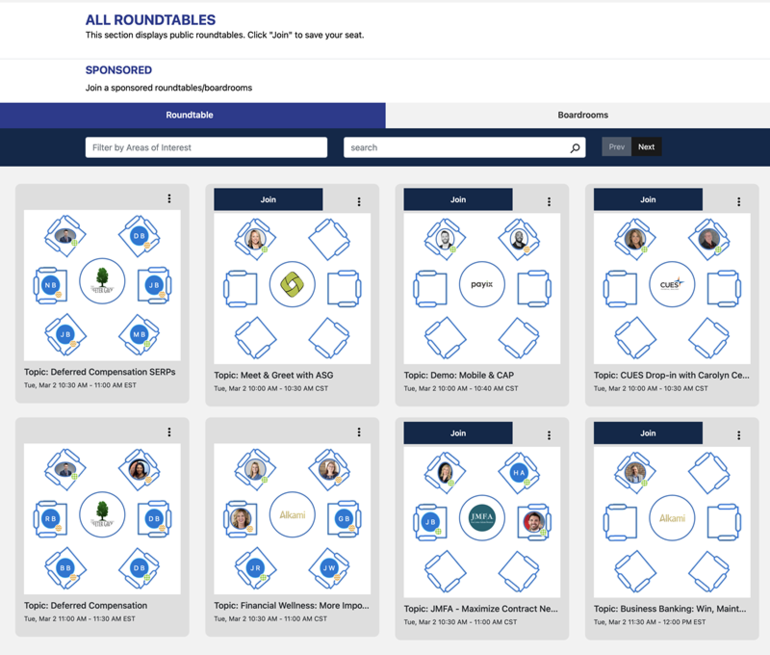
There is also gamification, where attendees receive points for visiting show sites—particularly vendor booths in the virtual trade show—which can be redeemed for chances to win prizes. The site has several virtual features to allow attendees to meet with each other and with vendors, such as a “mix and mingle” tool, and roundtables and boardrooms for larger meetings.
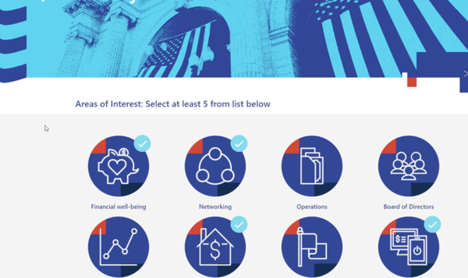
“We have utilized Social 27 a handful of times at our smaller meetings last year and we decided to use it for GAC because it is very intuitive for users and has a robust set of tools that allows us to bring the best of in-person GAC to a virtual setting,” he said. “One of the highest-rated things that we do at every GAC is creating dynamic networking opportunities, including meeting with attendees’ peers across the country. People always meet with their vendor partners, as well.
“With Social 27 we're able to bring all those components into this platform,” he continued. “While this is a virtual event, it’s going to be similar to being at the GAC in person—you will still be able to have this dynamic experience of being able meet with a group of four or five people that you normally have coffee with before the general session.”
Appreciation for TV Awards Shows
Spiczenski said he and the rest of the GAC staff are gaining a greater understanding for what production teams have to do to pull off the live, virtual award shows seen on TV during the pandemic.
“I have a new appreciation for those folks who produce these events,” he said. “I think the biggest challenge is moving from a live, in-person event, where you bring up your speaker, they meet you backstage, and then they give their presentation and walk off the stage. All of the production tools for that speaker have been set up in advance and they’re ready to roll when the speaker hits the stage. But in this new environment, for every speaker we are doing technology checks to make sure the technology they have in their office or home is working. And with recorded speakers, it’s about do they have the technology to pull off a really good recording…One speaker, for example, may have really good technology, while another might not, so there will be a difference in the experience for attendees. That is a concern.”
CUNA kicked off the 2021 GAC with preconference sessions last week, largely as a testing ground for this week’s event.
“We were able to fine-tune things and see if there were any technology hiccups,” he said.
Spiczenski said GAC will be about a 50-50 mix of recorded messages and live video.
15 Minutes Is All it Takes
But will the changed environment mean more speakers from Capitol Hill, since there is no longer a need to carve out travel time to be at the convention center?
“We're tracking right now to have about the same number as what we've had historically,” said Spiczenski. “But there is more flexibility for Hill speakers in a virtual environment. Wednesday morning is always the best opportunity for them, and this year it will be the same. But in this virtual environment, if they've got a 15-minute break, they can jump on the Internet in their office as opposed to taking a car to the GAC.”
GAC attendance has been climbing in recent years, exceeding 3,300 last year. Spiczenski said last week there were more than 3,000 people registered for the virtual event.
“We expect about the same number of people attending this year as last year,” he said, noting attendees don’t get to come to Washington for a nice trip, but they also don’t have to book a hotel room and pay for air fare and incur other expenses.
The Hill Hikes that are typically held on Wednesdays of each GAC, where attendees travel to Capitol Hill to meet in person with their respective representatives, have become virtual visits this year. Attendees have coordinated with their leagues for scheduled times to meet with their reps via video. The virtual Hill Hikes are scheduled to take place every day of the 2021 GAC.
Simulating the Energy
Traditionally, GAC general sessions share with attendees the key messages credit unions need to tell to their D.C. representatives, and this year will be no different. But Spiczenski agreed it can be more challenging to motivate people in a virtual environment.
“The good thing is that it is not difficult to motivate credit union people to talk about the credit union difference and tell credit unions’ story,” he said. “But when you're sitting in a general session with thousands of your CU friends, and somebody gives a very motivational presentation, you feel this energy and a call to action to go right to the Hill, right then. We will try to simulate that in a virtual setting.”
Putting on the GAC virtually is less expensive than a live event, explained Spiczenski. But costs do change. He pointed out, for example, technical and production costs obviously go up, while costs for food and beverage go way down. CUNA’s registration fee for this year’s GAC is $295-$445, depending on a CU’s asset size, approximately one-third of the registration fee for the 2020 event, Spiczenski said.
“We look at GAC foremost as a way to get a critical mass together to rally around the credit union difference and the people helping people philosophy, advocating and promoting that to the members of Congress,” said Spiczenski. “It's always been an advocacy event.”
The Silver Lining
The silver lining from the past year, reiterated Spiczenski, is the pandemic did not arrive at a time that would have made putting on a virtual GAC extremely difficult if not impossible.
“We have had a decent ramp-up to figure all this out,” he said, noting, again how the smaller CUNA meetings have paved the way to GAC. “Obviously, we didn't make the decision in March of 2020 that we would be in a virtual environment at GAC this year. But we did know we would have to pivot a lot of our other live events to virtual. And that was key to all this, all that we are doing at GAC.”