

Today is the slowest day you’ll know for the rest of your lives. Prepare for uncertainty. –Ian Goldin
BELFAST, Northern Ireland–What will the world be like in 2030? What has led to the Brexit? The emergence of Donald Trump and Bernie Sanders? Who or what else might emerge?
No one is quite sure, with one expert saying issues totally unrelated to each person will shape their lives in ways that are “unimaginable.”
But if there is any sense of direction to be found in answering that question, the same expert said, it is this: “When you think about change, think global.”
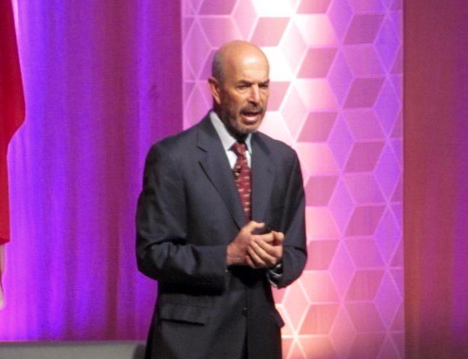
Ian Goldin speaking to WOCCU meeting in Belfast.
In thought-provoking keynote comments to WOCCU’s World CU Conference here, Ian Goldin, director of the Oxford Martin School at the University of Oxford, a former IMF official and the author of numerous books, offered some macro insights on what is happening in the world today, what globalization is really all about and why no walls can stop it, and the evolving market conditions of the planet in which credit unions will need to remain viable and relevant.
“There are five-billion connected people today,” according to Goldin, who wrote his doctoral dissertation on credit unions. “With this is a transformation of genius, ability, talent and workforces globally. What we are getting is the release of talent, not just the individual talent--there will be more Einsteins and Michaelangelos emerging from the streets—but also the collective emergence of talent. Expect more innovation to emerge than ever before.”
Goldin said what is most often referred to as “globalization” is really “integration and collectability” at a level not seen before.
A Second Renaissance
Goldin posited that the world is in the midst of a second Renaissance, with numerous parallels to the first Age of Enlightenment—including the negatives.
On the positive side, since 1980, the average global life expectancy has increased about 20 years. Illiteracy has gone down by 70%. Income has increased as the number of people living on less than $1 a day has declined by 300 million, despite an increase in total population of two billion.
“I think about this period as a Renaissance period,” said Goldin. “It is characterized by breakthroughs in our understandings.”
But can what Goldin called a most unusual period in human history be sustained? Or is it about to end?
“The first Renaissance ended in tears with extremism, like we see today with jihadism. It was followed by hundreds of years of religious wars,” said Goldin. “What’s worrying me today? Two things. The first is that that while the walls have come down between countries, the walls are going up within countries everywhere. All countries are seeing rising inequality. This is a characteristic of our time. When things change more rapidly, you get left behind more rapidly when you do not have the right skills or are not adaptable, for whatever reason. The second great worry of this integration is that not only good things travel; really bad things travel too, like pandemics and financial crises.”
Below are some of Goldin’s other observations on the world, trends, credit unions and more:
Population Demographics
Goldin noted the population trend line headed downward globally, but there is disagreement over at what pace. At the same time, life expectancy is rising. What is occurring is the development of huge, aging populations along with a quick change in fertility rates, with new generations becoming smaller in developing countries.
“So the average median age has doubled in most countries of the world, except African countries. What we’re going to have to understand is the burden of the elderly on the youth.”
For credit unions, he said, that will mean understanding the impact of demographics on finances, including where will money come from and how will it be spent.
Economic Growth.
Goldin said the next 14 years through 2030 will be much like recent years, with emerging economies growing faster than advanced economies, in part because they have learned some hard lessons from growth in the past.
“I believe the future will be characterized by more systemic shocks, and having more ammunition in your fiscal gun will become more important,” said Goldin.
In advanced economies such as the U.S. and Europe, he said political gridlock has emerged because economies have reached a point where “there is no room to give without taking.”
In economics, Goldin said many media reports about China’s slowing growth misunderstand what is taking place.
“Size as well as growth rates matter,” he said. “Six percent growth in China is a disaster? This is ridiculous. You can’t keep growing at 10% growth rates forever; you will become the whole world economy eventually. They are a $17-trillion economy growing at 6%. That’s much better than being an $8-trillion economy growing at 10%. China and India will continue to grow, and India will overtake China by 2030.”
Goldin said that in some cities in China per capita income now exceeds that of cites such as Belfast or Minneapolis.
“We also have an explosion of the middle class,” he said. “There are more than 3.5 billion in middle class, and that is your market. But where (opportunity) happens is not going to be in the old markets, it’s going to be in the new markets. The consumption share is going to change.”
The Brexit
“I think the decision by the U.K. to get out of Europe is completely disastrous for the U.K.,” said Goldin.
Technology
“We think we know what’s current in technology, but have no idea what it will be in five years,” said Goldin, who said along with others at Oxford he believes that Moore’s Law will continue to hold true, and that there will be a doubling of processing speed every 18 months at the same price at least through 2030.
“What will we do with it? That’s the question. We don’t know what to do with all this capacity,” he said.
Another big tech issue to watch will be genetic modifications and the ability to reprogram stem cells, forecast Goldin. “The capacity to change the way we are will be prevalent by 2030,” he said. “But as we move into this, the big question is will it increase inequality or bring equality?”
Risk Management
Goldin said the challenge in identifying emerging risks is “the past is an extremely bad guide to the future. We have little or no data, few or no precedents, and complex systems changing faster than human institutions. The silo mentality makes for bad risk management. We can draw risk curves for anything, the problem is the long tail. These are human-created systems that are too complex for us to manage.”
A critical risk management issue, observed Goldin, a native of South Africa who was forced into exile in Paris due to his opposition to apartheid in that country before being invited back by Nelson Mandela, is that many technologies are “dual use,” and create new problems as a result. “One of them is DNA sequencing. What cost $2 billion in the 1980s can be done today for $200. You can purchase a DNA sequencer, create smallpox, get a drone and fly it over cities.”
Goldin said technology has allowed small groups of modern-day “pirates” to emerge who can “strangle systems in significant ways.”
Cyber Risk & Technology’s Impact
If any audience is familiar with cyber risk is it credit unions, but Goldin noted such risks are expanding from breached financial accounts to the locks on front doors, which is having an effect on consumer attitudes.
“So trust and integrity become more and more important as it pervades more and more of our systems,” said Goldin. “We also need to understand that citizens’ reactions are becoming more and more important. Up to 46% of U.S. jobs might be lost to machine learning in the next 20 years. People will lose jobs to machines, including in the credit union movement. What the new jobs are and how politicians respond are going to have a major impact on future. What we don’t want is for citizens to say ‘no’ to technological change because they are afraid of it. How we manage and shape our future becomes more important the more powerful these change are.”
Good of the Individual Vs. Good of the Collective
An increasing challenge in an increasingly connected world, said Goldin, has to do with how the rationale for individual thinking is often at conflict with the rationale for those same individuals as part of a collective. As a case in point he cited is fishing. One person fishing isn’t harmful; a planet of fishermen is. Another example is antibiotics. One person taking antibiotics is good; collectively, all those antibiotics can have negative implications.
“This needs to be managed,” he said. “Unfortunately, governments are not very good at this. Short termism and political expediency drive out good decision-making.”
But perhaps the greatest threat to be faced, said Goldin, is climate change.
“We have 50 people working on this, and we are absolutely convinced this is a major worry. Average rainfall down will be down by as much as 40% in many places. This will particularly impact on poor people.”
Global Governance
While the global challenges are clear, said Goldin, far less clear is who is up to the task of responding to them. In Goldin’s opinion, currently no one is.
“The global governance system is totally unfit to do this. It’s not scaled to the challenge of global governance,” he said. “We are just rearranging the furniture. We won’t give up sovereignty. Eleven white guys smoking cigars in a room won’t cut it anymore. There were 75,000 people involved in negotiating the Paris Accords. At a time of great global challenge, we have less and less ability to deal with the challenges of the 21st century. At a time when we are more and more connected, the great paradox is the disconnect and xenophobia.”
Five Lessons from Financial Crisis
Goldin said there are five lessons to be taken from the global financial crisis earlier this century.
Lesson 1. Integrated systems give us much more strength, and also make us more vulnerable.
Lesson 2: There are governance gaps. The financial system transcends national borders, but regulators are nation bound.
Lesson 3: “We don’t understand the technological revolution. We didn’t understand credit derivatives. There are all kinds of risks we don’t understand. How do we get poachers to be game-keepers and into our audit committees?”
Lesson 4. The systems—accounting, regulation, short termism—increase fragility in both the public and private sector. The rigid systems are unable to respond.
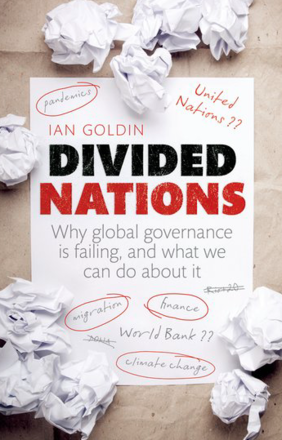
Ian Goldin's Divided Nations
Lesson 5. Too much data. “We are blinded by the blizzard of data. We lose our judgment. Everyone knew there was a credit bubble in the U.S. I was working in Washington and the cleaner in my office told me he bought a second home in Miami. We relied on systems. Wisdom, judgment and ethics become more and more important the more data you have.”
A Tipping Point
Goldin said many citizens of the world feel as if they don’t have any control, which helps explain the emergence of figures such as Donald Trump and Bernie Sanders in the U.S.
“This is very dangerous. We have become more insular at time we need to be more open,” he said. “This has happened before during the Age of Discovery. Renaissance times are always the most dangerous of times. Whether we prosper or flounder, that is up to us.”
What Can Credit Unions Do
“I think the challenge is going to be to use the new technologies to serve your clients effectively,” Goldin said in response to an audience question. “A big issue in the future is going to be more rapid change, so those sorts of things will have to be overcome as people overcome the geographical lock on them. What the credit union movement has is integrity and trust, which the big banks don’t have anymore. So capturing this moment of deserving this trust is what I believe you can do not only for your members but to solve world poverty and other challenges.”