

MADISON, Wis.–The stigma is gone, the benefit is popular, and the hybrid work environment is here to stay—and so are the challenges around how credit unions can develop the most ideal work arrangements, how to address “frictions” around perceptions of work, how to maintain and build productivity, and how to rework physical spaces.
Those issues and questions were the focus of a webinar that was part of Filene’s “So You Want to Talk About” series, in this case, “Headquarters and Hybrid Work.”

Cortney Arnold during webinar.
The primary presentation was made by Cortney Arnold, director of community development with Filene and The Cooperative Trust, who shared much of what research conducted by Filene and other organizations has discovered about the new remote/hybrid/in-office work landscape. Two other people also shared their perspectives as part of the webinar and are being featured separately in CUToday.info.
“There used to be a stigma against being a remote worker or working from home as your primary environment, but we're actually now seeing that is a benefit for a lot of applicants when they're reviewing job postings,” said Arnold. “People are excited about the idea of being able to either work from home completely or do it in a hybrid fashion.”
An Ongoing Experiment
As part of her remarks Arnold explained there are differences between remote and hybrid working arrangements, and that credit unions and other employers have responded with different approaches with which they continue to experiment. While employers look to strike the right balance and still drive productivity, Arnold pointed to a new study from the Atlanta Fed that found how much more likely people are to switch jobs if remote/hybrid work is available (see chart, below).
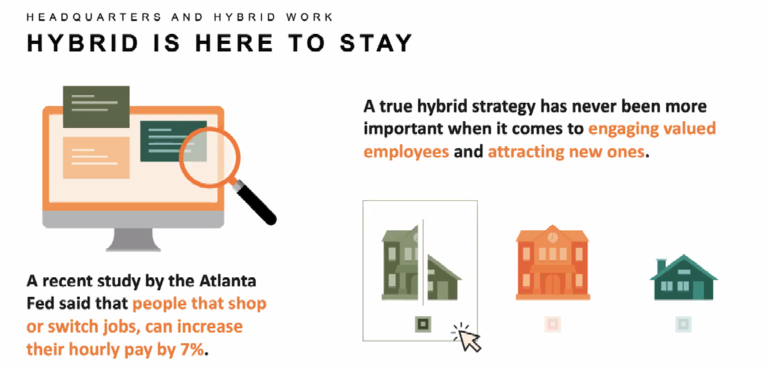
“When we think about this for our own credit unions, for our own organizations, if we are thinking that people aren't looking outside we're doing ourselves a disservice, because we're not preparing for the inevitable—that people are actually doing this,” said Arnold.
She recommended that if they haven’t already done so, credit unions get a remote strategy in place, especially as the seek to recruit and retain new hires.
New Ways to Engage
“It’s really important that they consider and discover new ways they can engage with the folks that are working at their credit unions and the folks that may potentially be working within their organizations, because of this ability to really shop around,” Arnold explained. “If we're thinking in the future, if we're having these conversations about what this will look like for our organization, for our organization’s culture, it can be a critical point in ensuring you're retaining those engaged employees and, again, also attracting new people.
“If there's one thing that I know for certain it is that if people love where they work, they're more than willing to share,” Arnold continued. “And if people don't like where they work they're also more than willing to share that. So, we want to be on this side of the fence where people are excited, energized and happy to come into our office, where they feel valued, where they feel like their voices are heard, and where they can also feel like they can be productive and add value.”
In an informal survey of the audience in the webinar, some attendees indicated they were working on a remote work strategy, while others said they had yet to do so.
A ‘Nice Marriage’
Hybrid work is a reference to employees only being in the physical office for a certain number of days per week, while working from home on other days, but there any numbers of ways to configure that. Arnold said she knows of one credit union that required employees to be in the office eight days each month, an arrangement she described as a “nice marriage.”
“If people only come in once a month or every quarter, that's more of a remote strategy and you're already setting yourself up to have less attachment to the organization,” Arnold stated.
As part of the hybrid working environment, Arnold said it’s important an organization’s employees understand why they need to come into the office, at what points in time, and when other people are going to be there, so they know when they're going to have their most productive times either in the office or out of the office.
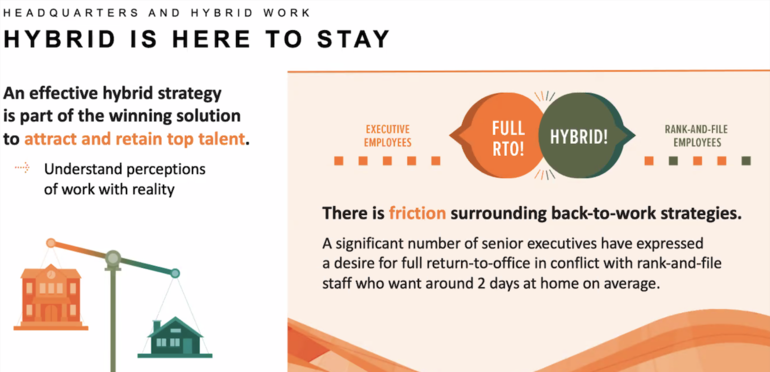
“That can really be a key strategy in attracting talent,” Arnold said. “The other piece is really just understanding the perceptions of what work happens. One real major discovery that this research is telling us is that there are absolutely different perceptions of what's happening when people are at home versus when they're in the office, and it would be silly of us to think that there is no friction related to this.”
What Research Shows
Arnold pointed to research done by Filene Fellow Dr. Sekou Bermiss, who heads Filene’s Center of Excellence for the War for Talent, that reinforced the need for a sound hybrid strategy for attracting and retaining talent.
“Many of the senior leaders he spoke with...found a real disconnect, again, between the perception of work that was happening at home versus at work,” Arnold related. “Universally, frontline staff really loved working from home when that was an option, when they had the tools and resources to do it in a way that worked really well for them. But then there were folks that couldn't go into the office or couldn't work from home…based on their role. And then there are folks that maybe did have to work from home but they didn't have the space or the environment that really allowed them to work in a way that was really productive.”
The best strategy, said Arnold, is to stop and pause and then be “extremely clear” about the organization’s requirements in remote and hybrid work and in what is expected from employees and leaders.
Arnold cited a survey of 70,000 workers in the U.S. that found the most satisfied are those in hybrid positions, but she added that it isn’t a “one size fits all” conclusion, as some people prefer fully remote or fully in the office.
Trust or Bust
And that brings organizations and employees to another critical point, according to Arnold: trust.
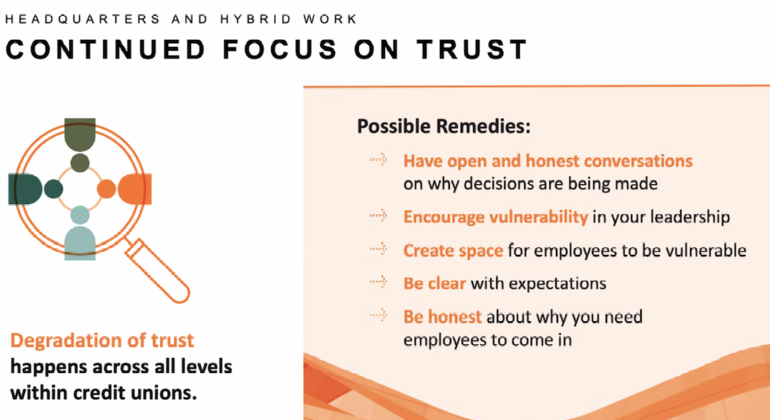
“We know that trust is so important because these are the reasons why people leave organizations or stay in our organizations,” Arnold said. “This can be the difference between a positive Glassdoor review and a negative Glassdoor review, or someone wanting to boomerang, basically an employee that leaves the organization but then wants to come back.”
For those credit unions and other organizations uncertain of where to start in developing their remote/hybrid policies and strategies, Arnold said using data based on surveys and building a foundation of trust are good places to start, and that includes “keeping your team members in the loop about what's working, what's not working. It can be a really simple way to continue to evolve and understand what strategies going to work well for you.”
What a credit union can’t do, she added, is assume it has employees’ trust.
Degradation of Trust
According to Arnold, Filene has found in its research a “degradation of trust,” with much of that due to “perceived outcomes of friction” and uncertainty over whether or not people could go into the office or not go into the office, in addition to whether they feel trusted to be productive when they're working from home versus when they're in the office.
She stressed that even if there has been degradation in trust, it doesn’t mean it can’t be rebuilt. Organizations can also watch their own scores on employment engagement or attrition rates to get a better handle on where they stand with employees on trust.
“It's really just about pausing and having an open conversation about why decisions are being made,” said Arnold. “Oftentimes, when I'm speaking with emerging leaders and young professionals in the Cooperative Trust community, there is this desire to want to understand why choices and decisions are made for a variety of reasons. People care deeply about their lives, they care about their free time, they care about their incomes and it really matters. Having these open conversations about why stuff is going on in an organization can also be a really important tool for learning strategic thinking, for expanding the ways that they might make decisions for their own teams and departments and then maybe eventually their own credit unions.
“Sharing why decisions are made can not only help build trust, you're also teaching folks the tools to make really smart decisions when it comes to strategy and business.”
Avoid the TMI
Arnold added that while it’s important for organizations to be authentic, it doesn’t mean every bit of information must be shared. But it does require creating a safe space for employees to feel like they can actually be vulnerable with the leadership team so they are willing to share when things aren't working and are sharing ideas.
Another component that builds trust as part of the remote/hybrid strategy is providing employees with autonomy, according to Arnold, noting people like to feel trusted to make decisions.
“We start to see improved employee satisfaction, because people feel again connected to their job, they feel the value that the purpose of not only to the work that they're doing but likely to the other people on their team,” said Arnold. “It's especially true when we stop and think about people who are caretakers, the parents who have small children or those who have older parents. Thinking about people in their own lives is where this can truly add something back again. It’s why this is such a powerful tool to retain and attract your talent.”
Physical Space
For credit union leaders, the other big question is what to do with physical office space when not everyone is coming in all the time.
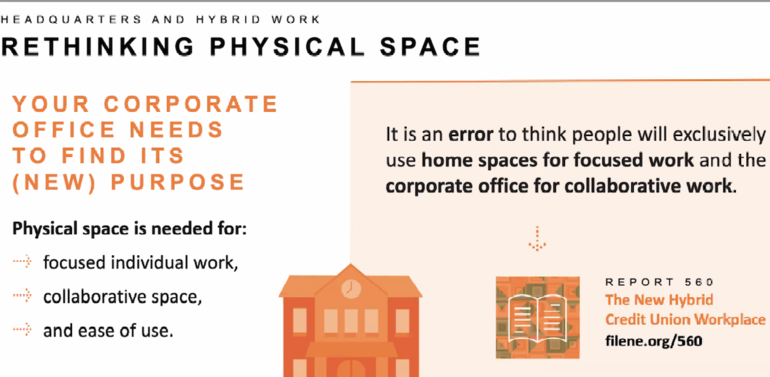
“When we think about space in and of itself it will require us to really be creative and think about its new purpose and its new uses in the ways in which people might actually be more productive in the space in which they're working,” said Arnold.
Odd Scenarios & The Need for Questions
The questions around physical space include whether those in the office are working individually or is the focus on collaborative endeavors. Some people may find it really hard to focus on work in an office with all its distractions, while others may feel they can be just as collaborative remotely.
Then there are the odd situations that have developed since the beginning of the pandemic, such as workers arriving at an office to find they are the only ones there, or spending all day in the office in virtual meetings that could have just as easily been done from home. All of that needs to be thought through
The best way to get answers, reminded Arnold, is to ask questions and look to the data.