

LONG BEACH, Calif.–Attracting and retaining talent remains top of mind for most credit unions, and two CU execs here shared what is working for them, including making scheduling changes, recognizing how the nature of employment has changed, offering mental health assistance and even tolerating an employee’s third bereavement request for the same uncle.
Offering their insights and experiences during NAFCU’s annual convention were Cheryl Brown, chief people officer with the $1.1-billion Credit Union West in Glendale, Ariz., which has approximately 200 employees; and Sarai Rodgers, SVP-chief HR officer with the $1.3-billion Frontwave Credit Union in Oceanside, Calif., which has approximately 265 employees it calls “dreammakers.”
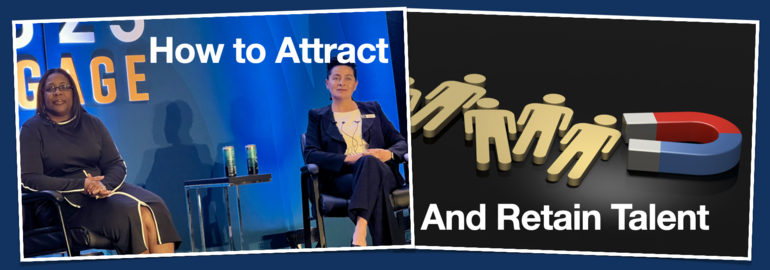
The session was moderated by Tracie Wilcox, president and CEO of On Tap Credit Union in Colorado.
Here is a look at what each of the executive shared:
Wilcox: What is the culture of your organization?
Brown: We started in 1951 servicing the Air Force community in Glendale. We understood the importance of service in serving those who take care of our country. Our culture is really built around service excellence. It’s one of our core values. For us service is Security. Excellence. Respect. Integrity. Commitment. Empowering our people.
Rogers: We have a military base through which 16,000 new Marines come every year. We are very much in that service space. We have a culture where we embrace passion, innovation and excellence. That is threaded through the entire organization and we start with the interviewing process. That continues through onboarding and annual evaluations. They have to be individuals who have a passion for individuals and making dreams come true.
Wilcox: Can you describe the difference between culture and engagement?
Brown: They are often use used interchangeably, but they are two different terms. Culture is all about values and behavior and, I like to say, our standards and processes. It’s how we support each other internally.
When you think about engagement, it’s all about discretionary effort. Are employees passionate and enthusiastic about their work and the organization? They have to work together. If you have the right culture and right behaviors and right way to do business, then you have an environment where employees want to give back.
Wilcox: How do you assess top talent?
Rogers: Employees are either actively engaged or actively disengaged and that can swing 20% one way or the other. At Frontwave, we call them BMs, bare minimum. We want an environment where people are learning and meeting with their mentors on a regular basis.
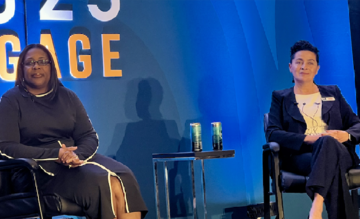
Cheryl Brown, left, with Sarai Rodgers during NAFCU meeting.
We start early on in assessing talent in the organization from the receptionist to the C- level. We use metrics for four categories.
- Solid. They are helping us meet corporate goals and are culture fit. Our target is 70%.
- Top talent. We target 10% of the organization who are not just meeting but exceeding goals. They are the go-to person. We are at 12%.
- Low performers. Ten percent are low performers. Truth be told, this is where we spend most of our time. We try to move and pivot so that we’re not spending as much time with the low performers.
- Crossroads. About 5-10% of our people are at a crossroads. Maybe they have had something personal happen to them. Sometimes we get "lifed.” If that is the case, we identify them and say they are at a crossroads.
Then, throughout the organizations, we have managers at all levels bubble up people and once a year go off-site and go over every single dreammaker. It’s incredibly detailed.
Wilcox: Any best practices you have for retaining talent?
Brown: I think it's important for us to really understand the pulse of the workforce today. I tell people it's not about what I think about the workforce, it's not about what I want or what the CEO wants, the organization has to really understand there are major disruptors that are taking place today.
Think about the gig economy. Think about the importance of flexibility. Women have been running out of the workplace since the pandemic. Women were doing so much during that time and then after COVID the flexibility was not there and (women left the workforce).
Think about the demographic changes when you're thinking about retaining talent. It really is about trying to understand the pulse of what is happening in the workforce today, because that's going to help you really understand what programs, what initiatives, what strategies you're going to need in order to keep talent.
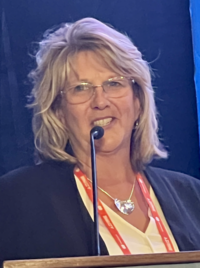
Tracie Wilcox
When you've done all that work to get them into your organization you want to do what you can to keep them. Things are different today; you may not keep people 30 years like you used to. If you can get people solid and committed and fully engaged in your organization for two to three years, that's a huge win today.
We had only a few roles that were remote, but because our employees were speaking up about it we now offer hybrid along with the remote. We have also changed scheduling. That's why the gig economy is growing, because people have options.
I think it's important that whatever changes you're making around flexibility that you have a communication plan. Outside of hybrid remote schedules, we now also offer four (ten-hour shifts). It’s really based on the position and the performance. You need to (think about) your employee experience.
We also looked at mental health. That was a huge concern in our organization based on the ask from our employees. We’re in the process of launching a new EAP that has tools to help their families and our employees. Today, everybody likes to use their phone, so the EAP program has the technology to support texting. People are overwhelmed, they're burned out, they're stressed, so we're elevating that experience through the EAP program and we're also elevating education around well-being.
We elevated our PTO program, as well. The average employee now has increased time off, about eight days.
Rogers: We did an engagement survey to find out where (our employees are) at and what's missing. At one point we had over 50% of our employees working 100% remotely, which was a challenge. We learned very quickly we had some quiet quitting going on…We started bringing people back and what we heard via surveys was, ‘No, we don't necessarily want to come back full time. How about hybrid?’ As a management team we considered whether we wanted to lose or risk losing all these individuals when it takes so much time in this economy, with this low unemployment rate to attract talent.
You're meeting with people, you're interviewing, you fall in love with them and they take another offer because you weren't quick enough or they go to a different organization…for a dollar more an hour or because they gave them the flexibility to work from home or remotely.
So, we are always actively listening to our employees beyond that one survey…It's so important to not just have them simply take the survey but to let them know their voices are heard…Some things are very easy to implement. Wearing jeans was unheard of prior to COVID. It could be something as simple as, ‘Can I come in a half-hour later? can I work every other Saturday.’
Having programs in addition to (answering) requests that are coming in from employees (is important). Career development is really important and it's not one-size-fits-all. Someone may be wanting to grow their career in the credit union space and you're going to be able to help them guide them and have them go to seminars similar to this where they can learn about the credit union space and the industry and they can become the next best you-fill-in-the-blank. But there are others that want to become teachers or artists or nurses, so you have to have that one-on-one conversation and have your leaders at all levels have that conversation. It’s not just once a year, it's ongoing to get to know them and help them with their development plan.
Wilcox: What strategies are successful in attracting Millennials and Gen Z?
Rogers: Our organization is 50% Millennials. I’m generalizing, but we've all read the books, we've seen the articles where Millennials are a little bit on the high maintenance side, a little bit right a little demanding. It’s ‘What’s in it for me?’ and ‘What have you done for me lately?’
They want to be a part of the community where with previous generations it's all about you know making sure that you're at a company with great benefits and there's a 401(k) plan and you're involved and there's a career path and you're going to be there for 10 or 20 or 30 years.
Now, this group that we work with are great, but they want to know what can you do for me today and when will we get promoted, and how much time do I get off, and how quickly can I make $100,000 and I want to be the CEO tomorrow, and they’ve been here like two weeks and we just got them through new employee onboarding. And oh, by the way, they are already want to work from home.
So, we are very patient in the HR space and we listen to them and if you are able to accommodate some of these things, do it.
Here are some tips that you can take or leave from someone who grew up in (a very conservative HR environment) where you had to wear pantyhose. We changed our handbook and we partnered with employees at all levels of the organization to do so. It’s not any of the legal stuff…but we flexed our handbook. Now, tattoos are OK as long as they're not on your face and neck. Piercings are OK but you can't have too many of them; they ought to be subtle. We don't care what your hair color is. We don't care anymore as long as you're clean and you show up to work.
The biggest win with all of the changes in dress code is employees love jeans and a logo wear shirt and if I can do that every day I'm going to stay here because this is the best company ever. So, beyond that listening to them. They don’t care about the HMO or the PPO option, they want to know if you have pet insurance, and ‘Could I have more PTO, more sick time?’
Obviously, there's a financial component, too; you've got to balance out do I give them more sick time, do I give PTO. What we've done is in addition to 18 days of PTO--which I think is a lot--if they need additional time we give them time. If they need to take a personal leave of absence we grant them that personal leave of absence eve if they need to take a third bereavement for the same uncle. We're being much more flexible with them.
Our retention levels have increased over the last three years pretty significantly.
Brown: I think it’s important in thinking about Millennials to recognize they grew up on all this automation and technology. They are very entrepreneurial driven. We are focused on compliance and regulation, but we have to think about cultivating an entrepreneurship environment where that is celebrated.
Wilcox: What are the solutions for remote work?
Brown: That could be an all-day conversation, but I think it all starts with what I call the two P’s: you want to look at the position and you want to look at performance. Those two areas help define who would even be eligible for remote work.
When you do that make sure you have guidelines. We do have guidelines. You actually have you take pictures of the space that you're going to have. We have an agreement on what their schedule is going to look like. The guidelines make sure there is cohesiveness and agreement on what the expectations are going to be.
In addition to that is the collaboration piece. You have to make sure that there's time for collaboration. If someone is full remote we normally have the teams come in. We want to support them, to make sure there's some type of engagement in-person. We all have these different tools like Teams, but we think for collaboration the best experience is in person.
But, again, think about who we were just talking, your Millennials, your Gen Z’s. This is how they engage.
Rogers: We’ve got 42 employees in our call center who serve as our membership; why wouldn't they be able to work remotely? They've got KPIs, so we know how many people they're talking to, whether they are on the phone or not, whether they are chatting with our members and when. Why wouldn't you want to give them an opportunity?
What we're finding is that we have just a few full-time remote positions and they are the underwriters because they're not talking to people face to face. They have all of the tools so they can do their jobs 100% of the time accurately in a remote environment. But all other positions have an opportunity beyond the branches to go hybrid and we are asking our dreammakers to come in three days a week, eyeball to eyeball. That relationship is really important to collaboration in all organizations. You've got to be there for your team, you've got to be there for your membership.
But if it is possible we're going to try it. We're big on trying and testing things and if it works we'll continue it.
For those individuals who are asking for remote and it doesn’t work for their specific assignment, we ask them to consider having a different assignment. We did that a number of times and had people moved throughout the organization quite successfully and it's a win-win.