

By Ray Birch
KEY WEST, Fla.—For Maggie Sayer, leadership has never followed a straight line—or a predictable scale.
As CEO of the $250-million Keys Federal Credit Union here, Sayer runs a geographically fragmented institution with just 50 employees spread across six locations, serving vastly different island communities and a highly transient military population. Yet this summer, she stepped into one of the credit union movement’s most visible leadership roles: chair of the Defense Credit Union Council.
It’s an unusual pairing—by asset size alone. But for Sayer, the juxtaposition captures something essential about modern credit union leadership: scale does not always define impact.
An Unplanned Path To The CEO’s Chair
Sayer did not set out to run a credit union, much less chair a national trade association. For nearly a decade, she served as Keys FCU’s IT director during a prolonged conservatorship, focused on stabilizing systems rather than shaping strategy. When the credit union’s CEO stepped away to care for family, Sayer raised her hand.
“I felt ready for the challenge,” she recalled.
That decision ultimately placed her at the helm of an institution founded in 1940 by civilian employees at a military base, one that today operates across the Florida Keys with branches that function almost like separate credit unions under one charter.
Each island brings a different demographic, economic reality, and service demand. The complexity, Sayer says, often belies the “small credit union” label.
Small Credit Union, Full-Scale Pressures
In industry terms, Keys FCU is firmly on the smaller end of the spectrum. In practice, the challenges mirror those of much larger institutions—often without the same margin for error.
Operational costs, staff turnover, and regulatory compliance weigh heavier on smaller balance sheets, Sayer said, particularly when institutions try to remain competitive by offering a full suite of products, from payday alternative loans to RV and commercial lending.
Membership growth, once steady at about 6% annually, has recently turned negative, reflecting broader economic and demographic pressures in the Keys. Immigration uncertainty has also complicated outreach to underserved and unbanked populations—groups central to the credit union mission but increasingly cautious about engaging with financial institutions.
And while Keys FCU is the credit union on base, only about 2% of its membership is military or veteran, a function of the area’s highly transient assignments. Service members often arrive already banked elsewhere, even as the credit union continues to support military installations and directs more than half of its philanthropic giving toward military causes.
Leading DCUC From a Different Perspective
Sayer believes that experience gives her a different vantage point as she steps into DCUC leadership.
She joined the DCUC board in 2019 after firsthand experience relying on the organization for guidance on defense-specific rules and operating agreements—support she said was immediate and practical. When asked to serve, and later to chair, Sayer initially hesitated.
She worried that a leader without overseas branches or a multibillion-dollar balance sheet might not be the right voice. Her predecessor, Jack Fallis—president of Pacific Northwest and international markets for $14-billion Global CU——thought otherwise, encouraging her to lean into perspective rather than size.
DCUC’s board, Sayer noted, is intentionally built to balance large and small institutions, ensuring that defense credit unions of every scale have a seat at the table.
Advocacy, Speed, and Practical Value
While advocacy is central to DCUC’s mission, Sayer emphasized the organization’s effectiveness lies equally in speed and specificity.
She pointed to DCUC’s rapid guidance surrounding the recently announced “1776” military dividend, when member credit unions received clear, actionable information—what it was, when it was coming, and how it would affect operations—before many details were widely reported.
That same responsiveness, she said, extends to military business lending caps, defense authorization legislation, tax-exemption battles, and the often-arcane interpretations of Department of Defense rules that no single CEO has time to master alone.
“For the price we pay, the returns are extremely high,” Sayer said, describing DCUC as both an advocacy force and a real-time operational resource for credit unions navigating defense-specific complexities.
A Different Kind Of Credibility
For Sayer, chairing DCUC while running a smaller credit union is not a contradiction—it’s a source of credibility.
Her day-to-day reality includes thin staffing, rising costs, membership volatility, and the challenge of doing more with less. Those constraints, she said, sharpen her understanding of how regulatory decisions, legislative changes, and defense-related policies land on the ground.
It’s also why she believes small credit union leaders belong at the highest levels of industry governance.
“Just knowing that small credit unions have a voice at the table,” she said, “when we’re talking about the challenges in this industry—that’s a really wonderful feeling.”
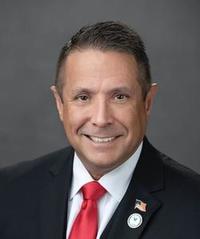
Anthony Hernandez
A Strong Leader
DCUC president and CEO Anthony Hernandez said Sayer is one of the sincerest leaders in the credit union industry.
“She deeply cares about the future of the credit union movement," Hernandez said. “I appreciate her no-nonsense leadership style which is familiar to most military professionals and I admire her tenacity when she asks the tough questions to quickly get to a workable solution. Yet, she is fiercely loyal, extremely supportive, and someone you want in your corner."

Jason Stverak
DCUC Chief Advocacy Officer Jason Stverak said Sayer brings an indispensable voice to the credit union movement on Capitol Hill.
“A voice that is grounded in defense readiness, financial resilience, and real-world experience,” Stverak said. “Her leadership serving active-duty service members, military families, and veterans, while simultaneously running a small credit union, gives her an unmatched understanding of how financial stability directly supports military readiness and mission success.
“Just as importantly, Maggie ensures that the small credit union perspective is not only represented, but heard and respected at the table,” continued Stverak. “She speaks with credibility, clarity, and authenticity that resonates with policymakers and industry leaders alike. We are incredibly fortunate to have her serving as our chair.”