

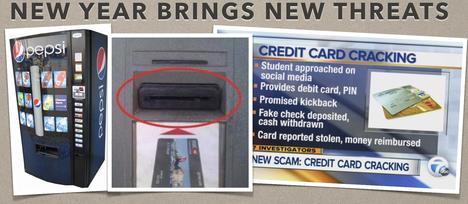
GREENWICH, Conn.—Credit unions are being urged to watch closely for members buying a soda from a vending machine with their plastic and shortly afterward making a big-ticket purchase at a nearby store with the same card.
Meanwhile, at the same time new versions of card skimming are victimizing credit unions and their members, while an old scam—card cracking—has made a comeback.
All those types of fraud are emerging as the New Year arrives, according to Mark Solomon, a detective with the Greenwich Police Department who works with authorities nationally to detect and prevent fraud. Solomon is also a member of International Association of Financial Crime Investigators.
He said that with all of the compromised plastic in play that crooks are buying large batches of stolen card data, dumping the data onto fake cards and then testing them first with a small purchase to see if the card is still valid.
“Testing stolen cards on a soda machine is becoming very popular for crooks these days,” said Solomon. “It’s an easy and quick way for them to test cards to find out if the stolen data is still good, especially with all of the card conversions to EMV. Soda machines have become very popular with criminals.”
Test Card, Then Shop
Once the crook knows a card will work, the next step is to visit a store close by the vending machine, often in a shopping mall, and make a big-ticket purchase.
“Criminals don’t want to go to stores and make a $500 or $1,000 purchase and have a card declined, or multiple cards declined,” said Solomon.
That is just one of the fraud trends taking shape as the New Year rolls in. Solomon said there are others.
Fraud solutions will also have to be tweaked to address how crooks are getting much smarter in where they use counterfeit cards. Solomon said criminals are learning where victims reside and using the cards in local stores to avoid triggering a fraud rule.
“This is making it much more difficult for banks and credit unions to determine if a purchase is fraudulent or legitimate,” said Solomon.
Solomon recommended that fraud solutions now be based more on member spending patterns—behavioral analytics—including what is being purchased.
“Outside of tracking member behavior, look for purchases of things crooks like to buy, such as a large number of gift cards purchased in a short period of time,” he said.
ATM Skimming
Meanwhile, with ATM skimming on the rise in the past two years, Solomon said that crooks are relying more on deep insert skimmers, which are placed inside machines and cannot be detected from the outside.
Solomon said skimming attacks of all types are appearing more at gas pumps and on ATMs inside convenient stores, since these machines typically are not closely inspected by their owners.

Mark Solomon speaking to the NASCUS Cybersecurity Symposium
When credit union staff inspect ATMs, Solomon said they not only have to be watchful for skimming devices and cameras, they must also look for false PIN pad overlays.
“Instead of relying on cameras and live video to capture PINs, increasingly criminals are placing overlays on PIN pads. These capture the PIN entries,” Solomon explained. “Crooks know that wise consumers cover their PIN entries with their free hand.”
Solomon said that point of sale skimming is on the rise, as well. He said fraudsters are creating replicas of POS device faces, walking into stores, and when no one is looking placing the phony front on a terminal.
“It takes them only seconds,” said Solomon.
Most of these devices are Bluetooth equipped.
“The criminal leaves the device in place for a while and then comes back to the store, and via Bluetooth downloads the stolen data,” said Solomon. “For those devices that are not Bluetooth enabled, the crook just removes the false front when no one is looking and takes the stolen data away.”
Cracking Cards
Finally, “cracking cards” is making a comeback, Solomon said.
Cracking cards is a scam that targets young adults, often college students, stealing money from accounts via the victim’s ATM card. The ruse fools young adults into naively handing over ATM PIN numbers as part of an easy-money scheme. The criminals typically contact the young adult via social media, ask if they can use the person’s account to cash a check, and then promise the victim a cut of the money they deposit. However, the fraudster deposits only fake checks and then quickly drains the victim’s account.
“Credit unions should be watching for this, as we have seen an uptick in this crime recently,” Solomon said.