

By Ray Birch
MADISON, Wis.—There are two culprits behind the significant slowdown in new and even used auto loan growth at credit unions this year, and the resulting decrease in interest income is creating a “handful of things to deal with,” says one expert.

CUNA Mutual Group’s Chief Economist Steve Rick shared with CUToday.info what he called some “surprising” trends in CU auto lending, including that CU new car loan rates now are about at parity with used.
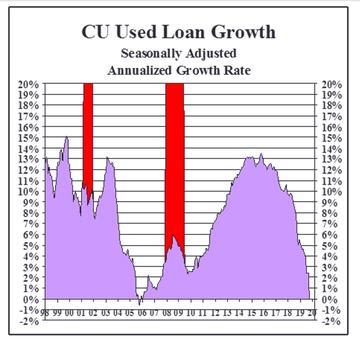
But what is the biggest concern for CU auto loan portfolios is that their bread and butter—loans for used cars—has hit the brakes hard since last year, Rick pointed out.
According to CUNA data, through July of 2019, year-to-date growth on used auto loans is 3.1%. The same period in 2018 showed more than 7% growth.
“So we are down by more than one-half,” Rick said.
What CUs Are Saying
In talking with credit unions Rick believes one of the reasons for the big decline is members have opted to take advantage of another dip in rates to refinance their homes and even cash out some of their equity at the same time as home values rise.
“They are taking that money and paying off some of their debts that are at higher rates, and that includes auto loans,” he said. “The refi boom is hurting credit union auto lending, and I think this is surprising many CUs. This is an issue. For example, if credit unions have a 10% target for consumer lending growth this year, they may not make that happen.”

Steve Rick, CMG
Rick agreed the sharp drop in lending for used vehicles is a bit more surprising, as consumers have been turning more toward used vehicles in the last two years as prices of new cars skyrocket. The average price of a new car today, according to several reports, is above $33,000. Moreover, a significant number of high-quality used cars have come off-lease in recent years, making used vehicles more attractive and keeping the price of used cars down.
Cycle at Work?
What may also be taking place is just the economics of a cyclical business, with demand for used cars hitting a low point. Rick noted many consumers waited to buy a car until after the Great Recession, when a rebounding and then booming economy driving consumer confidence and car purchases from 2015 to 2018.
“So we may be at the tail end of this business cycle, with many people not needing to buy a car for a few years,” said Rick.
The decline in used auto loans may also be driven by credit union loan-to-share ratios, which are at record highs, Rick said.
“A lot of credit unions are 90% loan-to-deposit, some 100%,” he said. “And they may be saying let's just slow down the pipeline a little, and we don't have to be as rate competitive to bring in volume. You have to go back to 1977 to see the credit union loan-to-savings ratio as high as it is now.”
Decline in New Car Loans
That thinking, too, may be behind the big decline in new car lending at credit unions, said Rick, who pointed out new car rates have risen a lot faster than used.
“New auto loans at credit unions are dropping even faster than used,” he said.
CUNA data show through July, new auto loan portfolio balances have declined by 1.5%.
“Compare that to new balances growing 6.5% last year for the same period—that’s an eight percentage point swing. That is huge,” Rick said.
One year ago the average of CU new car rates was 3.5% and today it’s 4.8%. But what’s most surprising to Rick is that, according to CUNA data, credit union new car rates are at parity with used.
“Credit unions, for some reason, have really jacked up their new car rates,” said Rick, noting NCUA data show CU new car rates at 4.3% today and used car rates at 4.7%.
“The concern going forward here is credit union earnings would be under pressure because interest rates are falling, so there's less interest coming into the credit union. But if they're not making as many loans all these deposits that are flowing in are being put into low-yielding Investments…,” Rick explained. “So credit unions have a handful of things to deal with.”
Evaluation Needed
Rick said credit unions must evaluate their pricing models if they want to keep lending volume up.
“Maybe they start adjusting rates again, marketing more, saying, ‘Yes I am still here lending,’” offered Rick. “I think how fast auto loan growth has dropped has caught many credit unions by surprise.”
Rick advised against reaching deeper into lower credit scores to keep volume up.
“With a recession looming, maybe in 2020, this is not the time to take a risk on riskier borrowers,” he said. “But, if a recession comes, with credit unions’ loan-to-share ratio being so high, they are well positioned to ride it out.”