

NEW YORK--Credit unions have spent decades trying to earn something many financial institutions envy: trust. And they have largely succeeded. Six in 10 members now consider their credit union their primary financial institution, and satisfaction levels exceed those reported by customers of banks. Yet when those same members stand at a checkout counter, book a flight or buy a new television, fewer than half instinctively reach for a credit union Issued card.
That disconnect—not trust, but transaction behavior—is the central finding of "Credit Union Innovation Readiness: Consumers Trust Credit Unions but Don't Always Reach for Their Cards," a new report from PYMNTS Intelligence, produced in collaboration with Velera. The research suggests the industry's next competitive battle won't be won by attracting new members. It will be won by convincing existing members to make their credit union card the one that never leaves the front of their wallet.
The stakes are larger than interchange income.
The report found members who make their credit union card their "top-of-wallet" card—the one they automatically use for everyday purchases—not only spend more on that card but also become more valuable overall relationships. Those members reported substantially stronger deposit growth than other members, suggesting that everyday payment behavior may reinforce broader financial loyalty.
In other words, the card someone pulls out to buy lunch today may determine where tomorrow's paycheck lands.
That connection may be the report's most important insight. Consumer members whose credit union card became their first-choice payment method increased deposit growth by 30% since 2024, while business members who did the same saw deposit growth climb 28%. No other demographic group experienced comparable gains.
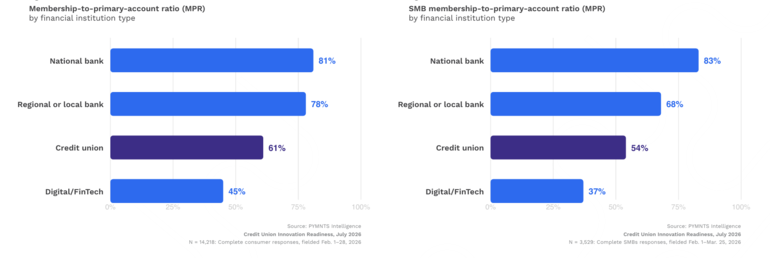
The irony is that credit unions already possess the foundation most competitors would love to have. According to the research, 61% of consumer members consider their credit union their primary financial institution, compared with just 45% for digital banks and fintechs. Among small businesses, that figure has climbed to 54%. Satisfaction is equally impressive, with 87% of members who use a credit union as their primary institution saying they are very or extremely satisfied.
But satisfaction isn't translating into swipes. Only 48% of credit union cardholders identify their credit union card as the one they use most often, compared with 69% of national bank cardholders. Among small businesses, the gap is even wider, with just 49% making their credit union business card their first choice versus 75% for national banks.
Clear Reason
The reason becomes clear when researchers examined where members actually use their cards.
Credit unions perform surprisingly well in recurring, often automated payments. Members are more likely than national bank customers to use a credit union card for rent or mortgage payments, utilities, internet service and basic healthcare expenses. Those are "set it and forget it" transactions that happen automatically each month.
Where credit unions stumble is where consumers actively make choices. For travel purchases, credit union cardholders are 45% less likely than national bank customers to use their credit union card. They trail in electronics, retail shopping, restaurant spending and subscription services—the very categories where consumers consciously decide which rewards card deserves the purchase.
That finding challenges a long-held assumption in the industry that relationships naturally lead to wallet share. Instead, the research suggests relationships may get a credit union's card into a member's wallet, but rewards determine whether it ever comes out. Cash back emerged as perhaps the clearest example.
Among all credit union cardholders, 44% cited rewards and incentives as the primary factor influencing card choice. Yet among members who already make their credit union card their top card, only 32% said rewards drove their decision. Those loyal members instead emphasized convenience, customer service and contactless payment capabilities.
Motivated By Rewards
That leaves a clear opportunity.
The members who haven't yet been converted into everyday card users appear to be motivated primarily by richer rewards programs—precisely the area where many national banks have invested aggressively for years.
The findings among small businesses tell a slightly different story.
While lower rates and fees remain the leading consideration for business owners, businesses that have already made their credit union card their preferred payment method place greater value on security, contactless capabilities and customer service. Businesses still using other cards are more interested in cash back and budgeting tools, suggesting there may be opportunities for credit unions to compete through expense-management features rather than rewards alone.
The report also uncovered another interesting fact. Credit unions continue to outperform national banks in industries and spending categories where local relationships still matter, such as construction, contracting and renovation-related business expenses. Those advantages are strongest among smaller businesses and rural markets, reinforcing the traditional strengths that have long differentiated credit unions.
Perhaps the biggest takeaway isn't that credit unions have a card problem. It's that they have a conversion problem. The industry has already persuaded millions of consumers to join, trust them with deposits and rate them highly on service. What it hasn't done is consistently convince those same members that its payment card deserves to be the default choice when discretionary spending—and the interchange revenue that comes with it—is on the line.
For years, credit unions have measured success by membership growth and primary financial institution status. The PYMNTS Intelligence research, conducted in collaboration with Velera, argues those metrics are no longer enough. In an increasingly payments-driven marketplace, the institution that owns the member relationship isn't necessarily the institution that owns the transaction. And increasingly, those may be two very different things.