

ORLANDO–Three Millennials who are credit union board members—including one who is chairman—offered advice and strategies to other (and older) board members here on how to attract younger people as volunteers—while making clear “being a Millennial” isn’t all they bring to the credit union.
The perspectives were shared during CUES’ Directors Conference here by James Sackett, a board member at the $1.3-billion Firefly Credit Union in Minnesota; Gregory Jenkins, a board member at the $56-million Greensboro Municipal Credit Union in South Carolina, and Shanna Yonke, a board member at the $2.6-billion Connexus Credit Union in Wisconsin.
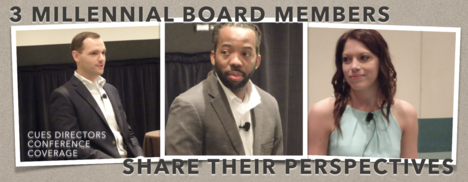
The session was moderated by Michael Daigneault, principal and founder of Quantum Governance. The questions below were posed by both Daigneault and members of the audience. Here’s a look at what was discussed:
Q: How did you come to join the board?
Sackett: I work in data in the health industry and I actually reached out to the credit union as I was looking to be involved. My brother was a member and Firefly was also recommended to me at a time when they were looking for candidates.
Jenkins: My story isn’t sexy. I am the revenue manager for Cary, N.C., and I have a 20-month old son. I was working for the city of Greensboro when I joined the board. My coworker and I would take an afternoon walk and when we stopped into the credit union, the VP at the time stopped us because they knew we worked in finance and asked if we would consider running for the board. I said I can’t do that, I’m not old. The first time I ran, I lost. The following year I ran again and won, and became chair the year after that and have been chair for 10 years.
Yonke: I have been a director for 18 months and a board associate for a year before that. They found me when the Conexus board decided to recruit Millennial board members. They looked at the recipients of our local ‘20 Under 40’ recognition and they identified two of us who became board associates and are directors now. I thought it was a great opportunity for me to grow professionally and personally and become a part of something greater than myself.
Q: What is it, the key concepts, the key actions, that are central to serving as Millennials that you want folks to know about?
Sackett: We talk a lot, especially lately, around overall member experience, employee experience. I would frame it in terms of your board experience, structure and processes, and by doing that you build in a succession plan and a perspective for change. Think about your meeting times. When do you meet? With a younger board member they may have a younger family, so it may be harder to get away. Are you meeting during the work day or the evenings? Where are your meetings? Do you allow people to meet remotely? When I joined the board I was traveling extensively and the credit union allowed me to meet remotely, and the technologies are out there. Now is the time to get off paper. The last piece would be thinking about meeting execution. It’s not very engaging for a Millennial board member to just review fiduciary reports. It’s not exciting, but also not the right thing for the credit union board to be focusing on.

James Sackett
Jenkins: As chair, at our credit union we have tried to push forward with technology. We do the electronic board packets. We have reformatted how we do our meetings, primarily because our board is a working board. We had to look at getting rid of paper. We have started to look at how to get people involved in our agenda. We have a consent agenda, but we want to be interactive. We allow people to call in and WebEx into our board meetings. I try to make every board meeting, but I do have the option of just videoing in. You are making yourself not just attractive to Millennials, but to all people, including associate members. We have tried to make it holistically attractive, and then we have focused on what kind of board member do we want to bring on board.
Yonke: You can’t recruit and engage any board member if you identify them as a token board member, and that includes token Millennials. I encourage you to look at all of us as professionals as well. I am an attorney and a partner in my law firm. My colleague who is a Millennial has also achieved a lot in her career. What’s important and unique about my board is they listen when we speak and respect what we have to say and appreciate the perspective we bring to the board. It’s not about saying you have a Millennial on your board, it’s about saying we appreciate you and your perspective.
Q: Give us some key pieces of advice or recommendations for credit unions in the recruitment, engagement and continued success of Millennials on their boards.
Sackett: There are three steps and we have done this. First, do something. That’s it. This panel exists because the credit unions did something. Stop asking the question and do something about it. Second, have uncomfortable conversations. If you are going to bring a new Millennial in, it might mean someone else has to go or another skill has to be deprioritized. Match it up against your strategic plan and think about how a younger board member could help get you there. Third, do the work. Put in the interviews, network, grab coffees and build relationships in the community to find candidates. Build a pipeline.
Jenkins: Educate, educate, educate. You first have to educate yourself over who you are and what you see around you. And then you go to the board or a CEO over what might be lacking. If you want to change direction and bring in people of diverse thought, you have to look at yourself. And then you have to educate your community. Once you’ve done that, you have to go out and actively engage. Credit unions have a very unique place in our communities and if we aren’t out there telling our stories we are missing the opportunity.

Gregory Jenkins
Yonke: I have two pieces of advice. Consider recruiting non-members. I was not a member when I was recruited. I was aware of Connexus; my parents were members. They gave me a compelling case for how the credit union and its values are aligned with the values of Millennials. You can really diversify the pool that way. My second piece of mind is always keep board succession top of mind. You can’t recruit one or two Millennials this year and then wait another five years. We just went through a skills assessment so we know what we need to look for in the next board associates and committee members. Also, invest in your board members. We have board director career plans so we can identity where we need to go. Make sure you are recruiting for not just board members, but board associates and committee members.
Q: I am the youngest person on the board by about 15 years, and I’m not young. We are same age, race and even religion. The challenge has been in getting some board members to understand how important this is. How do we do that?
Jenkins: One of the things I have tried to do is go back to our mission statement on the value of what we are. From there you can pull out the conversation you need to have. If the board believes in the mission statement, then you can say ‘We need to do this for the credit union and the credit union movement.’ It won’t happen overnight, and often you will need a facilitator to tee it up and keep the conversation going. People get territorial. They say, ‘I like being on the board, I like going to conferences.’ You get that, but you lose out on the conversations you need to have.
Yonke: What our board is doing is looking at the demographics of our members and the member we are trying to attract to the credit union, and trying to make a concerted effort to look more like them. It might be skill set, it might be socio-economic, it’s a broad range of characteristics, including age.
Q: What are Millennial values?
Yonke: Millennials really want to be part of something bigger than themselves. We want to achieve great big goals, and to do that we have to collaborate. We are willing to share ideas and resources and that is something that is very attractive to me.
Q: What about term limits? It’s mandated for us with three terms. I know it’s a dirty word sometimes. What do you do if you want new people but there are no chairs?
Sackett: Personally speaking, I’m not in favor of term limits; I am in favor of having tough conversations with people who aren’t contributing. Thirty years of the same leadership in any company isn’t that common.
Jenkins: I am also not in favor of term limits. It has its purpose, but it can also hurt you with a board member who is contributing. We are a small credit union. We don’t have a problem recruiting; if we have three open seats, we have five people running. Our issue is in finding that valuable board member who brings that value to us. They may have value in their daily job, but that doesn’t necessarily translate into having value on the board.
Yonke: We have strategy of mergers and with each merger we replace a board member.
Q: To me, it’s a chicken vs. the egg question. Should you go after Millennial members first, or Millennial board members first?
Yonke: You should start adding Millennial board members. They will introduce that perspective that will make you more attractive to Millennial members.
Jenkins: I agree. When I joined the board, my credit union didn’t have an app and the website was clunky, and I was saying for me to stay on the board we have to do these things. It didn’t make sense for me to spend five minutes trying to get an account balance, when I can get it in two clicks. It was a foreign concept on our board (at the time). Sometimes there is a technology I get excited about, but we choose not to pursue. But just the fact we had the conversation is important.
Q: We have a mission statement that begins, ‘We want to be the preferred financial institution…’ Snore. I need key words that are attractive to Millennials and one word to avoid.
Yonke: One word we would all enjoy is ‘easy.’ Easy, quick. We’re all busy professionals, with families, and we don’t have much time.
Jenkins: I would prefer the word ‘relationship.’ People want to be a part of a community, a relationship. I would say avoid the word ‘Millennial.’
Sackett: To me the two words are ‘Bank Local.’ That resonates with me.
Q: Those key words would apply to other financials, too. I was wondering about other words particular to cooperative financial institutions that Millennials would find attractive.
Yonke: I don’t know about one word, but I think what is attractive to us about credit unions is we are offering opportunities that people might not have at other financial institutions. We are making communities better, and we find that very attractive. At a credit union, we are helping people to achieve their goals. That really hits home with me and other Millennials. Someone just told us ‘You made my Christmas.’ That’s not something you would hear at Capitol One.
Sackett: I would imagine it’s something like Millennials are tired of these corporate bailouts and big wigs getting away with it with golden parachutes. Credit unions don’t do that, and I think emphasizing that would resonate with me.
Jenkins: I work in government and we see the small businesses, the coffee shops, the local businesses. We like these local businesses, these communities.

Shanna Yonke
Q: How do you have the flexibility with your families and work to sit in on various committees on the board? We have one postal worker on our board who can’t attend our meetings now because she can’t get off work. How do you deal with that?
Jenkins: For me and I think this would be true for other Millennials, we are looking for jobs that would support us and the values we have. When I interviewed for my job I told them about my commitment level to the credit union, and they said we support that. They want someone who is going to be happy and stay there. I think you will find a lot of Millennials have flexibility as long as the board is taking them seriously. The technology also means I don’t physically have to be there; I can have the conversation. To me, that’s key. I don’t have time for a lot of the chit-chat that happens.
Yonke: My firm is incredibly supportive and very community minded. So I do have a lot of support. A part of this is identifying the people who have that kind of flexibility; I do go to all the board meetings and I am an active committee member. We want our time to be used wisely.
Q: Did you go through an election or were you appointed?
Yonke: Our CU is quite large with 330,000-plus members all over the country. Our board nominating committee identifies candidates and puts them on the slate of candidates, and we make all members aware they can run for the positions, as well. But it’s been a very long time since there has been a challenge in that process.
Sackett: Our process is the same. Candidly, I do struggle with this a little bit around the democratic nature of credit unions and getting more engagement from our members in elections.