

By Ray Birch
LAKE TAPPS, Wash.—As the number of credit unions eliminating or reducing overdraft fees continues to rise, will the trend also lead to more small credit unions merging out?
Merger expert Glenn Christensen says it’s a concern he shares, adding he believes 2022 will only see faster consolidation among smaller CUs.
“I think at this point in time we were already seeing a lot of threats to the fee income component of credit unions,” said Christesen, who leads CEO Advisory Group. “Now, we are seeing what could well become a trend of credit unions eliminating overdrafts, which are a significant piece of their fee income.”

As CUToday.info has reported, the “dominos” are dropping in the overdraft space. After Ally Bank led the way, many other financial institutions have followed, including CU giant Alliant CU and mega banks Capital One and BofA. A report from Moebs $ervices indicates credit unions are leading the way in eliminating overdraft fees.
What worries Christensen is if the trend to eliminate overdrafts continues, driven not just by pressure from Washington and consumer groups but also by a wave of OD lawsuits, small credit unions that don’t have the scale to absorb the loss of overdraft income will face a dilemma.
“What do they do?” asked Christensen. “Do they eliminate overdraft fees? If so, where will they replace that income? How can they make up for that like the larger institutions that have much more scale? And if they decide not to cut overdraft fees, how will they be viewed by their membership when other financial institutions down the road have eliminated the charges?”
The Best Option?
Many may conclude their best option is to merge, suggested Christensen.
“Recently we have been seeing more and more credit unions responding to the no NFS movement within the marketplace,” noted Christensen. “Small credit unions that are trying to match this will see a significant erosion in their income and return on assets, which will further hamper their ability to pay out strong dividends to their membership and reinvest in growth initiatives.”
For all credit unions, but especially those with more limited assets, there are additional challenges beyond overdraft pricing, and that includes fintechs, reminded Christensen.
“A lot of the fintechs are whittling down various parts of the credit union revenue stream,” he said.
Overall, when it comes to the decision to stay in business or merge out, credit unions should ask themselves some important questions, stated Christensen.
The Big Question
“One of the biggest questions a credit union must ask is will it be able to effectively grow membership enough into the future,” said Christensen, pointing to new Merger Solutions Group data (see chart below) that aligns with significant reporting by CUToday.info that makes clear the majority of membership growth has been in the largest-asset CUs.
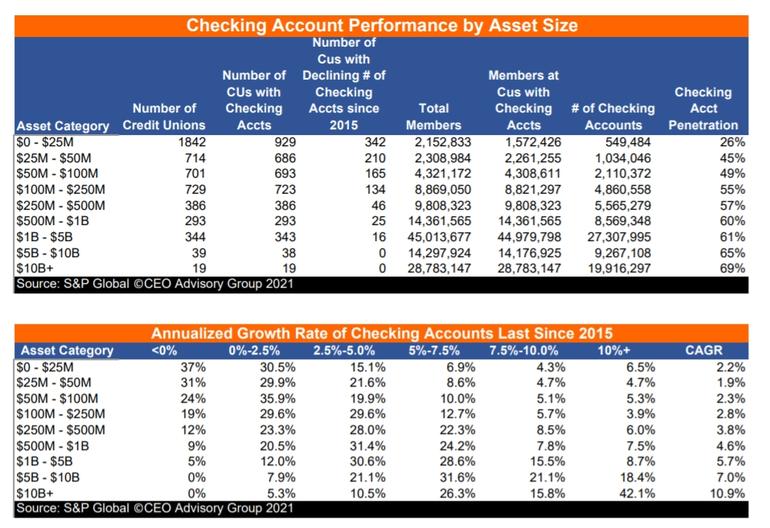
“Look at annualized membership growth since 2015; you're going to see credit unions under $25 million—72% of them have negative growth in that period of time. That's that almost seven years with three quarters of all credit unions at negative growth.
“Continue down and all the way to 100 million in assets, 50% of those credit unions, $50 million to $100 million in assets, are seeing negative growth over that period,” continued Christensen. “It's really not until you get to the over the $250-million threshold that you see you see a quarter of the credit unions seeing significant growth. This, to me, this illustrates a significant problem within our industry—the value proposition that the smaller credit unions are able to offer is not resonating with their members.”
Christensen said it is critical that boards of directors of credit unions that are not among the large shops ask whether their organization can sustain member growth.

Glenn Christensen
“I would say in the years 20 years I've been doing mergers, more credit unions are asking that question today,” he said. “They are saying we might be successful financially, in terms of good net worth, but are we really positioned to do what's in the best interest of our members going forward? Can we continue to sustain or build a high level of growth in the future?”
Widening Gap
Data show the industry is growing at 9% to 10% per year on an annualized basis, Christensen pointed out. “So, for a credit union to be able to at least sustain itself from the industry average for growth they're going to need to grow at about 10%, and that equates to about an annualized ROA of 1%.”
Christensen said it is difficult for small credit unions to generate a 10% growth rate.
“We are really only seeing this kind of growth among the very largest of credit unions, over $1 billion in assets,” he added. “The gap is just going to continue to widen.”