

LAKE FOREST, Ill.–Can overdrafts lead the way to economic recovery—and possibly approach $100 billion in annual revenue across all FIs?

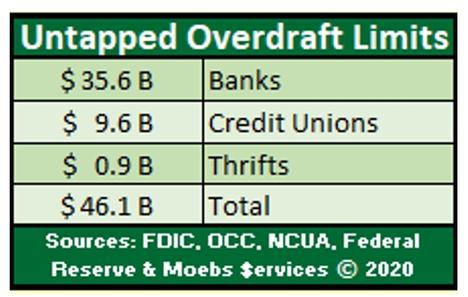
One economist believes that’s possible, stating even as the coronavirus wreaks havoc on the nation’s health and economy, banks, credit unions and thrifts can tap $46.1 billion in unused overdraft limits today to help consumers.
“The nation has over 300 million checking accounts with overdraft limits from $100 to over $50,000 just for consumers, and more for small businesses, notes Michael Moebs, economist and CEO at Moebs $ervices. “This is a financial goldmine for workers to help bridge the war between virus and economic victory.”
Moebs believes no new government program or stimulus checks are needed to overcome the liquidity crisis being brought on by the pandemic.
“In place at depositories are overdraft limits which consumers can use right now. Consumers need only to opt-in if they haven’t already,” he said. “Economist Arnold Kling has floated an idea of less stimulus and more overdraft protection promoted by the Institute for Policy Innovation. Kling has suggested increasing lines of credit for overdrafts backed by the Federal Reserve to reduce risk and avoid losses. The direction is a good one. Yet, the overdraft limits are in place today, with $46.1 billion waiting to be used and no Fed backing is needed.”
Price Decrease Needed
What is needed, said Moebs, is an overdraft price decrease.
“This could either be in the form of a temporary suspension of the price to zero or a lowering of the price,” he said.
A Moebs $ervices’ study of 3,000 banks, credit unions and thrifts shows a median national overdraft price of $30.
“Further research on overdraft cost and revenue reveals cutting the OD price in half to $15 still keeps ODs profitable for depositories, while providing greater value to the consumer in a critical time of need and substantially increases volume,” Moebs said. “Plus, $15 or less is below the $18 average for a payday loan of $100 per Moebs’ Payday Loan Study.”
Up to Four-Billion Overdrafts
In the U.S. during 2019 there were approximately one-billion transactions that required an overdraft, according to Moebs.
“If the OD price was cut in half, the amount of volume could increase up to four billion overdrafts a year,” explained Moebs. “Think of the furloughed or laid-off workers this could help.”
Moebs said depositories can win at the lower price.

Michael Moebs
“With a price cut to $15, banks and credit unions would have to double their volume to break even on a net revenue basis with the previous $30 price,” Moebs said. “Any volume above would add to the bottom line of every depository.”
If overdraft volume went to the maximum from the current level, depositories would increase overdraft revenue from $34.6 billion in 2019 to well over $100 billion. At the maximum volume, OD limits would hit capacity, which Moebs $ervices does not believe would be reached.
Increased Risk?
But, will more overdraft volume lead to more risk?
“Risk in underwriting is critical. While overdrafts by regulation are credit but not a loan, OD underwriting is unsecured credit and risky,” stated Moebs. “Judgmental underwriting should not be used for overdrafts, but rather automated, analytical underwriting to control losses. This is a process which rests solely on FICO scores as the only decision process needed to do OD underwriting.
“The President and the COVID-19 Task Force state the U.S. is in a war,” concluded Moebs. “Overdrafts can help those workers who are not getting paid because they are staying home to win the war. The Moebs study concludes the U.S. will win this war on the economic front by tapping the $46 billion available in overdraft limits, cutting the OD price by half or more and increasing volumes.”