

By Ray Birch
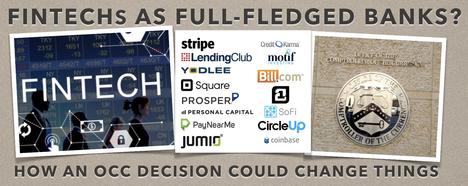
WASHINGTON—Fintechs are typically seen as peripheral competitors by credit unions, but that may change following a decision by the OCC to grant some of the upstarts national bank charters.
The announcement by the Office of the Comptroller of the Currency that it will begin considering applications from fintechs to become special purpose national banks only escalates the importance of CUs devising strategies to address these upstarts.
That’s the opinion of Richard Garabedian, an attorney with Womble Carlyle Sandridge & Rice, LLP, who believes the decision to grant fintechs a limited-purpose bank charter will give them greater ability to expand—possibly even adding branches.
“We don’t know how these fintechs will evolve, but they are getting an assist here to expand and that makes their threat to community financial institutions much bigger,” said Garabedian. “I think over the next three to five years we will see real change, because now you are letting in these companies and giving them a charter that has a lot of power.”
Accelerate Plans
In response, credit unions need to accelerate plans for addressing fintechs and their often creative product and service delivery methods, recommended Garabedian. He said that means CUs considering partnerships with the right fintech companies and also looking at their own products and processes to see how they might use technology to keep pace with the new competitors.
“I think that the fintech initiative by the OCC poses a real threat to community financial institutions—banks and credit unions,” said Garabedian. “You are giving the fintech providers, who are not saddled with bricks and mortar and many of the other costs that come with being a full-service banking institution, the power of federal preemptions.”
Federal preemptions allow national banks to serve consumers largely unfettered by state law.
“So you don’t have to be licensed in every state to do business, there is a cost and burden to that. You don’t have to be slowed down by all the different state laws, as state law gives way to federal law,” said Garabedian.
Credit unions, especially smaller ones, will face the most risk, asserted Garabedian. Specifically, he believes CUs will have a distinct disadvantage over a community bank in battling a bank-chartered fintech because of competitive limitations they face. He pointed to the inability to raise capital beyond retained earnings, FOM restrictions, and the MBL cap.
“In general, credit unions don’t have the same resources as community banks to fight these fintechs,” he said.
Look To Uber

Richard Garabedian
Garabedian acknowledged he could be wrong about his concerns, but pointed to how Uber has disrupted the taxi industry and is causing big problems within financial institutions that make medallion loans.
“Three years ago who would have thought Uber would have done this? We didn’t think much about that company then. NCUA and the banking industry had looked at these medallion loans like they were as good as government securities. Now look what happened,” he said.
But not all fintechs, currently free from banking regulations, will choose a bank charter, noted Garabedian. They must weigh the options of gaining the powers of the national bank charter against the regulation that comes with it, he said.
The OCC has said that companies that seek the new charter will be evaluated to ensure they have a reasonable chance of success, appropriate risk management, effective consumer protection, and strong capital and liquidity. The institutions would be held to the same rigorous standards of safety and soundness, fair access, and fair treatment of customers that apply to all national banks and federal savings associations, the OCC added.
The OCC acknowledges, however, that to approve a fintech charter the agency may need to account for differences in business models and the applicability of certain laws. For example, a fintech company with a special purpose national charter that does not take deposits, and therefore is not insured by the Federal Deposit Insurance Corporation, would not be subject to laws that apply only to insured depository institutions.
Big Fintech Advantage
Garabedian said that part of the deal could be a big advantage to fintechs that are limited in what they offer, essentially expanding but not facing all of the same regulations that cost banks and credit unions a lot of time and money.
Garabedian believes it may take about six months for fintech applications for a bank charter to begin rolling into the OCC. That gives CUs a little time.
“A threat is not something that comes up behind you and hits you on the head, but rather something that starts nibbling around the edges. And then next thing you now it’s on top of you and can’t do a darn thing about it,” said Garabedian. “Credit unions need to get moving, or risk being left behind.”