

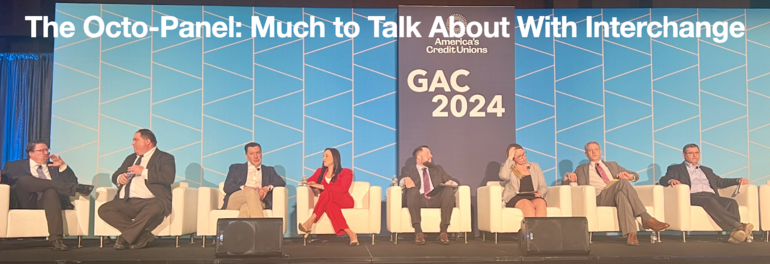
WASHINGTON–The threats related to card interchange are so vast it required an eight-person panel to cover them. And among the points shared: even as efforts are underway to reduce interchange income, for most credit unions, interchange doesn’t cover costs.
The octo-panel took place during America’s Credit Unions’ GAC here and came as numerous, well-funded threats to interchange rules can be found at both the federal and state levels. It’s a fight so full of misinformation, misunderstandings and more that credit unions should not underestimate the task ahead, according to the panelists.
The panel was moderated by Richard Gose of America’s Credit Unions. Panelists included:
- Jason Stverak and Brad Thaler of America’s Credit Unions
- Paul Russinoff, VP-state government relations at Visa
- Sydney Seral, VP-advocacy for the League of Southeastern Credit Unions
- Madison Rose, director of advocacy and counsel for payments and technology with America’s Credit Unions
- Brock McCleary, VP-Poling with Cygnal
- Wayne Grossman, Glen Grossman, director with Cornerstone Advisors
Here are some of the perspectives that were shared:
What Congress Doesn’t Know
“Interchange is an extension of credit and a lot of members of Congress and a lot of state lawmakers really don’t recognize that aspect,” said Gose. “They have particularly zeroed in on the evil duopoly of Visa and Mastercard. The one thing I’d like to say about interchange system this is something that has been a loser for us since Durbin 1.0. Credit unions have been losing money on their card systems. And (Congress is) looking to further push back the revenue stream. And that doesn’t even speak to what going on at the state level.”
Gose noted credit unions have attempted to communicate to elected officials and regulators all they do in the payments space, including frau prevention.
“We need to drive home that this is basically a cost of the merchants not wanting to pay for the cost of doing business,” said Gose.
Here are what the other panelists had to say about interchange:
Brad Thaler, America’s Credit Unions
Thaler urged everyone to get involved, calling interchange “one of the hottest issues on Capitol Hill…Many offices are constantly hearing from all sides on this issue.”
The Credit Card Competition Act, which America’s Credit Unions consistently refers to as the “Big Box Bailout Act,” has slowly picked up co-sponsors in the House and Senate, Thaler said, adding that Senate rules make it much easier to advance the legislation as a floor amendment, something credit unions are especially wary of.
The Good News? Nothingness
“The good news for us is this is probably the most do-nothing Congress ever,” said Thaler, before cautioning there are some vehicles that Sen. Durbin and others may try to target and attach the bill to, such as a farm bill or the National Defense Authorization Act.
Thaler further reminded that the number of merchants in each state far outnumber the financial institutions in each state, and he again urged everyone to get involved.
Jason Stverak, America’s Credit Unions
Stverak said one new “X factor” in the debate is the proposed Capital One/Discover merger and the effect it might have on moving the bill.
“If the argument from day one in passing this bill is the duopoly of Visa and Mastercard, with the merger you’ve got a third rail,” said Stverak.
Stverak emphasized it’s a point of emphasis that CUs need to repeat on the Hill.
He further stated that while credit unions believe they own the high road in the debate, many in Congress see the interchange legislation as a way to “stand up to the woke banks. I have talked to many Republican chiefs of staff who say it terms of pure politics, it can be a winning argument. This fight is not going away. Now fighting in the states, at the local levels, because what can’t be done in Washington can maybe be done in a large city or a small town.”
Stverak further cautioned that Sen. Durbin has said “this is a marathon” and has pledged he will outlast opponents of the legislation who will tire of the fight.
The State-Level Fight
Paul Russinoff, VP-state government relations at Visa
According to Rusinoff, the fight around interchange is national and well-resourced, backed by some of the biggest retailers in the country.
“At the state level we have seen interchange bills since 2006, and since then there have been 65 bills and counting in 29 states. Those bill don’t focus on network routing, they prohibit the collection of interchange on the state sales and local tax potion of electronic transactions. Since 2006, each of the bills has been defeated, but in 2023 there were 14 bills in 10 states and, for first time, they started to advance.
Unlike the CCCA, Rusinoff noted there is no carveout for small institutions from these state bills.
“If ever enacted, it would affect every transaction your members make,” he said. “The second and more fundamental issue is at Visa we process one amount. We don’t know what the service/product cost is and what the tax is. The other thing to bear in mind is large retailers have sophisticated POS systems. They can break out sales tax and pass it on. But small businesses can’t. Their POS systems transmit that one amount. They would have to buy more sophisticated and expensive systems, so it’s disingenuous to suggest small retailers would save money.”
Sydney Seral, VP-Advocacy for LSCU
Seral said the League of Southeastern Credit Unions has responded to interchange legislation using digital advocacy, the “Protect My Card” campaign, op-eds with minority legislators talking about how the bill would hurt minority communities, and grassroots advocacy.
“Credit unions and Georgia and Florida stepped up more than ever. The message we found really resonated was the retailers are asking members to give up their hard-earned dollars for something retailers want for free,” Seral said.
She said the league has further stressed that exempting sales tax from interchange is impossible to calculate, and has stressed with Republicans in particular that this is a privacy issue.
Seral said there has been a pivot in strategy by proponents of the interchange legislation to call for “study committees” that were biased in favor of merchants.
Responding to the Fed
James Akin, America’s Credit Unions
In a do-nothing Congress, the path of least resistance is at the executive level and at the agencies, such as the Federal Reserve, said Akin.
“We are working on a response to the Fed proposed changes to Reg II, which would cap interchange fees on debit card transactions,” he added.
An Issue of Old Data
Madison Rose, America’s Credit Unions
Rose noted the Fed has been working to codify an approach for updating the fee cap every two years based on info provided by FIs of more than $10 billion in assets.
ACU, she said, is unequivocally opposed to the proposal.
‘We know that when the Fed initially issued their regulations in 2011, 80% of authorizations saw complete cost recovery. In the latest report, based on 2021 data, covered issuers are still seeing 77% of those costs,” she said. “We think this proposal needs to be based on robust current data, not 2021 data. This is a nonstarter.
“Third, we know that when Durbin and Reg II went into effect, there was considerable impact on consumers. We expect something similar with the current proposed rule, with the biggest impact on low and middle income consumers.
“That this will help consumers is almost laughable at this point, but it’s not, as this is serious,” Rose said.
What the Survey Shows
Brock McCleary, VP-Polling with Cygnal
McCleary shared the survey below about consumer priorities for credit unions.
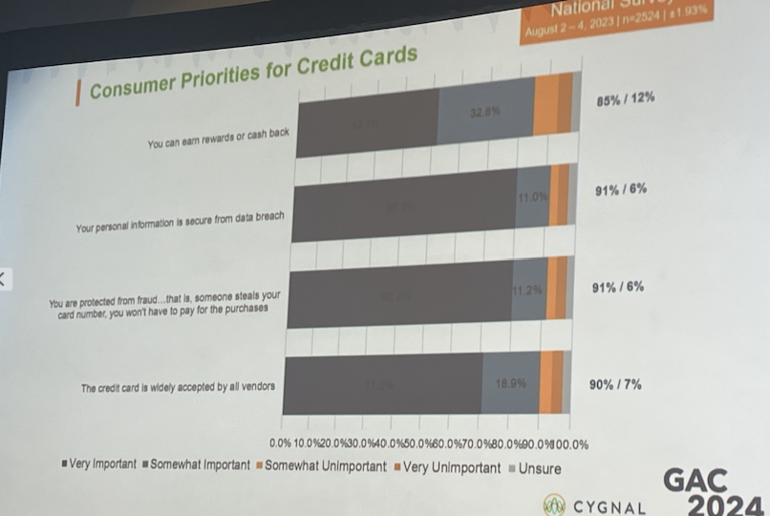
The survey found majority of people have two to four cards, and that older people particularly reliant upon cards.
“Cards are a critical lifeline for people who can’t afford an emergency expense,” he said. “Changes that are proposed are going to meet the most opposition from older folks.”
McCleary pointed to numbers showing that 77% of cards are tied to some sort of reward or incentive, and 42% of cardholders have said those rewards have driven more purchases.
‘No Mandate Here’
According to McCleary, the surveys show the credit card system is rated highly in terms of satisfaction by cardholders.
“There is no mandate here. People are happy with things they feel are important, fraud protection and data security,” said McCleary. “If you want people to continue to be satisfied with the system, the system needs to be able to continue to provide those things. Generally, public policy is driven by a mandate a change, and the industry lacks this fundamental.”
‘A Fraudsters Dream’
Glen Grossman, director with Cornerstone Advisors
Grossman shared these chart, below, which he said summarizes the research conducted by Cornerstone Advisors.
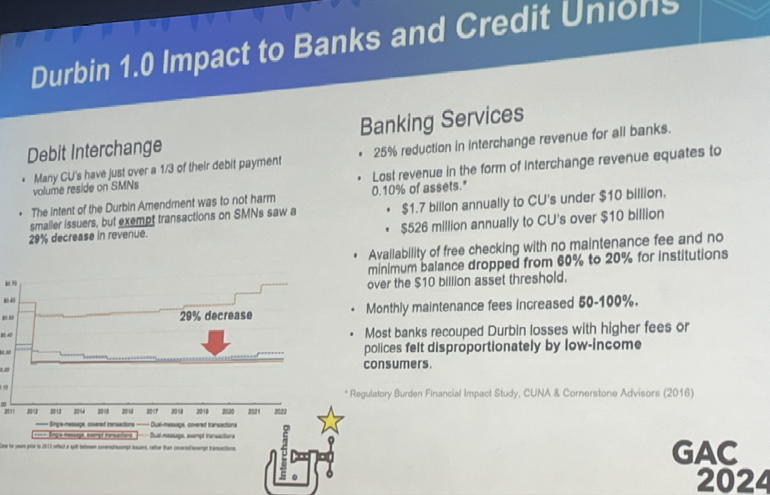
“What Mr. Durbin is proposing is a fraudster’s dream,” said Grossman. “Without a doubt annual fees are going to go up (under the proposal). The reality is we are losing money on interchange. (Card interchange has) been at a loss since 2016, and that is the Federal Reserve’s own data. Between rewards and fighting fraud, interchange isn’t making money.”
The income is coming from card interest only, he added.