

MADISON, Wis.–Extensive new research and analysis that offers a new way of thinking about members along with actionable strategies for winning their business and helping them at the same time has been released by the Filene Research Institute.
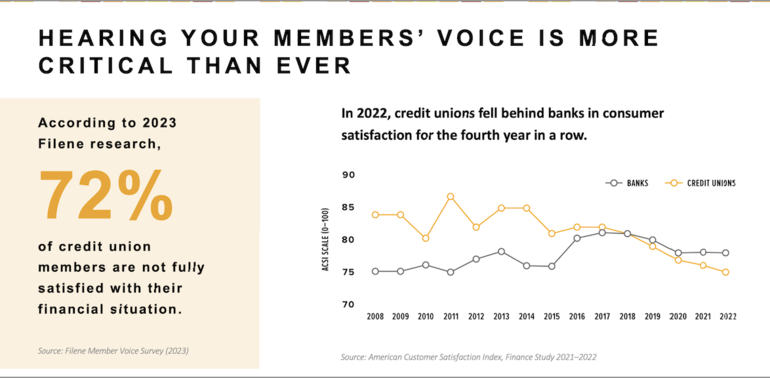
According to Filene’s new Voice of the Member research, 72% of credit union members nationally are not fully satisfied with their financial situation, and as a result say they don’t feel secure, one of the reasons credit unions have seen a continued decline in member satisfaction, according to Caroline Vahrenkamp, advisory services director with Filene Research Institute.
Vahrenkamp unveiled Filene’s new Voice of the Member research findings and specific recommendations during a webinar she co-hosted with Anna Bruzgulis, research manager with Filene.
The broad effort was launched in part to address what Vahrenkamp called the “diminishment” of the credit union brand and the value it represents to members and consumers.
Having the Ability ‘Not Enough’
“A lot of the conversations we've been having in this movement for the past 20 years have been about how do we use the data we have,” said Vahrenkamp, pointing to the big investments credit unions have made in data warehouses and other infrastructure. “It's only useful if we're using it. It's not enough just to have the ability…What we're proposing is a way that we can use your data not only in a descriptive way, but in a predictive and prescriptive way.”
And the key to doing that, Vahrenkamp suggested, is segmentation--but not the kinds of life stage segments credit unions have often turned to in the past as part of their traditional marketing strategies.
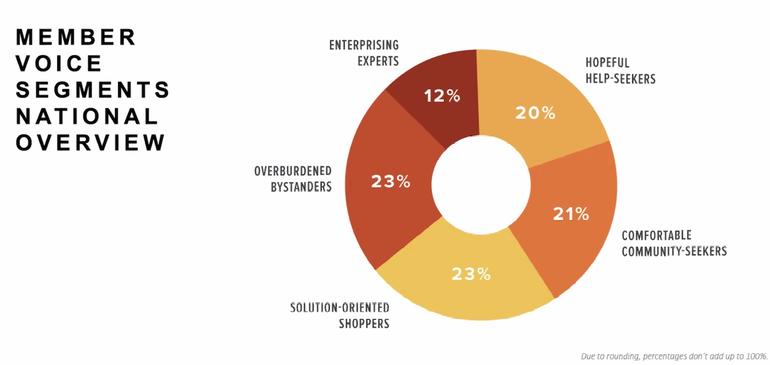
What Filene is reporting it has discovered, according to Vahrenkamp, are five key attributes that make for effective member segmentation. Those segments are outlined in the graphic below and, as Vahrenkamp noted, they are not about age or income demographics.
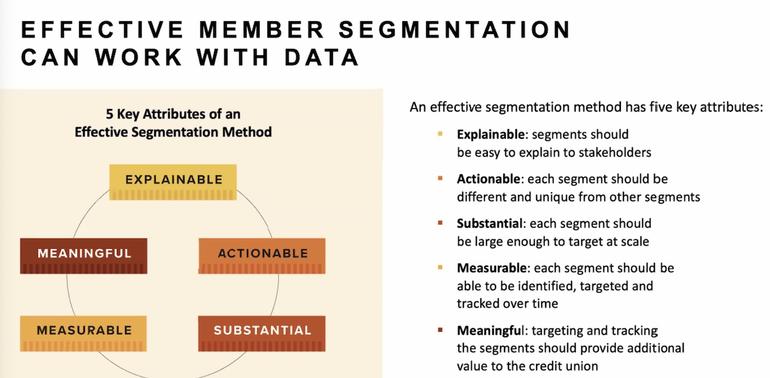
She described each of the segments as actionable, separate, unique and measurable.
“Demographics don't predict member needs, attitudes or behaviors,” said Vahrenkamp, stressing that point. “You often have situations like my 74-year-old father, who you would think would fall into a demographic that would be branch-loving and want a lot of communication and one-on-one time. No, he doesn't want to talk to anyone; he wants to do everything on his mobile phone; he wants to do everything digitally. He's not at all what you would expect from someone of his age and income to behave like.
“You have countless numbers of your members that are the same way. We're painting with too broad a brush,” Vahrenkamp continued. “The other problem we have is that age and income is meaningless if you're in extreme parts of the country. I don't know how many credit unions I've talked to in California who have said age and income demographics are useless.”
The New Thinking
The idea now, according to Vahrenkamp, is to move beyond psychographics for effective action a credit union can take to drive results for both members and itself.
Vahrenkamp outlined the challenges of segmentation in the slide below.
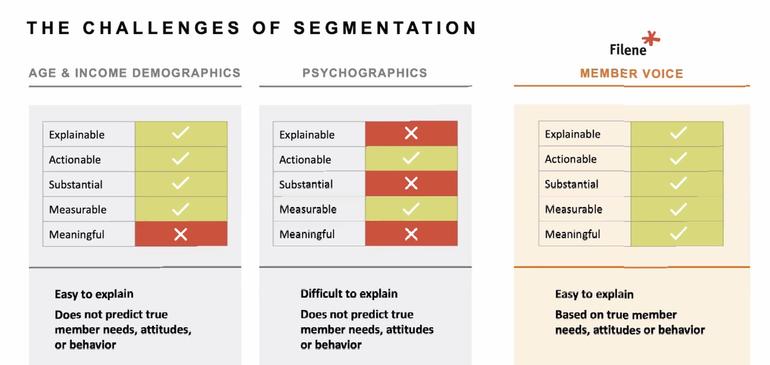
To get beyond those challenges, Vahrenkamp said Filene is strongly recommending credit unions instead turn to “Member Voice” for guidance.
“It’s explainable, it’s actionable, it’s substantial, it’s measurable and it’s meaningful,” she stressed again. “You will understand how your members think. Doing that will give you advantages over competitors.”
Eight Dimensions, Five Segments
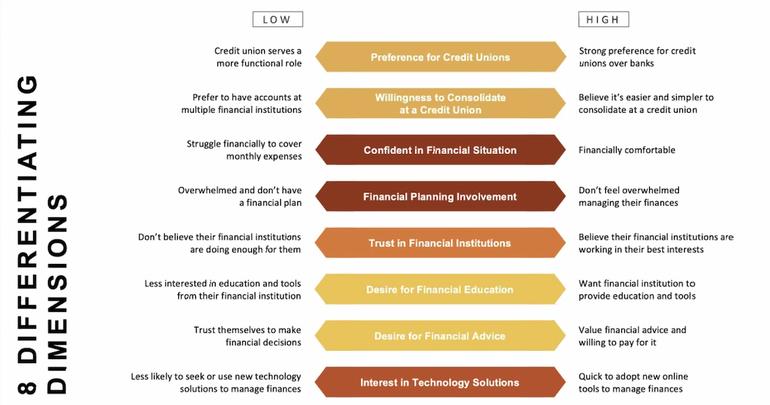
After explaining that any member can be defined based on the eight dimensions outlined in the slide above, Bruzgulis said Filene identified the five segments it believes a credit union’s data can be used to identify, and then act upon.
The Hopeful Help Seekers
The first segment is the Hopeful Help Seekers, whose attributes are outlined below.
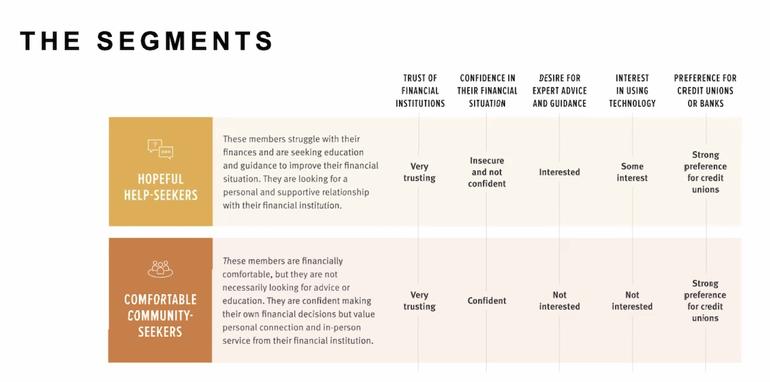
“These are members that really are struggling with their finances,” said Bruzgulis. “Their financial situation could be better, and they are also actively seeking education and guidance to improve their finances. They know their situation can be better and they want help to get there. They're really looking for a personal, supportive relationship with their financial institution, and the great news is their financial institution of choice by far is a credit union.”
Bruzgulis stressed this segment is seeking expert advice and, while they’re not opposed to technology, it’s not something that “pops for them.”
Comfortable Community Seekers
The second segment identified in the Filene research is the Comfortable Community Seekers.
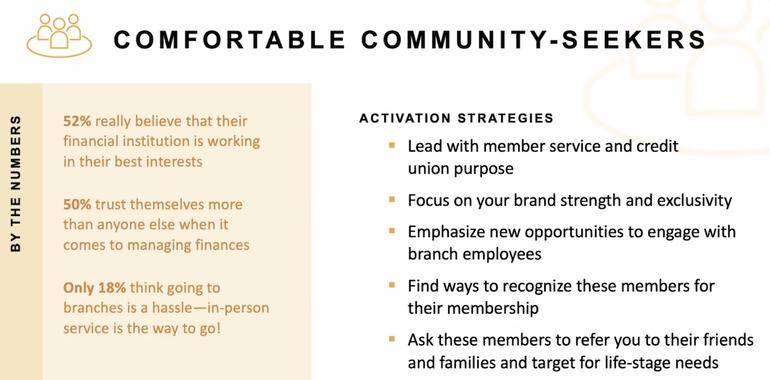
This group also has a strong preference for credit unions, “but beyond that they're quite different. These are financially comfortable members,” Vahrenkamp explained. “They're not really looking for advice, they're not looking for education. They're confident in their own abilities to manage their finances. They're looking for connection, they're looking for in-person service and personal service, even if it's on the phone. These are the members that are most excited that you know what their name is. They don't really care about technology and they don't need your advice, but they want to be part of the community.”
Activation Strategies
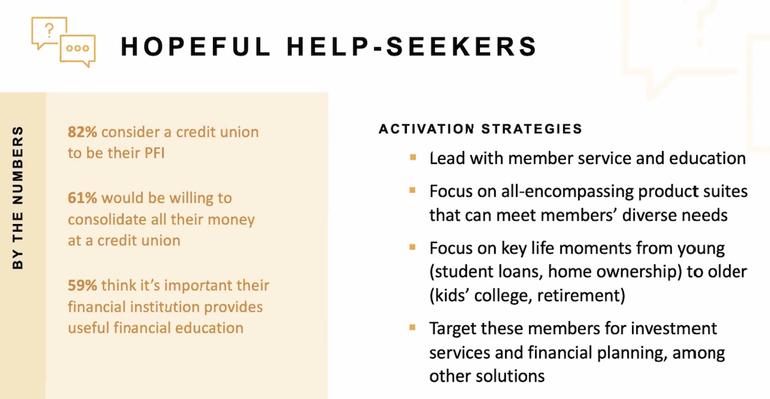
According to Vahrenkamp and Bruzgulis, other action items of note with the Hopeful Help Seekers include:
- “How do we activate this group? We lead with member service and education. This is a group where, when we're communicating with them, we're talking about (how) we’re here to help. Focus on all-encompassing product suites that can meet their diverse needs, don't just sell a product.”
- “They’re looking for help at really important parts of their life…So, think about their life moments. This is a place where demographics can help, although oftentimes people are getting older later than they did before.”
- “They don't mind going to a branch. They trust themselves managing their finances, but they trust you, too.” The best way to position the credit union is as a “good neighbor” in which the credit union should lead with service. “This is a group that maybe you send them a holiday card every year, a ‘Thank you for being a member.’ They'll eat that up and, again, they tell their friends and that's a good way to get growth out of this group.”
- Mission, vision and purpose resonates with this group.
Solution Oriented Shoppers
The Solution Oriented Shoppers are the third segment ID’d by Filene. It’s a group whose traits are outlined in the slide, below.
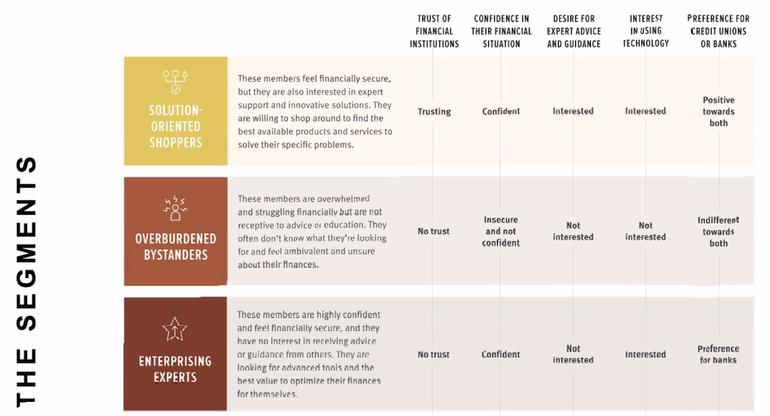
According to the presenters, this group is looking for a very specific solution to their needs, rather than gravitating toward one type of financial institution. Their biggest differentiator is just how much they're looking for expert advice and guidance. “To them, this is something very important as they shop around.”
Vahrenkamp said most credit union marketing and communication is biased toward Solution Oriented Shoppers.
Activation Strategies
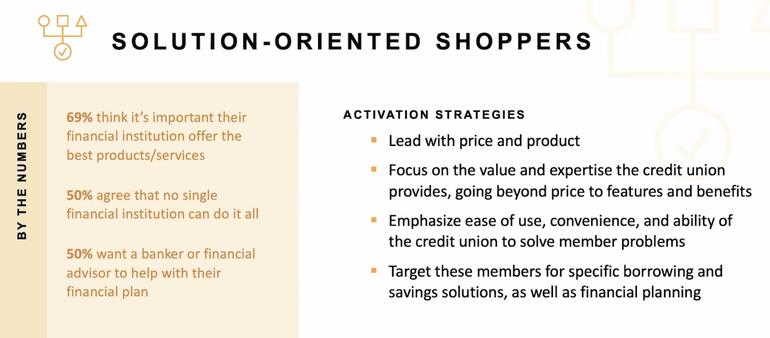
- This is a group that believes one financial institution can do it all, so the credit union should position itself as such.
- 50% are also looking for advice and want a banker or financial advisor to help with their financial plan.
- “This is the group with which you lead with price. The APR on a certificate, the pricing, the best deal--this is the group that cares about that. They shop around.”
- “When we talk about price and product and value, that includes convenience and ease of use. These are busy people. We found this is the segment that's most likely to have more products at the credit union.
Overburdened Bystanders
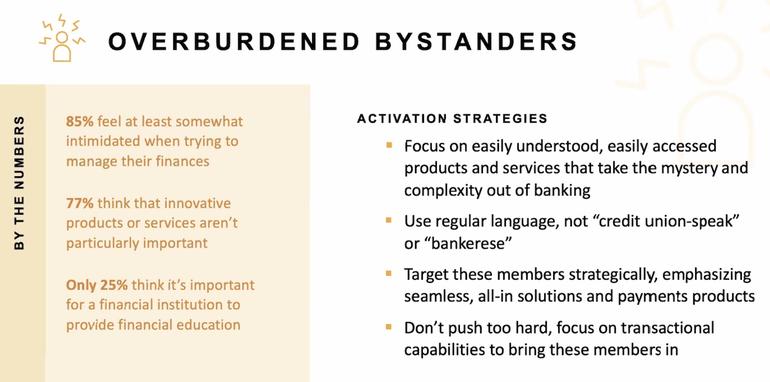
The fourth segment identified by the Filene research is the Overburdened Bystanders, who Vahrenkamp said are insecure and not confident, but also “not really looking for help because it's just too much for them. There's probably an opportunity to move some of these members into the Hopeful Help Seekers by showing them that it's not that scary. But right now, the fear and the anxiety is just too much for these overburdened bystanders.”
Activation Strategies
- This is a group that feels “there's so much coming at me I don't know what I should start with. I know I can be doing better, but I just don't know where to start.” The credit union can provide that place to start.
- “Innovative products and services aren't particularly important. This comes back to that sense of being overwhelmed. They are truly, truly, truly just looking for you” to help simplify finances. “They don't want to have a lot of information coming their way.”
- “They're not looking for constant promotions and rates and ‘check out these new products’.” Focus on easily understood terms and language. “They often have no idea what you're talking about. They don't understand things like APY, or terms and fees and conditions, or what a HELOC is. If you've got a big group of these members, think about ‘How do we clean up our lingo so that it is straightforward and basic in English, not in credit union speak.”
The Enterprising Experts
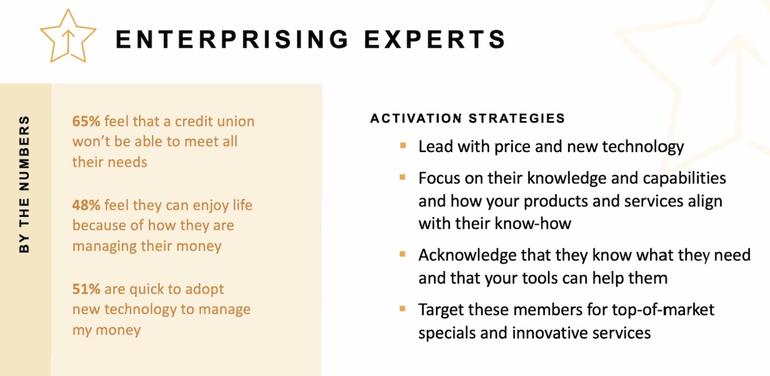
The final consumer segment identified in the Filene Voice of the Member research is the Enterprising Experts, and they represent the toughest sell for credit unions, according to Bruzgulis.
“They are secure in their situations and because of that they really don't have a lot of interest in receiving guidance from others,” Bruzgulis explained. “They really believe that they themselves have the capability to make financial decisions on their own and they embrace that. They're always looking for advanced tools and technologies and they really are just seeking to optimize their financial situations to their maximum levels.”
Lack of Trust
Bruzgulis said it’s a group that also doesn’t trust financial institutions, but when they do they have a preference for banks over credit unions.
“If you're looking to try to appeal to this group, you have to think about a very specific niche,” Bruzgulis recommended. “Often, that an online, high-tech solution that might appeal to them. They're not going to be brought in by an ad for a best rate or general promotion.”
Activation Strategies
- While Enterprising Experts represent just 12% of credit union members, they are also big asset-holders. But oftentimes, credit unions don’t have a lot to bring to the table with this group and often lead with price and new technology. “It's got to be splashy, it’s got to be new. Focus on their knowledge and capabilities and how what you have aligns with their know how.” It’s “you know what to do and we can help you do that.”
- “This is the group that when you have that fantastic special they'll be interested in that fantastic special, but they may not be interested in the daily regular stuff.”
Some Final Thoughts
Bruzgulis returned to Vahrenkamp’s earlier point of demographics not being the “be-all, end-all” of the story and said she if hopeful the Filene research will “challenge some assumptions,” such as it isn’t just those who are young who are struggling financially.
“When we dug into the demographics and the age distribution of that segment, we actually found that 50% of Hopeful Help Seekers are 50 and older,” she said. “That is a huge departure from what an assumption or bias might initially lead us to believe about this segment.
‘Think About What You’re Missing’
“In the same way, when we're thinking about Comfortable Community Seekers who are really looking for that point of connection, who like to often go into their branches, we might assume that this group is often older, but actually one-in-five is under the age of 40,” Bruzgulis continued. “Just think of the different members that you would be missing if you only focused on age when you're looking for deposits or promotions or channel marketing.”
To that end, she noted that many of the Overburdened Bystanders are actually high income-earners.
A Practice to Avoid
Vahrenkamp said one practice to be avoided is to think of segments as pictures of people, saying assigning a persona puts people into boxes that are often wrong.
“Understanding how members chose you can help you understand who your future members are going to be,” said Vahrenkamp.
The two presenters said the question credit unions need to ask with these segments is “why choose us,” and then follow up with tailored offerings that show an understanding of how those segments feel and think.
The Voice of the Member research is designed to provide answers to those questions, according to both presenters. They added more information based on the research is on its way, along with additional actionable strategies.
Five CUs Part of Pilot
Filene has been working with five credit unions on the Voice of the Member research—A+ FCU, Elements Financial, Truliant, Sound Credit Union and Vantage West—as part of a broad effort that involves combining a member survey with member transaction data and using machine learning to build an algorithm to “type” members to their segment.
“We’re going to make this as usable as possible,” said Vahrenkamp.
Filene has made post-webinar resources available here.