

By Ray Birch
WASHINGTON—Buddy Gill says there are several “little known facts” that led to the passage of the Credit Union Membership Access Act, but none bigger than the story of the hot dog vendor, who for a short while became the face of the Credit Union Campaign for Consumer Choice.
In 1997, Gill was brought in by CUNA President Dan Mica, NAFCU CEO Ken Robinson and CUNA Mutual Group’s Larry Blanchard to help assist with the campaign, a coordinated effort between CUNA and NAFCU to drive passage of the Credit Union Members Access Act. Gill emphasized that attacking the banks was never considered a winning strategy.
“One of the first things I did when I came to the campaign was shorten the message emphasis,” said Gill, a former senior advisor to two NCUA chairmen, who in 1997 headed Gill Consulting Group. Today he is a consultant to credit unions. “When I got there the campaign was in a way beating up on the banks, which was not going to get us any Republican votes for the bill. We needed two wings to fly the plane—we had a left wing but did not have the right wing totally in place. Trying to demonize big banks for picking on little credit unions as the fulcrum communications tactic would not get the kind of traction we wanted.”
Bankers Taking Shots
But the bankers in the late 1990s were glad to take shots at credit unions, noted Gill. Bankers took out a full-page ad in the New York Times—it was a picture of a hot dog vendor saying, essentially, “I will pay more taxes this year than the entire credit union industry,” recalled Gill.
“So we went out and found a real hot dog vendor who had been laid off from work and then started his own hot dog stand,” said Gill. “No one would lend him money for his business except his credit union. No one believed in him except his credit union. His name was Frank. As I remember, Frank, in the ad, said he repaid his loan but that he could never repay his credit union for believing in him. We ran that ad up the Hill, through the ranks of
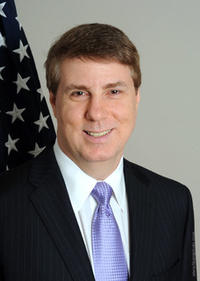
Buddy Gill
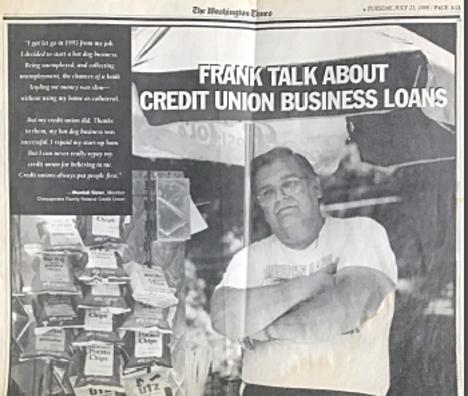
CUs' advrtising response to bankers' 'hot dog vendor' ad
Congress.”
Gill said that ad killed the banker attack on the CUs “right then and there.” An attack that could have posed a serious threat to passage of HR 1151.
“We changed the subject from who’s paying taxes to who’s serving members and that banks were not making loans to people like Frank,” said Gill.
While Gill said the hot dog vendor ads may be recalled by some within the movement, other events occurred behind the scenes that many will not recall, or ever knew occurred, he said.
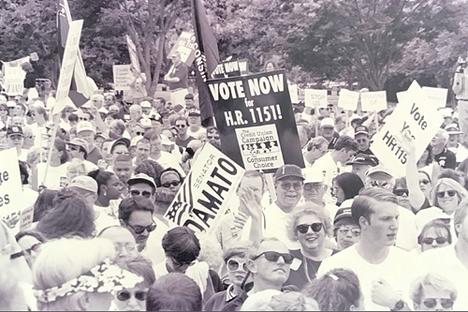
“There was a point in the campaign where we had our bill going, we had started building momentum after (Republican House Speaker) Newt Gingrich stood up at the GAC in 1998 and said he was behind the bill and that all Republicans should back it as well,” said Gill. “But at that time the House was already trying to pass HR 10, which would eventually become the Gramm-Leach-Bliley Act.”
House Paying Attention
Gill said there was an effort rising in the House, noticing the strength of the credit union grassroots efforts, to link HR 10 to HR 1151.
“They wanted to use the CU grassroots efforts to also fuel the passage of the big corporate bill that would help the big banks and insurance companies,” recalled Gill. “We had to kill that effort, and we did. But it was not pretty. There was this calculation by House leadership, someone got the idea, saying, ‘This credit union grassroots effort is the biggest thing we’ve ever seen. We have to tie these two bills together and get them both passed.’”
But Gill said the credit union lobby “screamed bloody murder, and stopped it. I think we stopped it in the Rules Committee, if my memory serves me correctly. People forget that those two bills almost became tied together, and if that happened that would have seriously jeopardized HR 1151.”
Gill said that another story not many people outside Washington know is that when HR 1151 moved out of the House to the Senate, it had in it Community Reinvestment Act requirements for credit unions.
“Joe Kennedy (D-MA) insisted in putting it in for the Democratic side, and this is why Ron Paul (R-TX), who was really a credit union champion, was one of the seven or eight people who voted against the bill on the floor of the House,” explained Gill. “Philosophically, he could not stomach the bill having CRA for CUs.”
Senate Committee
When the bill reached the Senate it went to committee.
“And the Republicans, led by Phil Gramm (R-TX), pushed the MBL language in the committee. Al D’Amato (D-NY), a credit union champion, voted to keep CRA in because he thought it would kill the whole bill if it was pulled out. Gramm said he would pull it out on the Senate floor, and he did. When the bill got to the floor he had the votes and pulled CRA out of the bill. A lot of people don’t remember this.”
Gill also recalled how the massive grassroots letter writing campaign was likely the last of its type, since after the attacks on the World Trade Center in 2001, mail was irradiated as it arrived in Washington, which delayed it significantly, and the use of email also exploded.
“That was really the last big gasp for that kind of mail campaign,” said Gill.
But what Gill hopes those in the movement remember the most is that credit unions used “every tool in the toolbox—grassroots support, polls, paid television, print, earned media and events, coalition building, phonebanks and more. And the bankers, in the end, grudgingly gave us credit for that.”
Hard To Say No To CUs
Gill said that in the end it was very difficult for members of Congress to say no to the massive credit union constituency.
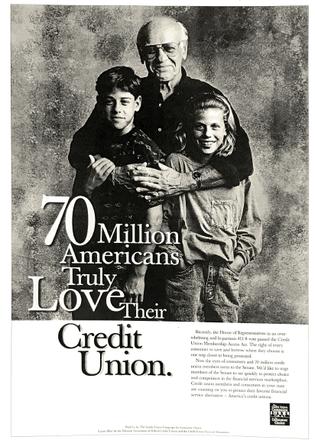
“People talk about the grassroots, but what credit unions did really well was mobilize their SEG groups,” said Gill. “Those SEG groups were really powerful and hard for members of Congress to say no to. When you have ten to 12 of the largest employers in your district supporting credit unions and putting their names on CU ads, saying, ‘Hey congressman, we need your help. We want to make sure that we can keep our people in credit unions. We need Congress to fix this so people can stay with their credit unions.’ That is one of the biggest things that got the Republicans on board. They knew credit unions were the little guys, but that we had 1,000 Davids to one bank Goliath.”