

PARADISE ISLAND, Bahamas–Are you influential, or really just a persuasion steamroller when it comes to leading your team or organization? Your future depends on it, according to one person who has spent 20 years studying how influence works.
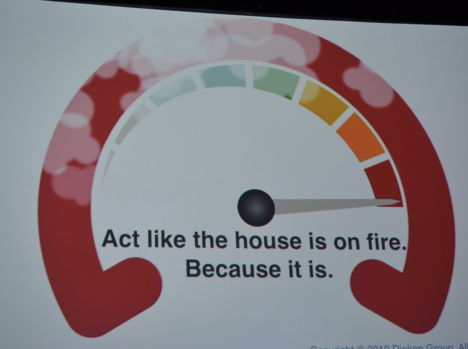
Speaking to the World Council of Credit Unions’ World CU Conference here, Connie Dieken—founder of strategic advisory firm The Dieken Group and Influenc3 360—told representatives from more than 60 countries that with change coming at people In organizations faster than ever, the question everyone must ask is this: “Are you going to lead the future and bring people along willingly where they are committed to helping you in this transformation, or are they going to come kicking and screaming and are just complying with you? I advise you act like the house is on fire–because it is.”

For credit unions, it isn’t just banks constantly “plotting” their demise, there is overwhelming technological and new competitive changes that must be dealt with by leaders who must “persuade” their teams to buy into the strategies needed to respond.
One frequent problem, suggested Dieken: “The fact is people are trying to influence a world that no longer exists.”
Two Types of Leaders
To be influential in a new world, Dieken urged her audience to imagine two leaders: one leader is dealing with things that are very hot and heavy right now. “This leader talks people into doing things. They are like a firefighter, constantly chasing and putting fires out.”
Leader two, said Dieken, approaches things differently, with the team taking the initiative. Under this approach, issues surface and are resolved early. “This person earns commitment from their people,” she said.
“What is the difference?” asked Dieken of the two types of leaders. “Leader one is persuasive and goes for short-term goals. Leader two is influential because he/she goes for sustainable gains.”
The Trap
The trap of persuasion, explained Dieken, is that people/employees are vulnerable to the next persuasive person who comes along.
Leaders who are persuasive rather than influential leave their teams “swinging in the wind and very, very anxious. They don’t know what they are supposed to do next. They don’t know why. That’s why influence is so important. Influencers shape the future. Persuaders maintain the status quo. So I ask: how are you leading? Are you helping people to maintain the status quo right now? If so, it’s inefficient and often exhausting.”
Influential leaders create more efficient organizations because employees take initiative on their own and shape the future.
Dieken clarified that in many short-term transactions, such as trying to get a room upgrade at a hotel or get an auto dealer to throw in some extras, being persuasive makes perfect sense. But longer-term scenarios demand influence, she said.
“To be influential, I’d like to make the case to choose. Stop persuading your teams,” offered Dieken. “Influencers don’t’ play the game. They changethe game. That is what is occurring right now.”
Where to Start
The very first person who must be influenced is “yourself,” said Dieken. “If you haven’t bought in and aren’t convinced that you have to lead this, you are not going to succeed. People will smell it on you like a dog. It’s up to you to lead your teams through these changes.”
According to Dieken, her study of more than 100,000 leaders of what makes people influential comes down to three factors that are a skill that can be learned, and they are composed of the three C’s.
“There is a pattern of three things influencers do, and they do them in a particular order,” she said.
Those three C’s:
Connect. “There is a core. To connect with anyone you create openness. It’s your ability to engage anyone, regardless of their position or power. People who can connect are on the first step to influence.”
Convey. “Once an influencer has made a connection, they move on to the conveying of information,” said Dieken. “What does that mean in this context? It’s about creating clarity and framing the right content in the right amount. Do you naturally streamline, or tend to share too much/too little?”
Convince. “Here is the dirty little secret of convincing,” you don’t convince anyone of anything--you convince yourself. You’re the only person who makes that decision inside your head: yes I’m in, or no, this isn’t doing it for me. The great thing is you generally don’t tell people.”
Is it Working?
So how does a leader know if others have been persuaded? Dieken said to look for people offering specifics in response, instead of just saying, “I love it.”
“Convincing is the ability to inspire commitment so that people will choose to take action,” she said. “But research shows many people who think they are convincing are really just steamrolling people. Do people commit, comply or ignore?”
How to Execute
To execute on the three C’s, Dieken offered this advice:
- To connect and capture attention, she said people have to care. “Link with their values. Combine what drives them with what you want.”
- To better convey information, Dieken said it requires a new, more concise approach. This is a frequent problem point, she said. “When you convey well, you have to do the heavy lifting for people,” said Dieken. “People are not listening closely to you; they are skimming your emails. You have to be in control of this; if you confuse, you lose. You have to simplify to amplify.” One tip: pictures work best. The brain processes visuals 10x faster than information in other forms. Another key: make points in threes.
- To better convince, Dieken reminded leaders to remember where subordinates’ minds are. “We are living in the age of anxiety. People are so stressed out with all of the changes, and we don’t seem to acknowledge that as bosses. You may not recognize how much people are stressed around you. The most prescribed medication in the world is anti-anxiety medications. What you are putting on people now and for the next few years are going to be major changes. People don’t know what to do. They worry they are going to lose their jobs and aren’t up to the challenge.”