

SAVANNAH, Ga.–Speaking almost one year to the day since customers of Silicon Valley Bank withdrew some $42 billion in deposits over just a few hours, leading to the bank’s collapse, Vince Passione told credit unions here they are going to have to be rethinking their deposit strategies--and that includes using loans as an enticement.
During a session on “Deposit Growth and Retention Strategies in a Falling Rate Environment” at America’s Credit Unions Strategic Growth Conference, Passione, CEO and founder of Lendkey, noted credit union core deposits saw record growth in 2023.
But it came at cost—as in cost of funds, as well as the changed deposit mix. He said last year the cost of funds was up industry wide and averaged approximately 218 basis points.
“Sixty percent of deposits are now held at major banks,” he said. “In 1990, regional banks, community banks and credit unions had branches in places many of those money center banks didn’t think were important. But those branches as a form of acquiring deposits have become less effective, ergo, those large banks have become better at getting deposits.”
It isn’t just the big money center banks have become deposit magnets. Passione pointed to apps such as Venmo and Square that are also increasingly grabbing consumers’ funds.
“Consumers don’t see much difference between Venmo and a checking account,” he said. “You can do things with Venmo in that one app that you would have to open up several accounts with traditional financial accounts” in order to do the same thing.
The ‘New Concierge’
According to Passione, the next economic cycle will mark “the end of the lazy consumer.” He urged credit unions to be thinking about:
- Open banking. “This will remove the friction of how people move money.”
- Real-time processing. This will improve the speed at which money moves.
- Generative AI. “This is going to create this new concierge that consumers can use, and when go to bed at night it’s going to sweep their deposit accounts to where they can get the highest interest rate and automatically refinance all the loans.”
In short, Passione said, the deposits of the future are “going to be less sticky.”
The New Deposit Normal
Looking forward, Passione said the “new normal” environment for credit unions will mean:
- Cost of funds will be much higher
- There will be increased focus on operating efficiency
- Deposit retention will require constant vigilance and new strategies
- New member acquisition and relationship-building strategies are critical
When it comes to deposit gathering, Passione said many of Lendkey’s clients have been using lending to reward new deposits or to attract new deposits.
As an example, he shared a case study from Navy FCU and its relationship recognition program in direct auto lending, an area where he acknowledged it’s “difficult to be successful,” especially for CUs that lack Navy FCU’s heft and national reach.
Navy FCU, the world’s largest CU, did $2 billion last month in direct loans.
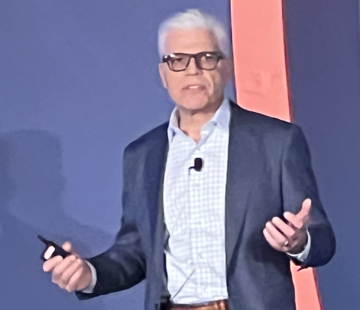
Vince Passione speaking to Strategic Growth Conference in Savannah.
“They offer programs to incentivize members and deepen relationships,” he said. “They do win at the dealership. In some cases, that’s difficult to do because of cores, but some credit unions are using open banking so they don’t have to go to core to get business.”
Other issues touched on by Passione included:
Embedded Finance
Passione also urged credit unions to be paying attention to embedded finance options. Embedded finance is a nonfinancial software platform that offers adjacent financial services as part of the customer journey.
In addition, he pointed to POS lending.
“To me this is what credit unions do best. It’s being a community lender. It’s working with merchants in your area to offer loans,” he explained. “It’s a win win win. It’s a win for the member. It’s a win for a contractor. And it’s a win for the credit union. You get these loans and you get your brand out there in front of members.
“And there is something else you get out of this and we are working with our clients on this,” he continued. “Most of these merchants are small business owners. They need working capital lines. They need Treasury services. As a result of helping them on the POS side of the business, you can engage them in other business banking.”
Getting Younger
Every credit union is seeking to attract younger members, and yet less than 5% of Gen Z and Millennials belong to a CU, Passione pointed out.
“It’s tough. But there is a solution. And that is student lending. The headlines are all about federal loans. That has nothing to do with private loans,” he said. “Private loans are underwritten, credit based and 90% are co-signed. In refinance, 40% are co-signed. They are typically given to someone out of school and working. This is a big market. These are your members who have a crisis and where credit unions do their best.”
Passione said the in-school market is a $130 billion lending market that grew 70% in last decade, yet credit unions have less than 4% share.
Lifetime Value
“The lifetime value of the relationship is high. Our records show about 1,600 credit unions will refer the member to someone else, and then wonder why they can’t get relationship with them,” Passione said.
He noted two-thirds of those borrowers get a checking account with the lender.
“There is upsell and cross-sell with lending products. These are very discerning shoppers,” he said. “If you get them, great, but you have to find ways to keep them.”
Some Things to Think About
Passione offered this advice to be thinking about moving forward:
- Accept the new normal and don’t wait to adapt.
- Historical credit union differences, like trust, lower rates and fees, financial education, and putting the member first, are still key differentiators
- Leverage your lending programs to attract the members of the future and retain/reward your loyal members
- Use embedded finance techniques to create a community lending ecosystem
- Partner to innovate quickly and cost effectively