

LONG BEACH, Calif.–In what were often “candid” remarks here, one person told CU leaders they can’t allow 2023 to become another missed opportunity similar to that of 2008, even if it requires some tough “soul searching” involving the “good, the bad and the ugly.”
Speaking to NAFCU’s annual conference, Pete Hilger, CEO of Allied Solutions, offered some frank assessments of where credit unions stand, opportunities he believes they are missing and threats that are not seeing an adequate response, while also offering an overarching theme of where he sees a promising future for credit unions if they respond in the right way.
Noting he has been involved in credit unions for 33 years, he said he’s seen the “good, bad and the ugly.”
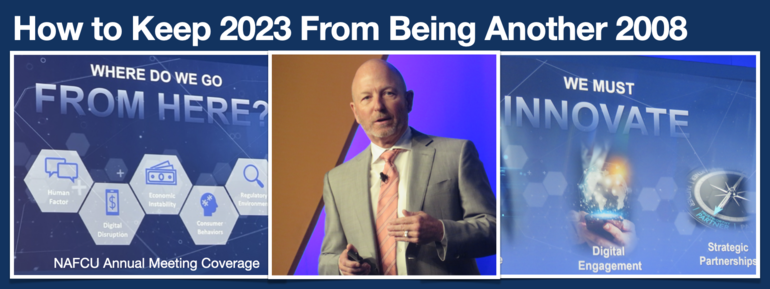
“You have a wonderful opportunity, but you have some challenges out there, and the first one to think about is the human factor,” said Hilger.
The 5% Struggle
That human factor includes not just the debate around working remotely vs. returning to the office (he personally favors the latter), but the fact organizations are struggling to find people, period. He said approximately 5% of the positions at Allied are currently unfilled.
“So, what you have to do is you have to start to disrupt things, you have to start looking at what you can do digitally to make your organization less dependent on the human factor,” Hilger stated. “You’ll hear me say this a couple of times today. When you start talking about digital, start talking about artificial intelligence.”
That doesn’t mean everything will go smoothly, he reminded.
“Things are going to go wrong. It doesn’t matter how much you prepare, how much you plan, things are going to go wrong. The difference is with technology you can fix it and it stays fixed in most cases. I think that’s an important thing to remember as you start to innovate and focus on how you’re going to take advantage of this great opportunity that you have today. Not tomorrow. Today.”
All That Data
One of those opportunities can be found in all the data that is at every credit union’s fingertips, he said.
“Find out how to make it meaningful,” he advised.

Pete Hilger speaking to NAFCU meeting.
As an example, he said his company and others it works with is able to use data from various sources that is just related to automobiles to know who is getting married, who is having children and more.
Brand & Marketshare
According to Hilger, credit unions do not sufficiently invest in their brands. That includes sticking with names that imply limited fields of membership or that don’t make clear it’s a credit union, he said.
He urged every credit union to understand who and what it is as well as its value proposition, adding, “You can’t be everything to everyone.”
“You can't be cheap about it. You’ve got to spend the money to get communities behind it and you have to understand what your mission is and where you're going to fit in within the marketplace,” Hilger told the meeting.
Moreover, added Hilger, a “candid” observation from the standpoint of Allied Solutions indicates many CUs are simply “not very responsive from a partner standpoint” when it comes to getting phone calls returned or responding to other requests.
“We're trying to help you guys out and there's (other CU) partners that are trying to help you out that are leaders in this industry,” he said. “You need to focus and don't be afraid to leverage (them) and make some decisions, because this window will close like it did in 2008 and it'll close fast, because the companies that you're competing with on market share have almost unlimited resources.”
‘Blank Faces’
After sharing findings showing the strong erosion in trust in banks by consumers, Hilger said, “If that’s not an opportunity and if you don’t wake up and take advantage, that’s a big , big mistake.”
And yet he noted that underinvestment in brands can be seen in something as basic as when he mentions credit unions to people he meets and the response is a “blank face.”
While Navy FCU can afford to run advertising nationally, Hilger said nearly all other credit unions cannot. The solution, he believes, lies in “that partnership piece.”
“Trust is one of the greatest assets you have because your members do trust you,” Hilger said. “Your brand is absolutely invaluable and you should be leveraging that every day. There are many consumer-friendly tools out there, but you have the big one--you actually care about the financial well-being of your members. You need to somehow figure out how to get that message out to potential members.
Pro’s, Cons & A Big ‘Eye Opener’
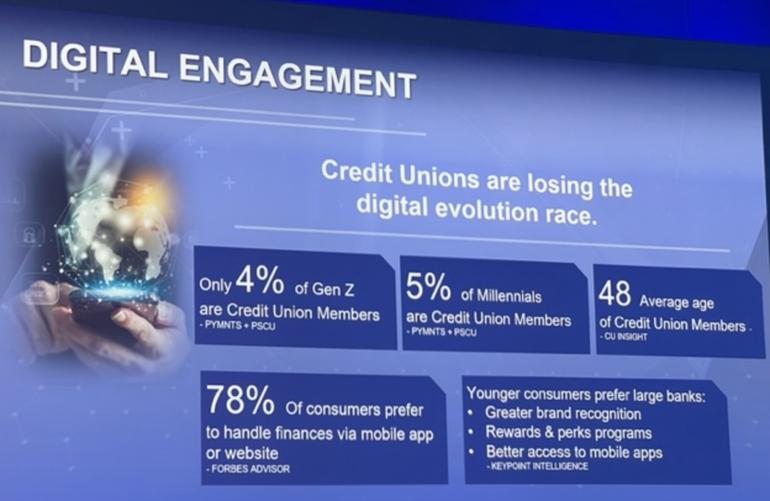
Those are the pro’s in favor of CUs, Hilger said. But the “cons” include the number of people who want to use mobile banking who are primarily younger, even as the average age of a credit union number is between 48-52 years old.
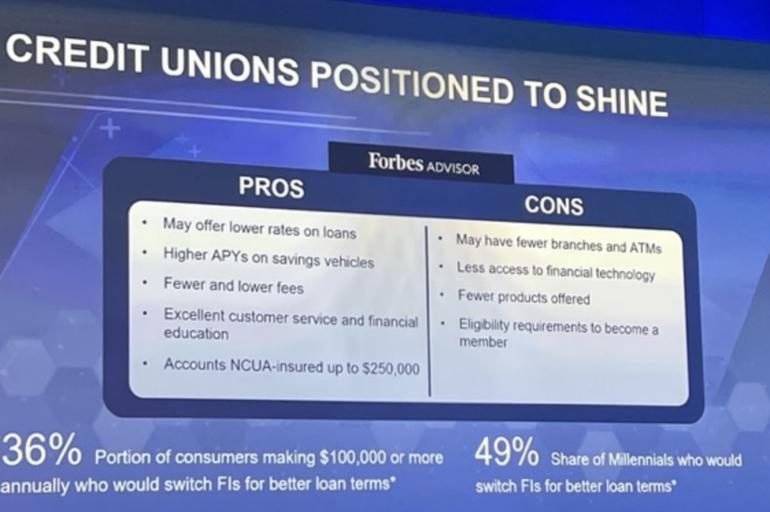
Often, credit unions simply don’t offer the technology options those younger demographics desire, according to Hilger.
“Why are some of these groups of people so unengaged with the credit union marketplace? “ he asked, noting 36% of all consumers have said they are willing to change banking relationships for lower interest rates and lower fees, which should be a CU strength. Moreover, 49% of Millennials would switch FIs for better loan terms.
Hilger said the “biggest eye opener” for him is that a tiny 4% of Gen Z are credit union members, according to data from Pymnts and PSCU, while just 5% of Millennials are credit union members.
“You think it might be marketing?” he asked. “I’d be curious to see what percentage of people today could say ‘This percentage of my budget is directly related to marketing to grow my membership.’ It’s very small. How do I know that? Because we are talking to you every single day.”
The Critical Issue
The critical issue with different generations, according to Hilger, is that each wants to be treated differently.
“The right mix of digital solutions are critical to compete in today’s competitive market,” he said. “When you look at the digital tools out there, you can’t afford them.”
And that begs another difficult question, according to Hilger.
“Why is it we build a lot of these fintechs (by buying their solutions)…and they turn around and sell for $200 or $300 million? (Credit unions) aren’t getting the money. The best thing you can do is ‘own.’ If you own, you can control. There are enough of you out there who can afford to buy these companies and control that experience. I encourage you to look a little deeper at what those opportunities are. This is core to your future.”
Strategic Partnerships
Hilger said the strategic partnerships credit unions have with CUSOs and certain other companies are critical.
“Trusted partners are your eyes and ears. Leverage their expertise and experience to strengthen your position and offerings,” advised Hilger, who called it “mind-boggling” that some credit unions in the same market won’t talk to each other. “Why are you thinking your competitor is your own, when it’s not?” he asked. “Your competitors are these big finance companies, these big banks, that do not have the trust of your current membership base and, most importantly, your future membership. You need to get out of the basement and see what your future is. If not, you’re just going to be a small credit union.”
Hilger asked his audience how many had actually sat down and identified what it is they want to be from a marketing and branding standpoint, as well as identified where they are now and what direction they want to go in the future.
One Company’s Journey
It’s a process Hilger said his own company has gone through, and he made clear it’s not an easy journey. In the case of Allied Solutions, its transformation process was called Allied OCT, which stands for occupational and cultural transformation and which was part of its OneAllied initiative.
“It’s not cheap,” Hilger said of retaining PwC to oversee its effort. “But go and find a company that you can engage to truly understand what you're going to look like by 2030. You're going to spend anywhere between two- and five-million dollars. After they help you develop it they then make you commit to it, because you have an entire focused entity helping build your vision and your direction. They can start helping you achieve that today and you have to do it today, because if you don't do it today you're going to be left behind.”
Status Quo Has to Go
Hilger said he’s aware of CFOs and other C-suite executives who are “OK’ with maintaining the status quo.
“If you look at your C-Suite team and you're really candid and open about it, develop a leadership action plan with each and every one of them, and then put it in a word cloud so you can criticize each other about it and you can compliment each other about it,” recommended Hilger. “Then, make them have the human factor commitment, because you can't do it with a strategy and a plan and a vision. At the end of the day, the human factor is the most important asset that credit union has.
“You can buy all the AI you want, you can pay for all the technology you want,” Hilger continued. “The fact is there's still a lot of people that want to talk to you and there's still a lot of energy that you have to drive to create the overall success of the credit union movement.
Don’t Miss the Opportunity--Again
“If you take just a small part of this and you go back and you do some soul searching within your team, if you're willing to have a healthy debate as to where you think you need to go, where you want to go, and you make it your number-one priority you'll take advantage of this great opportunity that you didn't take advantage of the 2008,” concluded Hilger.