

LAS VEGAS–The concept of leadership, says Steve Farber, very often encounters a challenge: it “smacks” right into the reality of leadership.
But in remarks to the CUNA HR and Organizational Development Council here, Farber, who is president of Extreme Leadership in Poway, Calif., said leadership both personally and as an organization comes down to a concept not often associated with business: love.
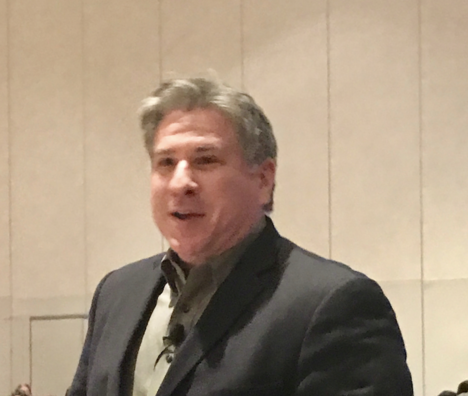
Steve Farber speaking to CUNA HR OD Council meeting.
Farber, the author of several best-selling books, quoted Terry Pearce as saying that despite all the talk of leadership, “Many people think they want to be matadors, only to find themselves in the ring with 2,000 pounds of bull bearing down on them, and then discover that what they really wanted was to wear tight pants and hear the crowd roar.”
Farber told the meeting they can stare down that bull—which doesn’t mean they shouldn't be fearful at times—and demonstrate and practice “extreme leadership” by understanding that it all comes down to one word, and then some questions to ask themselves.
“Extreme leadership can sound a little jargon and buzzwordy, and it is,” said Farber. “The real problem with it is it’s a redundant phrase, or at least it should be. There should be no reason to modify the word Leadership with ‘extreme.’ If we’re already doing it, it’s already an extreme act. It’s about the act of transformation in some way or another. It stretches and grows our abilities as human beings and does that for the people around us. The extreme leader in my experience is someone who strives to take a radical leap day in and day out.”
What the extreme leader consistently does, said Farber, is four things: cultivate love, generates energy, inspires audacity and provide proof.
Cultivate Love
“We’re not accustomed to using this word,” acknowledged Farber. “It can make HR people squirm from time to time. But this idea that love and work are different experiences and should never cross is one level a tragedy and on another level completely insane. It’s at the foundation of any successful business.”
Throughout his remarks, Farber touched on the theme of “love” and where it fits in leadership and credit unions.
Customer Satisfaction? 'Doesn't Mean Squat'
Farber said that he and others his age who often make up senior management now are part of the Tom Peters Generation, named after the author of “In Search of Excellence,” who were raised to believe that “customer satisfaction is everything, only to come to find out that customer satisfaction doesn’t mean squat anymore. If someone says, ‘I’m satisfied with what you do for me,’ there is no greater likelihood they will come back. I’m not suggesting it isn’t important—I’m suggesting it’s become SO important it’s a baseline expectation. We expect to be satisfied anymore with every product we buy. Customer satisfaction means everything to everybody, so it doesn’t mean anything. Satisfaction doesn’t breed repeat business, so what does? Love. When they love us, that’s where loyalty and repeat business and forgiveness come from. So how do you create that kind of experience for customers in a meaningful and sustainable way over time? It’s virtually impossible to do unless you have a culture that people love working in.”
Farber said credit unions shouldn’t take his word for it that love is important. He pointed to Warren Buffett who, when asked how he decides which companies to invest in, responded, “I look into their eyes and try to figure out whether they love the money or if they love the business. If they don’t love the business, I can’t put my money into it. Then my job is to make sure that I don’t do anything that kills that love of the business.”
This all gets very personal very quickly, acknowledged Farber. He said there is “no way” to create a culture employees love working in unless management has that love first.
“The question on the table now is what is your connection to the work you do every day, regardless of your title,” he said.
Doing what you love is important, clarified Farber, but it’s not the whole story. The whole story, he told the CUNA Council meeting, comes down to asking, “Do what you love in the service of people who love what you do.”
Some will embrace that, others will see it as a crock, according to Farber. But to get to that point, he asked a series of questions he called “extreme leadership practices” in and of themselves:
Why Do I Love This...And How Do I Show It?
Farber said everyone should make it a habit to ask themselves this question as often as possible. Some days, he admitted, that “love” question can be a bit of a stretch, but “the more difficult it is to ask this question, the more important it is answer this question. It’s designed to help you inspire yourself.” The second part of the question, “How do I show it?” must be answered behaviorally, he said.
When it comes to generating energy, he said, “I guarantee any company or any team that is led by someone who is dead is going to create clones throughout the organization. I can walk into the lobby of a business where I’ve never been before and tell in 30 seconds if it’s exciting and energetic, or it’s a morgue. It’s not an accident; it’s not a random occurrence. It’s a direct result of the energy leaders are putting into it. Do you notice a difference from branch to branch? Of course, you do”
What everyone must not do, he said, is underestimate the impact they can have on the energy level in their own workplaces.
A good litmus test question, he said, is “‘Do I generate more energy when I walk into a room, or when I walk out of it.’ We all know people who are the walking vacuums of the human spirit. You want to make sure you’re not that person.”
So how does one go about doing that? According to Farber, there are infinite ways, many of which are common sense, such as fostering great relationships, setting the right kinds of goals, etc.
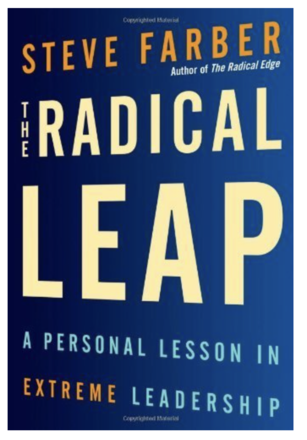
One of Steve Farber's books on leadership.
He urged everyone to also ask themselves, “What is it you really do at your credit union, beyond just the transactional stuff?”
As an example, he cited two commodities manufacturers, Gillette and Kimberly Clark. Gillette is passionate about shaving and its employees don’t believe they are in the razor business. Instead, workers strive to live up to the statement “We own the face.” Similarly, he shared the story of talking to someone who oversaw the diaper division at Kimberly Clark. That person told him, “We’re not in the business of diapers. We are in the business of happy babies and happy moms.”
“So, don’t tell me there is nothing to get excited about in the important work that you do,” Farber continued. “The question is, are you really clear on it and do you tell people all the time?"
What Do I/We REALLY Do Here? What’s the Higher Purpose/Calling in Our Work?
Farber said that human beings, on a “really deep, primal level,” have a “need to be a part of something great, and it’s very easy in the day to day crush of things to forget why the work we are doing is so important. Our job as leaders is not just to remind ourselves but the people around us why our work is important. This creates energy in people.”
Audacity
Ferber described audacity as the “bold and blatant disregard for normal constraints in order to change the world for the better is the ultimate audacity.”
But the idea of changing the world, said Farber, can discourage people. It shouldn’t, he stressed. “There is such a thing as a small ‘w’ world, your community, your credit union, your family or just one person in your family. These things do add up. What holds us back? One simple thing: fear. Changing the world is a scary proposition. I would suggest that in the right context fear is a good thing and we should seek it out.”
Proof
When it comes to changing things, said Farber, it’s not enough to have this discussion; a credit union must do what it says it’s going to do.
“There’s not much to say here. It’s practice what you preach. Walk the Talk. So, it begs the question, do I really want to do this?”