

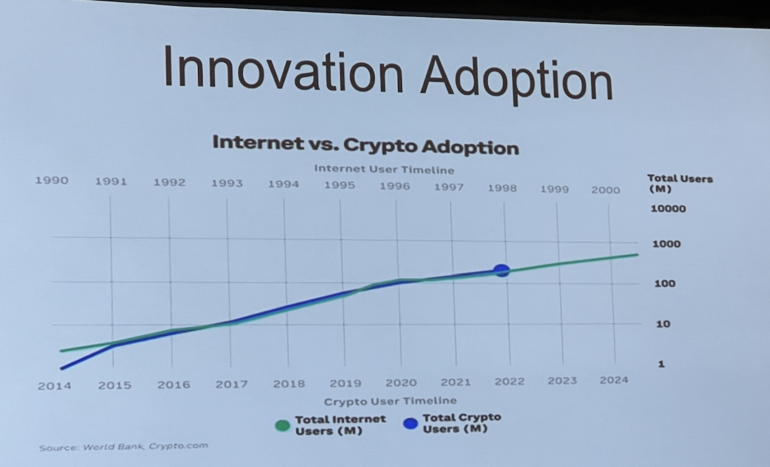
GREENVILLE, S.C.–When a group of credit union execs gathered here was asked how many had made a purchase using cryptocurrency, no hands were raised. When they were then asked how many had made a purchase using their phone, every hand was raised. In a decade, those hands will all be raised in response to both questions the audience was told—meaning they better start developing a crypto strategy now, according to one CU that is among the first to offer crypto to members.
Speaking to NAFCU’s Strategic Growth Conference, Joe Keller, VP-digital assets with New York-based Visions FCU, which offers crypto services to its members, and Tammy Bangs, relationship manager, banking, with NYDIG, shared why Visions FCU got into the crypto business. The credit union uses NYDIG to provide Bitcoin services to its members.
This is the first in a three-part series in CUToday.info on cryptocurrency and what credit unions are doing.
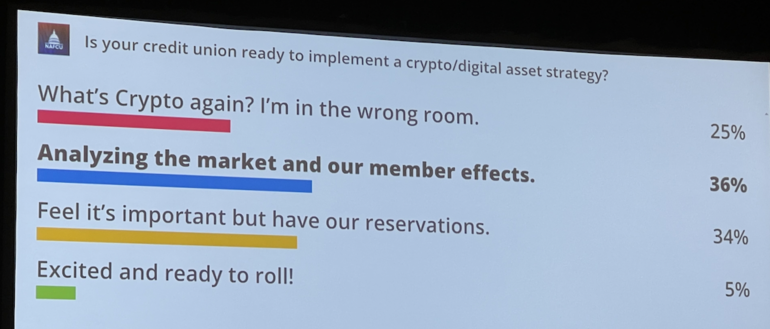
Here's what attendees at NAFCU meeting had to say abou their own CU's interest in crypto.
Keller began with discussion of commonly used words in the cryptocurrency space and what they mean, explaining there is significant confusion. Indeed, he said some people still buy Bitcoin and then expect to receive an actual coin.
A video created by Visions FCU to explain crypto can be found here.
Another survey of the audience found plenty of reasons most people aren’t familiar with crypto, with an online poll finding 70% had never bought anything using crypto.
Bangs clarified that NYDIG is not like Coinbase in that Coinbase is a crypto-exchange. NYDIG provides the technical support to credit unions so they can offer bitcoin services to members.
NCUA Letter Cited
Bangs pointed credit unions to an NCUA Letter to Credit Unions published in 2021 ( 21-CU-16) in which it provided guidance to credit unions that makes clear the nation’s financial co-ops are permitted to engage in cryptocurrency offerings.
“Regulators are very open to it,” said Keller, citing as additional evidence a recent letter from President Biden encouraging regulatory agencies to move forward.
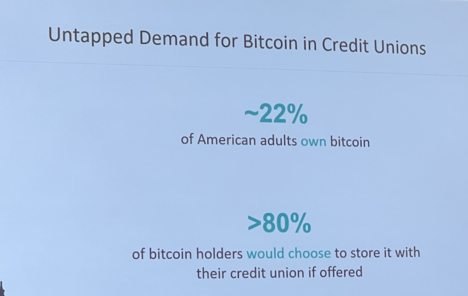
Bangs said the research makes clear that the majority of bitcoin holders would prefer to deal with their credit union, because they are known entities and especially since most exchanges do not provide much in the way of customer service
NYDIG is regulated and holds a bit license. Bangs said the company is focused on regulatory compliance, offers a cold storage/closed ecosystem, and provides support, compliance and marketing services to financial institutions.
“All we do from a wallet standpoint is cold storage,” emphasized Bangs.
One CU’s Story
Keller credited Vision FCU CEO Ty Muse for always being on the lookout for disruptive innovations, which helped speed the pace with which the credit union got into crypto.
But there was another reason as well—a look into its data revealed a growing number of members were moving their money and buying crypto, making it a “member retention issue.”
“Over the last three to four years we’ve seen a real increase in interest and in the value of crypto,” said Keller. “In 2021 we decided we needed to have a better conversation, including what does it mean to bottom line standpoint and how is it affecting members, including the outflow of capital from the credit union to things that enabled crypto-purchases.
“We were really starting to see that shift in capital,” he continued. “And that right there said we need to start paying attention to this more. The deep dive started toward the end of last year. I joined the credit union in January of 2022 and looked at what will we do this year and over the next 18-36 months.”
The First Question
The first question Keller said the credit union asked itself was how it could retain some of that capital that has been going elsewhere and could it find a partnership to help it accomplish the goal. More specifically, he said Visions FCU was looking for a service that would allow members to buy, sell and hold crypto that also had enough controls in place. That led to the partnership with NYDIG.
According to Keller, Visions FCU has sought to investigate a variety of new tech, including the blockchain, P2P transactions, and real-time payments, all of the things that are going to be a disruption and which will likely be attractive to many members.
“We used an innovation priority roadmap we already had in place to see where we wanted to go this year and where to go next year,” Keller explained. “Bitcoin was the easy one. It’s pretty seamless to get started as long as your with the right platforms.”
Payments and lending will be two areas at which it will look next.
The Use Cases
Indicative of the growing number of consumers with crypto investment, Visions FCU has begun to see some members and member businesses looking to use their crypto holding as collateral for loans, which several other CUs in attendance at the NAFCU event confirmed as happening at their credit unions, too.
One member sought to make a mortgage payment using crypto, which Visions FCU declined, he added.
Changing Attitudes & Where to Start
Bangs said she is “excited” about the potential for lending that crypto offers, and there are other benefits, too.
“You can change the hearts and minds of Millennials with this,” she said.
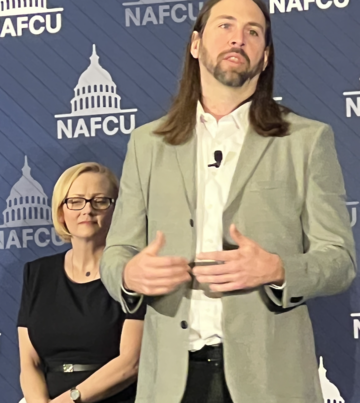
Joe Keller and Tammy Bangs speaking to NAFCU meeting.
So, where does a credit union start? Keller offered these steps:
- Internal self-assessment. “Understand the flow. Do an internal analysis of what’s happening inside the credit union. Find out who in the Credit union is using crypto. It’s going to grow exponentially, so being prepared is really important.
- Continued Education and Awareness. “Don’t just run out and act” on crypto,” advised Keller, saying it did its homework before entering into a relationship with NYDIG.
- Develop a Strategy and Roadmap. That roadmap should answer the question of where crypto is most likely to affect the credit union and the member. With that answer in hand, he said, it provides a roadmap on where to start first. That includes tackling issues related to the credit union’s core.
Audience Questions
Keller and Bangs fielded several questions from the audience, including:
How can you be confident that the value of digital assets will be well established and consistent?
Keller, who began his career as a risk manager, responded by saying, “You can’t. There is no way to clearly see where this is headed.”
But he added a credit union can can look at the trend lines to get greater clarity.
“The other thing I would do is step back from what everyone think of as bitcoin, such as stable coins and central bank digital currencies, where there is no volatility,” he said. “Getting into bitcoin isn’t necessarily the 100% way to do it.”
How can a credit union now where dollars flowing out are going
How can a credit union better monitor capital outflows?
Bangs said if a credit union doesn’t have a clear understanding of where the outflow is going, NYDIG can give a CU a list of exchanges that offers some answers.
At Visions, Keller said the credit union in the beginning just looked at ACH volumes, before then starting to look at wires, where it really began to get a better understanding as the amount went up substantially.
If members can’t remember their account numbers, how on earth will the credit union not be held responsible for remember the key needed to unlock crypto?
With NYDIG, Bangs said members never have their own private key.
“It’s a really like a password that’s like cash. If you lose it, you lose it. It’s a big deal. If we hold it for you, we have it as long as you can authenticate yourself to your credit union. You don’t even need to know your private key.”