

WASHINGTON–There is one clearly bipartisan agreement in Congress: it’s never been more partisan. Beyond that, credit unions at NAFCU’s Congressional Caucus here heard from a half-dozen representatives and senators with just as many views on the upside/downside of gridlock; a 60-foot-high pile of regulations; why community banks and CUs should stop fighting each other; the perspective that being 75-years old brings, and all about a “holy writ” and she who must not be named.
Gridlock's Upside/Downside For CUs, From Rep Who Has Worries About Congress
WASHINGTON–The upside of congressional gridlock? The tax status of credit unions isn’t at risk. The bad news: other CU priorities are being bogged down by that same gridlock.
That’s the word from a 33-year member of Congress, who expressed frustration with what Congress has become while saying that ultimately he believes democracy will win out and many of the issues will be resolved.
Rep. Sandy Levin (D-MI) told NAFCU’s Congressional Caucus that the “deadlock” in Congress has become the status quo that will be “very difficult” to change.
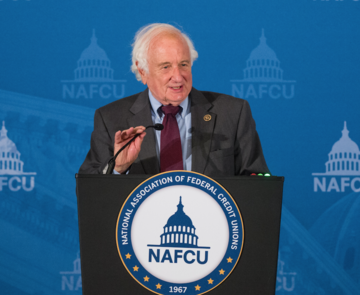
Rep Sandy Levin (D-MI) speaking to Congressional Caucus. Photo: Kevin Dietsch
“Some in Congress are talking about how we have to face the issue of the national debt and there are some who are essentially saying ‘Let us lose our creditworthiness in exchange for passing some sort of amendment to a bill.’ So I’m really not sure how it’s going to work out. We will perhaps pass a highway bill, but we’re deadlocked in how to fund it.
“I think what we’re likely to see in these next couple of months is further deadlock,” Levin continued. “It’s possible we will essentially not take action and put this country once again into turmoil. I don’t think it will happen, but it’s possible. I think you can be assured there will be no change in your tax status, in part because of the deadlock here, but in part because of the merits of the case.”
Like other members of Congress who spoke to NAFCU’s Caucus, Levin had praise for credit unions, saying he was surprised and impressed to learn that 4.5 million Michiganders belong to CUs.
“The strength of credit unions in this country is what you do and how rooted you are in this country,” he said. “I think you ought to brag about that. I think the strength of the credit union effort at home is really what has mattered. When there was an effort to revoke the tax exemption it never really got off the ground, and I think that’s because so many members have seen what credit unions do in their communities.”
During a Q&A with the audience, Levin returned to the theme of the lamentable changes he has seen in Congress, what can be done and what might lie ahead.
“There is a political crisis in this country in my judgment,” he said. “The political picture is more confused than it’s been in a long time. We have a substantial percentage of the population that is disillusioned with the political process, and I’m concerned with how that is going to work out. When there is this kind of gridlock there is a temptation for the extremes to take over. I don’t think in the end that will happen, and democracy in this country is so vibrant that eventually we will straighten out these issues.”
Levin noted that when he first arrived in Congress he knew not just his fellow members but their children. Now, “We hardly know each other.”
“I have a deep faith that in the end democracy in this country is so deeply a part of our fabric that we will come out on top, but I do worry that it seeps into the daily life of our institution. Tell Congress you would like to see them work together, that this kind of deep polarization is not in the best interests of the United States of America.”
Half Of You Won't Be Back, Thanks To 'Nuke-You A'
WASHINGTON—Rep. Bill Posey (R-FL) found a pretty powerful way to make his point about the costs to credit unions of regulation.
After reeling off statistics on the number of CUs that have disappeared in recent years, he said, “Half of you won’t be back here at the end of my next term should I be re-elected.”
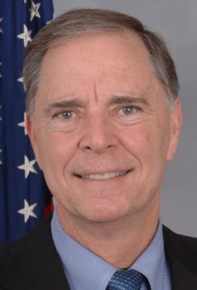
Rep. Bill Posey (R-FL)
Posey used that comment as a launching point for equally strong remarks regarding where many regulations come from and what he thinks of NCUA.
“What I’m hearing is that you need regulatory relief, especially the administrative procedures process,” said Posey. “The biggest complaint I hear after Dodd-Frank, which I voted against, is about these sorry laws that passed by unelected and unaccountable bureaucrats. That’s just the truth. In my office we started collecting the laws made by these unelected and accountable bureaucrats. Every day each member of Congress gets a copy of the Daily Register, which lists all new regulations and which I promise you no member of Congress reads. In April of 2011 I started collecting these. How high do you think the stack of Daily Registers is in my office today? It’s over 60 linear feet now. It’s incredible. The stack of laws made by members of Congress who were elected since 1776 isn’t one quarter of that. The process has been completely taken over by the bureaucrats. That’s what’s hurting you and that’s where we need reform.”
Posey showed that when it comes to NCUA, he includes the agency among the unelected bureaucrats.
“I call NCUA ‘Nuke-you-a,’ because I think they are nuking you,” he said.
We're Becoming Europe; Watch Out What You Ask For
WASHINGTON–Sen. David Vitter (R-LA) knows just what credit unions are asking for, and why, but he also had a caution for CUs that involves the old adage about being careful with requests.
“I’m really concerned about the assault on your types of institutions,” said Vitter, who chairs the Senate Small Business Committee.
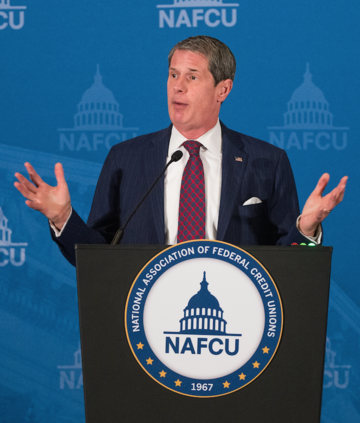
Sen. David Vitter speaking to Congressional Caucus. Photo: Kevin Dietsch
“Too big too fail was supposed to be fixed, but the fix is worse than the ailment. Dodd-Frank is extending and promoting too big too fail in many ways with over-regulation. I’ve been trying to reverse that trend and to replace this over-regulation with systemic approaches, such as much higher capitalization for certain banks. A bill I am cosponsoring with Sherrod Brown (D-OH) also contains regulatory relief for smaller institutions.”
Vitter said he saw one study that indicated the regulatory burden of CUs has increased 100% in recent years, which he considers “conservative.”
“If we don’t fix that and soon we are going to change the landscape of financial institutions across our country permanently,” Vitter cautioned. “We’re going to become just like Canada, just like Europe” with a limited number of large banks only.
Vitter told NAFCU’s Congressional Caucus he did wage and win a fight to get better representation for small institutions on the Federal Reserve Board.
Meanwhile, in response to an audience question, Vitter urged CUs and community banks to drop their fight with each other.
“I think it’s a circular firing squad. I think it’s a mistake for community banks to focus on the CU tax exemption and for credit unions to focus on limiting banks on business loans, especially when you are surrounded by much larger financial institutions,” said Vitter. “And I tell the bankers the same thing.”
When another audience member said all he wanted was a “level playing field” with community and regional banks when it comes to business lending, Vitter replied, “That’s exactly the argument I get from community bankers when it comes to your tax status. So be careful about what you ask for.”
An Absent Senator & Holy Writ From The Heavens
WASHINGTON–Although she wasn’t a speaker at NAFCU’s Congressional Caucus, the presence of Sen. Elizabeth Warren (D-MA) was clearly felt, with Republican members of Congress saying she alone is preventing any reform of the Consumer Financial Protection Bureau.
Sen. David Vitter (R-LA) said Warren, who was the architect of the CFPB, starts a “ruckus” any time anyone mentions anything related to the agency.
“Politically, she scares the bejesus out of her Democratic colleagues and they run like the building is on fire,” said Vitter.
Separately, Rep. Bill Huizenga (R-MI) made a less than veiled reference to Warren when he said, “We have a problem in that there are some loud, prominent voices in the Senate. Not to name names, but a New England senator also has said there will be no changes to Dodd-Frank. I missed the time when this was named Holy Writ from the heavens that shouldn’t be changed. It’s all going to depend on whether colleagues in the Senate are going to stand up to this."
The Divide In Congress Begins Early
WASHINGTON–The divisions in Congress begin early, according to one representative who said he is trying to change that.
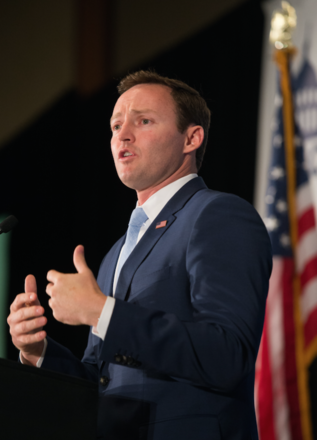
Rep. Patrick Murphy speaking to Congressional Caucus. Photo: Kevin Dietsch
Rep. Patrick Murphy (D-FL) recalled that when he recently arrived in Congress he discovered that members are “segregated” into one room for Republicans and another for Democrats. In response, he started a bipartisan group called United Solutions that is seeking to find some common ground.
One area where there is some common ground, said Murphy, is in what he considers the “biggest issue, the disappearing middle class.”
Although he is a Democrat, Murphy stressed he also believes in regulatory relief, stating “compliance doesn’t help get more money into the marketplace.”
Murphy, a CPA, is sponsor of the so-called “Stop and Study” bill that would require NCUA to further study its risk-based capital proposal before any plans are made to implement it.
Murphy’s other priorities: doing away with Fannie Mae and Freddie Mac, and pushing flood insurance to the state level.
Why Government Isn't Run Like A Business, And The Advantage Of Being 75
WASHINGTON–Age and experience bring a certain perspective, which was evident in the observations made by Rep. James Clyburn (D-SC) when it comes to Congress, running government like a business, and what everyone should hope to accomplish by the end of their lives.
But before he offered insights into any of that Clyburn also offered a caveat about his forecasting skills, especially when it comes to government shutdowns.
“Three years ago when I met with you here we were facing the ‘fiscal cliff’ and the infamous sequester, and we were debating what we would do,” Clyburn told the NAFCU meeting. “I predicted we would punt the ball and avoid the sequester. Like a lot of predictions, I was wrong. So I’m not going to predict anything today. I believe we made a mistake in putting the sequester in place in the first place. I accept some of the blame of that. I was on all three of those budget committees.”
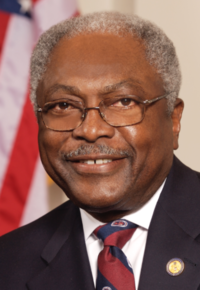
Rep. James Clyburn
Clyburn, who worked in government prior to being elected to Congress, said he is a believer in big budgets and in being “creative and innovative” within those budgets instead of “doing small stuff for short periods of time. And that’s what we are facing in Congress today. We are taking baby steps and trying to get through the next crisis. People want to see us get something done. There is no Democrat or Republican way to fix a bridge or to fund infrastructure.”
An issue that was raised by several Caucus speakers, as well as the presidential candidate debates, is getting government to operate more like a business. Clyburn believes that idea sounds better than it actually is.
“There is always a battle between efficiency and effectiveness,” he said. “I hear people say, ‘You’ve got to run government like a business.’ I could not disagree with that any more than I do. Government is not in the business of making a profit. We are in the business of effectively serving communities' and people’s needs. If you really want efficiency, I tell people you want one-person rule. That’s the most efficient government you can have. You may not like it; but that’s efficiency. What we need to do is seek a balance; look at some efficiencies and find effectiveness.”
Another statement often made to him, Clyburn said, is that the best way to be elected is to simply be an “obstructionist.”
“I don’t’ see it that way,” said Clyburn. “I just had my 75th birthday, and there is a great benefit in that you just don’t give a hoot. I want my government to work and to be as effective as it can be; I want to plan for our children and our grandchildren and do it in a way that will have a positive impact on their lives and communities.”
'Tap The Brakes Here, NCUA'
WASHINGTON–Rep. Patrick McHenry (R-NC) pulled few punches when it came to Dodd-Frank or NCUA. But he had respectful words for the role of credit unions.
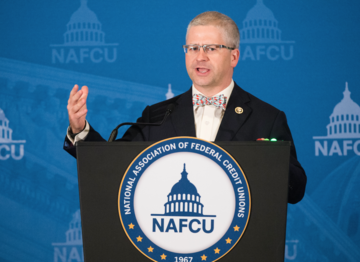
Rep. Patrick McHenry at Congressional Caucus. Photo: Kevin Dietsch
McHenry, the vice chairman of the House Financial Services Subcommittee and chief deputy whip, told NAFCU’s Congressional Caucus that “the social utility of what you do has got to be the reason you get up in the morning. The opportunities you provide in communities is the reason for your tax status.”
But getting up in the morning isn’t easy, he said, joining a parade of GOP speakers who were critical of the Dodd-Frank Act.
“What credit unions are experiencing is an extension of this issue of systemic risk, which is Dodd Frank,” he said. “You need to have a wise and good regulator that understands your industry. (McHenry paused as his audience laughed.) I concur. So the idea that you have an agency that dramatically increases their budget, basically doubles it over five years, without any transparency for those they are assessing is a travesty that needs to be remedied. I think risk-based capital for credit unions is a good thing—if done correctly. But what we’re seeing is moving too fast. When you have five credit unions that would have to raise $60 million in capital in order to comply with a bad rule jammed through by your regulator; that’s dead wrong. That’s why we’re saying tap the brakes here, NCUA.”
'Pie In The Sky' & 'Ridiculous Proposals'
WASHINGTON–Rep. Maxine Waters (D-CA) was well aware numerous other members of Congress had preceded her as speakers to NAFCU’s Congressional Caucus. Credit unions shouldn’t believe most of them, she suggested.
“You’re going to hear a lot of talk. Some people will talk about relieving you of ALL these regulatory burdens,” she proclaimed. “It’s pie in the sky. What you need is real honesty on regulatory relief, and you do not to be tied in with others, that somehow you are all in this together with those ridiculous proposals they have. You don’t need to be used by anybody. We can do for credit unions what doesn’t need to be done for the biggest banks in the country. You don’t need to be tied to them.?
Meanwhile, when it comes to small business lending, Waters added, “If the banks don’t want the business, I’m happy to see that you all get it. But I’m happy to see you get it even if they want it.”
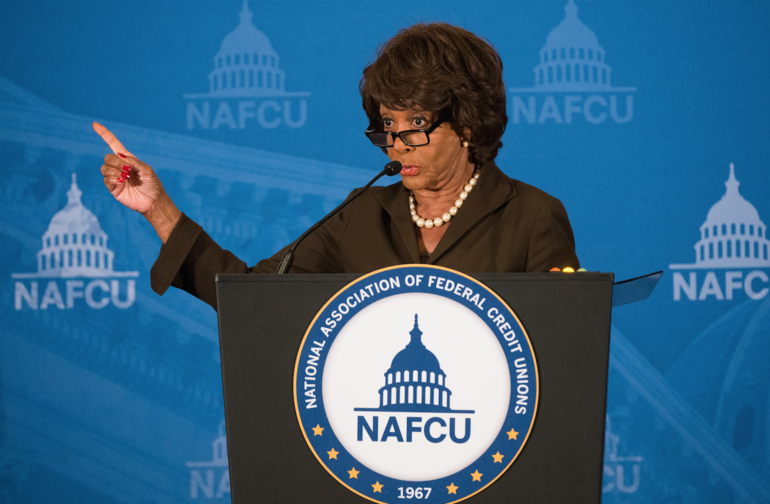
Rep. Maxine Waters speaks to Congressional Caucus. Photo: Kevin Dietsch