

WASHINGTON–New World Council of Credit Unions President and CEO Elissa McCarter LaBorde got right to the point when it comes to a large, international body whose focus and policies may seem far removed from the comparably small global credit union community whose leaders seldom give it much attention.
“You may be asking what does the G20 have to do with me and my credit union?” said LaBorde in introducing the webinar titled, “Credit Unions & The G20: The Push for Financial Inclusion.”
“It’s the body where leaders from around the world meet on many issues and they give directions to the international standard-setters, the Basel Committee, the Financial Action Task Force and others governed by central bankers and other supervisory bodies,” LaBorde said in introducing the topic.
In short, the G20 influences international and national regulators that in turn implement rulemaking that often does not take into account the burden placed on smaller institutions. In other words, it’s the global application of the frequent complaint in the U.S. that rules made for Wall Street are crippling the relatively tiny operations on Main Street—hurting members and especially CUs’ ability to serve more diverse, lower-income communities.
Officially, the G20 is an intergovernmental forum comprising 19 countries and the European Union that works to address major issues related to the global economy. Unofficially, its work and policies can have what are often undesirable outcomes for smaller organizations, such as credit unions, unless the world’s CUs become stronger and more vocal advocates.
LaBorde’s comments in the World Council webinar are featured here as part of a week-long series in CUToday.info in conjunction with International Credit Union Week, during which viewpoints from five people from several different countries are being highlighted.
‘Key Enablers’
It’s important to acknowledge, said LaBorde, that bodies such as the G20, even indirectly, are “key enablers” of financial inclusion, which is why it’s so important to define for those policymakers what is meant by “proportionality,” or the tailoring of regulations for credit unions and other smaller financial services providers.
“It's not about giving an exception,” said LaBorde. “We want proper, safe, sound regulations but we also want rules that allow the cooperative model to work properly.”
LaBorde said that while international standard-setters such as the Basel Committee have embraced proportionality and incorporated it into the international standards, the ongoing challenge is getting national regulators to do the same. “They either don't have discretion to tailor their regulations to their local context or they don't have good capacity and they’re hesitant.”
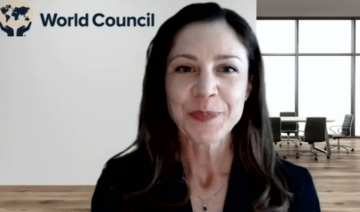
Elissa McCarter LaBorde during WOCCU webinar.
LaBorde, who recently joined World Council as its new president/CEO and who was profiled in CUToday.info here, added that at the national level WOCCU has seen a variety of regulation tailoring across the countries it represents, and in some places no tailoring at all takes place.
Why Issue is Critical
The reason the issue of proportionality is critical, according to LaBorde, is it is what enables credit unions and other smaller players that are inclusive finance providers to fulfill their missions.
“Where we are trying to offer responsible and importable financial products to rural and underserved markets, those are expensive to reach,” LaBorde observed. “This is in line with the G20's objective to reduce inequality to promote inclusive growth. We are providing crucial financial services, things like loans to (small- and medium-size enterprises) to marginalized groups, to other members of modest means. They are underserved by large commercial banks, but what we see is many of these regulations are designed for those large commercial banks and that's often an impediment for credit unions trying to serve these markets and reach these kinds of customers.
The ‘Ask’
In short, LaBorde said, the World Council’s “ask” of the G20 is for the international standard-setting bodies to work with national level regulators on proportionality and to provide frameworks that let the cooperative model continue to serve those more vulnerable members.
The good news, according to LaBorde, is the G20 is being chaired by Governor of the Bank of Italy Ignazio Visco, who haspublicly stated the G20 intends to include a menu of policy options addressing financial inclusion gaps and that there will be financial inclusion language in the declaration that will come out of the organization at the end of October.
In the following days in this series, CUToday.info will have viewpoints from Australia, Canada, the U.S. and one international perspective.