

SAN FRANCISCO–At the intersection of marketing and technology are too much of a focus on the future, narcissistic strategies, “vanity” metrics–but also a great opportunity unique to credit unions, according to three experts.
Moreover, marketers can demonstrate to CFOs the ROI to be had on tech investments in marketing solutions that go way beyond just measuring clicks and applications, according to a panel here.
Participating in the panel at the CUNA Marketing & Business Development Council annual meeting were Andrea Parrish, digital marketing specialist with STCU in Spokane, Wash.; James Robert Lay, CEO of Digital Growth Institute in Houston, and Madhukar Kumar, VP of product strategy with Oracle in Redwood City, Calif. The panel was moderated by Patrick Adams, CEO of St. Louis Community Credit Union.
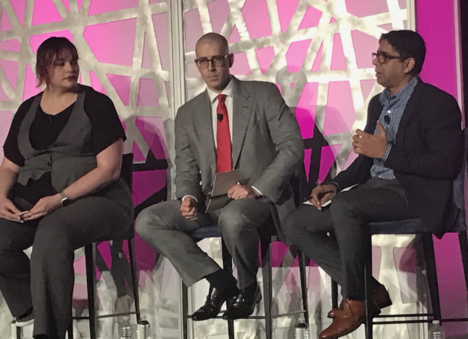
From left, Andrea Parrish, James Robert Lay and Madhukar Kumar at CUNA Marketing and BD Council meeting in San Francisco.
Below is a look at the Q&A:
Adams: Share with us your thoughts on where we are now with marketing and technology.
Lay: Think of how you communicated 25 years ago. You had to pick up a phone and call someone. One thing that hasn’t changed is we are still a people-centric industry. The number-one technology I see that we want take advantage of is how can we help people toward their hopes and dreams with marketing automation technology. It can simplify our lives, so we can simplify the lives of our members and community.
Kumar. I run product marketing for Oracle. The vision of (Oracle founder) Larry Ellison has been if you are a business you should be able to run your entire business with nothing more than an Internet connection and a browser, and now, voice. We have focused a lot on data and information management.
If you step back and think about why does a business exist, in credit unions’ case, it’s because of our members. Your primary goal should really be around creating a member and keeping a member. In the last seven to eight years, if you look at the technology for marketing, it has narrowed down the definition of marketing.
Marketing isn’t just to bring in a member, it is to keep the member. Marketing is part of everything we do in an organization. I think in the next two three years that is the change we will see.
Everything that can be an app is an app now. Everything that can be done to increase efficiencies has happened. There is a huge commoditization of functionality. You have what everyone else has. What really differentiates you is the relationships you have with your members. Now you can go beyond the narrow definition of marketing to something more, which is engagement in the relationship.
Adams: So much of our business is commoditized. How can we use it to differentiate?
Parish: It’s my belief that good communication is great marketing. You have to take into account that there is a human being on both sides of technology. Rather than thinking of technology as a solution, tech is what enables the solution.
Lay: Google has commoditized financial services. No longer can we compete on just great rates.

The way I look at using tech to differentiate is extremely simplified: Help first, sell second. People want a trusted guide, someone to get them beyond the financial stress that is taking its toll, someone to guide them to a better place in the future. Technology is just the means for doing this. This goes to our purpose of why do we exist as a credit union. And that is still rooted in that motto of People Helping People.
Kumar: Every time we have seen a technology disruption happen it has amplified human capacity.
In each shift it has taken progressively fewer and fewer years to go from one shift to the next. Now we are going from digital to intelligence. If it amplifies human capacity, we have to ask what do we do with it. How does it relate to the core of your organization? What are the other things you are doing today that can be automated and how can you use technology to find the right people at the right time to help them to their next stage?
Adams: What kind of application of marketing technologies could we see in our marketing department and what kinds of displacement of personnel is to come?
Lay: With technology, it’s about enablement at that point. We need to address the capacity gaps. Technology is about enabling us, not replacing us. Digital technology and digital marketing, I believe, are more of a mindset of how to use these tools. I would like to see the conversation shift at the executive table to marketing being an acquisition tool.

Parrish: We have we used Facebook Live video. I think this plays into how we are using digital. It is an acquisition channel. Our first live video was three and a half hours of an ice cream cone melting. We wanted to test our technology and we partnered with a business that sells ice cream and we turned it into a contest. It was a teeny test of Facebook Live. Since then, we have been using a lot of Facebook Live to highlight community partnerships. There are a lot of compliance issues, because the last thing you want is someone to quote a wrong rate. But if you use it right, your community can see you as a trusted partner, something they want to be a part of, rather than ask questions of.
Lay: What we see in financial services is narcissistic marketing. It’s all about us. But when we use technology to put the spotlight on our partners, people are more likely to trust us. We are playing the role now of Mr. Miyagi.
Kumar: To humanize the interaction is still a challenge. And that’s where we have to overcome the barrier.
Adams: What’s the next big shift?
Kumar: From a technology perspective, you can take this as far as you want. If you look at just the digital front, we have gone from being digital, to doing it all in the cloud, and then because it’s digital in the cloud it generates a lot of data, and now we can use machine learning in real time to humanize interaction with whomever is your partner, member, customer.
Each one of these stages relied on the previous stage. If you invested in data scientists to make sense of this now you are at the point where you can go to the next level. To my mind the next shift will come at two or three different levels. One, what can you do with data, which is where AI and machine learning come in. Two, the way we interact with machines and computers is changing. It used to be through a keyboard and user interface, now it’s through voice and augmented reality. Gartner suggests by 2020, a lot of shopping online will have augmented reality. And three, is more of a peer-to-peer interaction through technologies like blockchain. But, truly, no one really knows where that next shift will be.
Lay: We can be so future-focused we miss the opportunities in the present. People build careers around futurism. But I don’t live in that world. I look at what can we capture now. For marketing executives it’s easy to feel overwhelmed and that you’re being left behind. We look at the horizon, but instead of looking at the horizon against that, why don’t we measure our progress against what’s behind us, from where we came. If we keep looking ahead we’ll never arrive.
Parrish: This is about setting our own expectations, too, around technology. It’s about stepping up and setting an aspirational goal and what is it we actually expect from it.
Audience Member: How do you keep from crossing the line from personalization to creepy stalker?
Kumar: Now, many customers have made a decision before they arrive at a business. So why not give a person a choice in how to personalize that communication and ability to say ‘Stop, this has gone too far.’
Lay: It boils down to not being creepy but contextual.
Parrish: It’s about context and telling members, for instance, ‘During this time you will interact with a chatbot.’ and then giving members an out: ‘If this robot is not meeting an expectation, then here is when you can speak with us.’ This allows us to set expectations.
Adams: This audience is managing many pathways to purchase–branches, mobile, conversational and messaging–these are the four pillars to be managed. What’s your feeling on this?
Kumar: I think, again, I will go back and say you have to go back to the core of your business. Why does your business exist? I repeat that because you have to temper technology against your core.

The companies that created railroads are not the companies that created automobiles, and the companies that created automobiles are not the companies that created airlines. But if each one of them really took a good hard look at the core of their business it was about moving people. You have to ask what is it you truly do and care about from an organizational perspective, and how can you take technology to stay true to that. From a tech perspective, there are no longer barriers. The second thing you have to think through is centricity around your member. The best thing to do is to give members choices and to ask them what they want from your organization and what you can do to help them.
Lay: As credit unions, we are in the business of moving people from their questions and concerns to their hopes and dreams, from stress to well-being. The way to be successful all comes down to strategy planning. Eighty-five percent of FIs today do not have a defined digital growth, digital marketing plan. They are operating ad hoc. They are not seeing any measurable results. But when we place the consumer journey in the center of these four pillars it provides clarity and confidence because you know how these different channels interact with each other.
The most important thing to know today is how consumers are starting this journey today, and the majority start online. If we can take more of a proactive stance in this journey it gives us a leg up.
Adams: CFOs love measurable ROI. And it’s harder to get the ROI on digital. Thoughts?
Lay: I think right now with digital when we work with credit unions we see a lot of vanity metrics being reported: clicks, likes, page views. What CFOs want to know is, ‘For every $1 I spend what am I getting back?’ Digital does provide the ability to do that. If you want to simplify that you need UTMs in your Google Analytics. If you are not using UTMs in Google Analytics you are pretty much flying blind. Digital does provide the opportunity to close the loop. Sometimes there are failures. And that’s frowned upon in financial services. But it can be worth it if you learn from it in digital, because you can optimize on the fly.
Kumar: I have been in a position when I ran marketing and I have always thought of this as a big problem. As a CMO you are constantly being measured by the pipeline you are creating. But if you truly look at the broader view of marketing it is beyond this pipeline, I think it’s about the lifetime value of the customer you bring into an organization. Now, you are not just responsible for bringing in the customer but for the customer journey. For that reason, the metrics in marketing need to change. This is a cultural shift in organizations. Yes, you want to measure if you were successful, but it isn’t just about clicks and eyeballs; it’s about that

lifetime value.
Parrish: A lot of times when measuring social media the measure is correlational. It’s not about how many clicks did we get on the link, it’s about how happy or how helped does that member feel.
Lay: A lot of people here measure Net Promoter Score. I see NPS as a vanity metric. You have to take value from the question about whether you would refer a family or friend. If people give you an eight or a 10, ask for the referral as the next step and you will gain new accounts, new loans as a result.
Parrish: It’s that correlational; it’s about what are the actionable steps we can take with that vanity metric.
Adams: How can these folks get more budget devoted to their efforts on the analytical side of the business?
Lay: Let’s not look at full funnel analytics. But if you can go home and turn a brochure website into something that generates marketing qualified leads, we can now quantify that we are starting to see leads from our website. It’s in the consideration stage of the buying journey that I see a huge opportunity. No one has touched consideration stage at this point. That’s a way to start to provide marketing’s value that it’s not just about creating awareness—which is important—we are generating leads.
Parrish: I think part of this is pointing out that members are starting with technology and digital. It’s pointing out that we all live in a blended life. If you are in a meeting and someone says there’s no budget for digital, point out that half the people at the table have their phone out. It’s how people interact with the world and if we as credit unions are not there, then we are not part of that table stakes conversation.