

LOS ANGELES–A pioneer who created a food truck phenomenon sees a lot of parallels with credit unions, and believes the coronavirus pandemic can be a defining, historical moment for both.
And even though he’s optimistic, he also offers a dose of reality over whether the “bottom of the boot” will end up crushing small businesses of all types—and further questions why anyone pays $34 for an $8 plate of pasta.
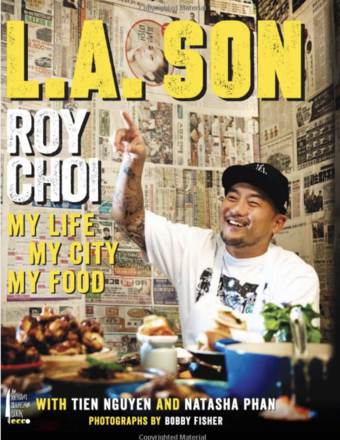
Roy Choi, who after rising to executive chef at Hilton Hotels changed direction and co-launched the Kogi food trucks in 2009, has been named one of the top 10 “Best New Chefs” by Food and Wine magazine and among Time Magazine’s 100 people to watch in 2011. He has since had a best-selling book, launched other restaurants, won other awards and hosts a show on Netflix.
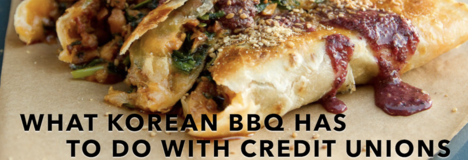
But as Choi made clear during remarks as part of CO-OP’s THINK 20 Virtual event, he isn’t in it for the fame or the awards, and like credit unions, especially isn’t in it for the money.
Choi, whose life is loosely the basis for the 2014 movie Chef, shared with credit unions his life story as the son of Korean-immigrants who spent a decade working his way up the ladder at Hilton Group, including becoming chef at its top property, the Beverly Hilton in Beverly Hills, Calif. He would spend a year in that position before leaving to run Rock Sugar Pan Asian Kitchen in Los Angeles. It was a life he is quick to admit he loved. Until it wasn’t.
Professional Amnesia
“In the summer of 2008, all was going fine until something happened where I hit this thing I term cooking or professional amnesia. I just woke up and I couldn’t remember to do the things I spent my life training to do,” he said.
It wasn’t because business was bad. Rock Sugar was a hot ticket in LA, serving a thousand people per night.
“I had lost my footing. What I am leading to is, I got fired, kicked out. I deserved every bit of it,” admitted Choi. “At the time I got fired it was at a time similar to now, with no jobs available. I was overqualified for a lot of jobs out there. In my book I noted I was a wrinkled person in a wrinkled suit with a wrinkled resume that no one would hire. I struggled for three or four months and then a friend called in September and said, ‘Don’t worry, let’s go to the night clubs and sell tacos. I have a truck.’”
That food truck would offer Korean barbecue tacos and in no time, it was a sensation.
“We are brought up to believe we need to separate who we are as professional people from our personal lives. I had all these things I had kept separate in my life, how I had grown up as an immigrant kid and had all my weird thoughts,” said Choi. “But with that phone call all those walls broke down, and I was able to pour it all into these tacos. I didn’t know it would be so deep; we were just trying to make $500 a night, and within a month we became this huge phenomenon. This flavor that tasted like Los Angeles felt new and fresh but also extremely familiar and old. It all created perfect storm; within a month I had thousands of people.”
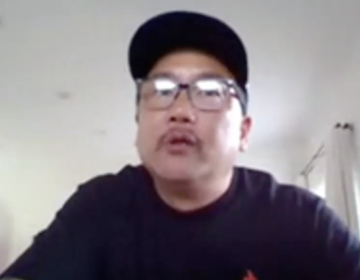
Roy Choi participating in THINK 20 Virtual event.
Serving the Working Class
Choi said part of the success was having the food truck available at times and in neighborhoods where food of any kind wasn’t available—especially quality food at very affordable prices. It was an approach he said is similar to that of credit unions.
“We were going to working class neighborhood and places that never get the culinary focus or shine in magazines. As it grew we began to figure out our identity, and that was being the underdogs and being true and transparent and honest with our customer, very much like a credit union,” Choi said. “It wasn’t that we weren’t aware of the larger world, the awards and all that, we just never got caught up in any of that. We stayed true to who was in front of us.”
While he said he isn’t a “true businessman,” Choi’s business nonetheless prospered. He came to own or partly own a number of other restaurants, including one in Las Vegas and another in which he partnered with Wolfgang Puck. Prior to the pandemic, all were thriving.
“I kept hearing about the need to have an exit strategy,” he said. “I don’t know what that is. To me a business is about longevity and family, taking care of the people around you and nurturing and community. We didn’t build Kogi to sell it off to some conglomerate and forget about it. Philosophically, that’s what we believed in and we found our strengths in our customers.”
Motivation for CU Leaders
Choi shared some thoughts he said he hoped might “motivate” his THINK 20 Virtual audience.
“In the darkest times, you are going to hear all these voices and opinions about what you’re doing wrong and what you need to do, but in this crisis, when the restaurant world has reached an apocalypse, the Kogi truck is like the Millennium Falcon. What kept Kogi alive has been the original customers and philosophy of Kogi. They knew we were the ones who drove through two hours of traffic just to serve for one hour. I see that parallel in credit unions. We are the true grassroots idea of what I think the American economic system should be; taking care of one another, reducing profits so the holistic nature can do better.
“All my friends’ restaurants have closed; they couldn’t even survive one week without revenue. I have a restaurant that has closed, but Kogi has survived this because even when we hit the worst times we were so lean we were able to pivot and maneuver, reinvent ourselves and continue to grow, and that’s where we are now,” said Choi.
He said he’s now working to create a blueprint for Kogi 2.0 in which all the profits are like a river flowing back into the sea.
“We’re putting the money back into communities and feeding people,” Choi said. “If I ran the world that’s the way it would be. People tell me I’m idealistic and naive and childish, but we’re the one left standing.”
Getting Philosophical
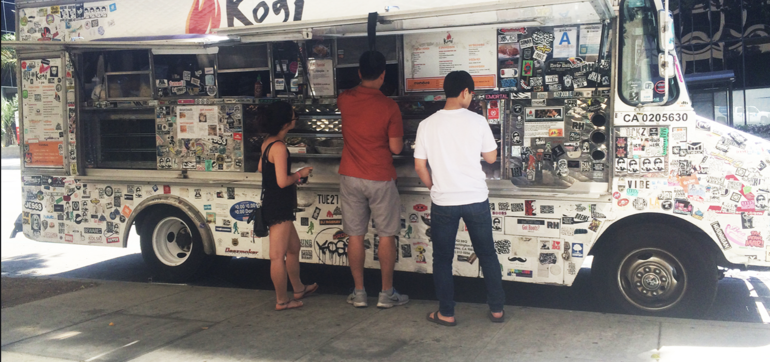
Choi, who holds a bachelor’s degree in philosophy, said the philosophy of Kogi has clearly “rang true” with consumers, which is to offer high quality food at low prices. He said he has avoided taking outside funding—the business was started for $50,000–and focused on being realistic and on paying attention to the customers “right in front of us. Ten people became 20 people in front of us, and that 20 become 100.”
There are now four Kogi trucks, one small taco stand, and a catering operation, all in Los Angeles and Orange County.
“Again, I think it’s about not getting twisted and disillusioned by the voices and we think defines success. Instead, we should be defined by what makes you comfortable and makes you feel like you can do it,” he said. “When you pushed into a situation or a corner, you feel your voice being taken away. We were able to make decisions extremely quickly. We pivoted, because there was no one we had to ask permission of other than our own moral compass and what we thought was right. It is very similar to credit unions, because there is power in neighborhoods and groups.”
Chutes & Ladders
While Choi didn’t draw a direct comparison, his description of food truck vs. the restaurant industry sounded quite similar to that of credit unions vs. the larger financial services industry.
“I couldn’t cut corners as a cook or chef,” said Choi. “We are working with organic and natural purveyors. That was important to me. I guess in a way we were looking at the model as many are looking at it now; what are all the things we had placed on top of what is really important, just to make a profit? The restaurant industry had all these chutes and ladders that raised prices to create what was thought of as an experience. And I thought that excluded so many people. I looked at it as what if we cut away all of those things, price just enough to cover costs? Could we save enough over six months or a year and then open a small shop? That ended up being our power. It gave us our independence, our freedom, our strength and connection to the community. That became revolutionary. For the first time something that tasted like 20 bucks cost two bucks. There was never a true, honest deal in life up to that point on a mass scale. If there was, it was always, ‘What’s the catch? It’s only $2? What’s going on?’ Pasta should be eight bucks, but you pay $34 for all of the story behind it. I think that is so similar to what credit unions are.”
Choi, who pondered whether his food trucks and philosophy toward food couldn’t partner with credit unions in some way, suggested there is another parallel between his business and that of CUs.
The Bottom of the Boot
“If you look at it, what’s happening right now in the world, what’s really being challenged the most and is on the brink of disintegrating is the neighborhood restaurant, the neighborhood store,” he said. “We’re looking at the bottom of the boot about to crush us. That’s being challenged because everything about that experience, staying six feet apart, not going in and browsing, these are all small little things that make a neighborhood business what it is, a neighborhood credit union what it is. It’s all the things that are not transactional. The transaction is maybe the least important part of the whole equation.
“Where are credit unions going to end up after all this? Will you be forgotten as well?” Choi continued. “As far as social purpose, everything we do, $2 tacos and $6 burritos, ain’t nobody getting rich off that. There has to be something else that guides us. And that is taking care of people, bringing a smile to their face.”
Choi said the coronavirus is an opportunity for people to rethink things.
Making a Choice
“We have been put in a position where we have a choice and we can recalibrate what is most value to us. We can value who we lend our money to, who we are going to get behind and support,” he said. “We can rewrite our moral values, find our north stars. We can value the things I’ve been ridiculed over my whole life: sharing, compassion, love, not making profit at the expense of the customer so everyone wins. All the things that don’t show up on the P&L. Those are the things we have the ability to restructure overnight.”