

MADISON, Wis.–The “new normal?” Forget that. Get ready for the “never normal.” Digital transformation? It may be the least of all disruptions. The COVID-19 pandemic? It was a “warm-up” act. Those forecasts and more were shared with CU leaders by one expert who offered some caution as well as some advice on competing in a new landscape.
Speaking to the World Council of Credit Unions’ virtual World CU Conference, Greg Verdino, a well-regarded authority on “the digital now” who has shown what many have called an uncanny ability to forecast trends, spot the difference between fads and the future, and for helping business leaders solve pressing challenges and seize opportunities, told credit unions that adaptatility is going to be one critical key to which organizations survive moving forward.
Verdino said he, too, has heard all the talk of a “new normal” and a “next normal.”
“I agree the old normal is gone,” he said. “But the worst thing any of us can do right now is wait for a new normal to emerge. I believe that in the coming years individuals will need to learn to adapt in the face of wave after wave of change, some small and some sweeping, and some will be almost predictable, but many will be unexpected in virtually every area of work in life, I call this…the never normal.”
In the decade since the real emergence of FANG (Facebook, Amazon/Apple, Netflix and Google), companies have gotten serious about digital transformation, and every company had a digital transformation plan in place, observed Verdino.
“But as my favorite modern philosopher, Michael Gerard Tyson, once said, ‘Everybody has a plan until they get punched in the mouth’.”
10 Questions, 11 Answers
But just what is digital transformation?

Greg Verdino speaking to World CU Conference.
“It's one of those questions where if you ask 10 people you're likely to get 11 different answers,” he answered. “I've actually always had a problem even with the phrase itself. To me, it's never really been about being more digital per se. Digital transformation is fundamentally business transformation—it's about your strategy more than shiny objects. Digital transformation is human transformation. It's about people and culture much more than it is about tools and technology.
“And then there's the word transformation. To me, it's always implied scale and level of effort that are so large that they would be out of reach for many organizations, and it implies that there's a clear before-state and clear after-state, and that despite all of this ongoing accelerating change happening all around us that transformation is somehow, some way, at some point done, and that's not true. So, I've always defined digital transformation by what it achieves rather than the means.”
What the transformation must ultimately achieve, Verdino told the World Council meeting, is a closing of the gap between what an organization’s digital constituents—members, employees, partners, suppliers—already demand and what an analog organization actually delivers.
If moving forward weren’t challenge enough, Verdino said there is another challenge, and that is that organizations “don't slide back to their old model as lockdowns come to an end.”
“Ultimately, individuals organizations and entire industries will not be judged on what they managed to get done in the face of an active pandemic panic, but by what they choose to do next,” said Verdino. “Transformation is not and it's never been an event; it's a journey and no matter how many steps you've already taken down that road, for most organizations that journey is really just getting started.”
A Bigger Reality
According to Verdino, there is an even bigger reality organizations must come to terms with beyond just the transition to all things digital.
“In fact, digital may turn out to be the least of all disruptions,” suggested Verdino. “Yes, of course, technology will continue to advance exponentially. There's no question that the line will continue to blur between technology and humanity. It will force us to rethink the workforce and the role that humans play in the workforce; to recalibrate our organizations around new customer expectations; to rearchitect our businesses by more aggressively implementing the technologies that provide us with some sort of strategic advantage.
COVID: The Warm-Up Act
“This will be one big driver of change, but at the end of the day it is still just one of those drivers, because while all of this digital disruption is happening around us the 2020s will simultaneously force organizations of every type to deal with wave after wave of change, many of which will dwarf the impact digital has had.”
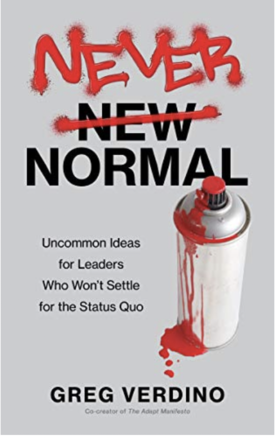
The COVID pandemic, said Verdino, will seem like “nothing but a warmup act at the end of the day. The idea that digital disruption itself is the most significant challenge businesses will face in the 21st century will seem like yesterday's logic. Disruption is everywhere. Think about how COVID was more disruptive than Airbnb or Uber or any challenger bank and all of this will look like a hiccup compared to climate change.”
Saying he didn’t want to sound completely “doom and gloom,” Verdino said an era is coming, the era he calls the “never normal,” that will see “unprecedented progress.”
What An Organization Must Do
But the organizations that meet that progress will need to be extremely adaptive, he said.
“I've worked on I don't even know how many digital transformation programs (with) dozens of different organizations in virtually every industry, including financial services, and one of the key things I found was that the biggest obstacle was never technology,” Verdino said. “The biggest obstacles arose when organizations haven't built a foundation that supports repeated and reliable change.”
Verdino told the meeting he and a colleague have identified a number of what he called “underlying values” and “practical principles” that can help provide the right kind of foundation for “always-on change readiness.” It’s a framework he said has been captured in an “Adapt Manifesto.”
“Forrester was also looking at adaptability as a strategic advantage for organizations and they ultimately came to the conclusion that adaptive business is the next step beyond digital business,” Verdino said. “They found that adaptive companies grow 3.2 times faster than their industry peers. The Adapt Manifesto was our attempt to lay out a way to get there. Now, I want to be clear, when I'm talking about adaptability I'm not talking about the long, slow slog of biological evolution. I'm talking about the things that organizations and the people in them can do to proactively prepare for change in order to minimize the time between a sudden external shift and a rapid internal response.
The Manifesto Principles
The Manifesto Principles, according to Verdino, are designed to get leaders to think about reimagining their “never-normal” futures. Those principles include:
All Leaders Must Embrace Ambiguity
Ambiguity is not to be merely tolerated but leaned into, said Verdino.
“Ongoing accelerating disruption moves us further and further away from the world of how we've always done business, away from all of those proven models and methodologies, the historical data, the competitive case studies. Commit to acting in the face of imperfect information. Commit to experimenting in the face of uncertain outcomes. We need to learn to trade less in the world of knowns and more in the world of unknowns.
“Game-changers are not waiting for the state of the post-pandemic world to become obvious to everyone before creating the future in which everyone else will need to compete,” Verdino continued. “Now is the perfect time, the exact right time, to take part in reimagine the future of credit unions, the future of banking, or even the future of financial services in general.”
Every Leader Must be a Student of Change
“I'm sure you have a lot on your plate right and it is very difficult to step out of the day-to-day the demands of the business to consider the possibilities of the future, but when change is constant and ubiquitous, observing when where and how the environment is changing around you is vital if you want to have any chance of understanding what these changes might mean…” he said. “Amazon and Google don't necessarily want to be banks; that's the good news. But they do want to be the dominant platforms on which banking happens for billions of people around the world. That is an incredibly powerful position to hold.”
It isn’t just Amazon and Google that are threats, said Verdino. Numerous fintechs have been peeling off segments of membership with various offers, including branding themselves as more diverse and inclusive in a “culture that increasingly demands these things from every business.”
A Question for CUs
Speaking of fintechs, Verdino asked the World CU Conference, “How could you potentially partner with other credit unions, let's say in your region, your country or even around the world, to establish a fund that you could all contribute to and maybe all benefit from in the age of the network? The network always wins. Think about how you can establish, build, participate in your own winning network.”
Verdino reminded all of that is taking place at a time of the exponential rise of decentralized finance.
In a world in which banking is conducted without banks, Verdino urged CU leaders to think about how a credit union remains relevant if the future no-bank banking.
“What business are you really in? What's your purpose? Given how you might answer those questions, what are some of the new ways that you can create value for your next generation of customers?...At the same time we need to think about the very real human, social, cultural, economic, political and even environmental implications of any banking disruption or development.”
Power of Adaptive Businesses
Verdino said credit union leaders will need to make strategic decisions in the never-normal by maintaining agility, adaptability and optionality.
“This brings me to the next principle: the power of adaptive businesses to blend the best of the old and the new. By all means, don't let me stop you from no longer doing the things that no longer serve your organization or your customers and then reinvest your effort, your energy, your resources, your money into the things that you need to do.”

Falling Victim
“We often talk about transformation as a journey, but the truth is that many organizations have fallen victim to the challenge of trying to change too much too quickly, while others fall prey to doing nothing at all because they don't know where to start or they're stunned into inaction by the sheer scale of it all,” said Verdino. “The reason digital transformation has become such a daunting prospect over the course of just the past few years is that too many organizations failed to keep up with the pace of change over the past couple of decades. Digital transformation is basically one big game of catch-up and now the scary truth is that the vast majority of all business transformations fail. So, we're going to try to avoid that. Revolution through evolution means that a series of small sequential steps will add up to massive and meaningful transformation over time. Now, to be clear, I am not saying go slow. Steady, yes, never slow. Always think about change as deliberate Darwinism. Identify important areas where you can begin making incremental changes today. Then scale as quickly as you can and make sure you're sharing knowledge across the organization
Learn, Unlearn, Repeat
Borrowing the “learn, unlearn, repeat” principle from author Alvin Toffler, Verdino said people are the most important component of any transformation, and that means upskilling and reskilling people to remain relevant, productive, engaged and fulfilled.
“In the face of that transformation, it’s the single most important thing any business leader can do,” said Verdino. “If anything, the digital skills gap may actually widen in the coming years. Instead, we need to reassert the value of our durable human skills, the so-called soft skills like creativity, empathy, emotional intelligence or ability to make decisions in absence of certainty. In other words, always keep in mind that in a digital-by-default world, where anything that can be automated will eventually be automated, the things that are undeniably human about your business, your workforce, your brand--these are the things that will set you apart. Humanity will be your last remaining competitive mode, even in a world of digital change.”
Challenge Assumptions
Verdino said credit union leaders must be prepared to let go of the things that no longer serve the CU and its members and must commit to learning new skills, adopting new behaviors, and embracing entirely new mindsets.
A Final Question
Verdino concluded his remarks by challenging credit union leaders with a question of his own.
“I would like you to ask yourself what is your ability to see change as it happens around the edges, before it moves into the mainstream? To see the new and the novel before it becomes the norm? To understand what it might mean for you, for your team, for your organization, for your industry and even for the world? And then to act with conviction, smarter and faster than even the outside environment demands, because this is what it will take to thrive to adapt and thrive in this age of unrelenting, always accelerating change. This is what it will take to adapt and thrive in the era that I call the never normal.”