ORLANDO, Fla.–Every credit union, and especially their CFOs, is feeling the pressure of margin compression, and yet the news isn’t nearly as bad as many believe and there are actually some opportunities in the market to be had—if a CU approaches its balance sheet in the right way, according to two people.
Rob Johnson, president and principal of c.myers corp., and Sean Zimmerman, senior VP with the company, shared their insights into the issue of margin compression and strategic progress during America’s Credit Unions’ Finance Council’s annual meeting here.
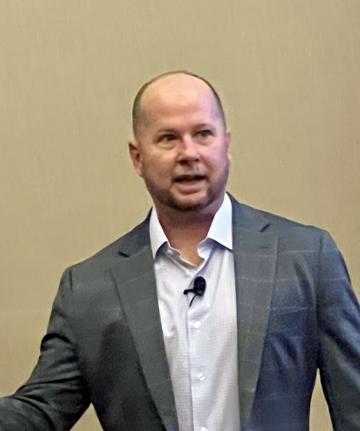
Rob Johnson speaking to Finance Council meeting.
Johnson said there are reasons to be “excited” about the current pricing landscape, as “some good things are happening.”
That was welcome news in a room where the gallows humor, head nods and raised hands made clear most finance professionals are facing the same pressure-filled challenges.
“For many institutions, the combination of margin compression, increasing delinquencies, pressure on expenses and urgency to move forward strategically is creating the need to make hard business decisions,” Johnson said.
The key, both Johnson and Zimmerman said at several points, is making sure the credit union is making the right decisions for the right reasons.
Johnson said the other piece of good news is that as his company forecasts out over the next several years, most credit unions see earnings and risk profiles improving.
The FAQ
“The most frequently asked question we get is, ‘When will rates go back to normal?’ One, that’s the wrong question. And two, zero is not normal,” said Johnson. “The last thing you want to do is build your plan around, ‘Hopefully, another disaster happens so money is free again.’ So, the question is how to get comfortable in this environment?”
Johnson shared this graphic below to illustrate the two directions of margins for credit unions.
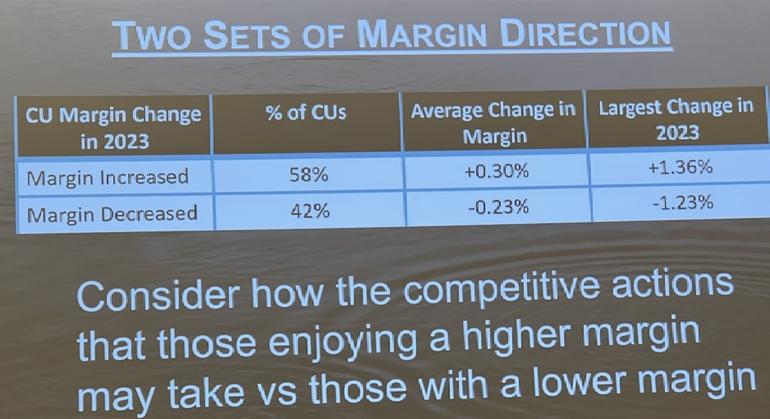
“Consider how the competitive actions that those enjoying a higher margin may take vs. those with a lower margin,” Johnson said.
According to Johnson, among the questions CFOs need to be asking is, “How are you positioned to manage in a material rate environment? This is where you can get a return on your savings. It changes competition. Most of the leaders in the industry became leaders in the last 15 years. What are they used to? Low-rate environments. So, what is the basis for your decisions? There is a shorter lens of leadership experience. You need to change the mindset. You need to ask, ‘What if we’re here for a while?’”
Johnson said most rate projections foresee a market with rates between 3.5% and 5% for the next decade.
“Rate forecasts are always wrong, but you have to ask yourself how are you positioned for a material rate environment,” Johnson advised.
The analyses that look backward factor in an environment in which there was little competition for deposits and don’t apply to what’s happening now and moving forward, he said. It has also created a challenge for many in working through the challenge of how to create a deposit strategy, he added.
How Margin Compression is Changing
Zimmerman noted much of the action taking place in margin compression now is on the liability side, where costs are on the rise. He noted the last time rates were averaging 5%, the cost of funds was around 3%.
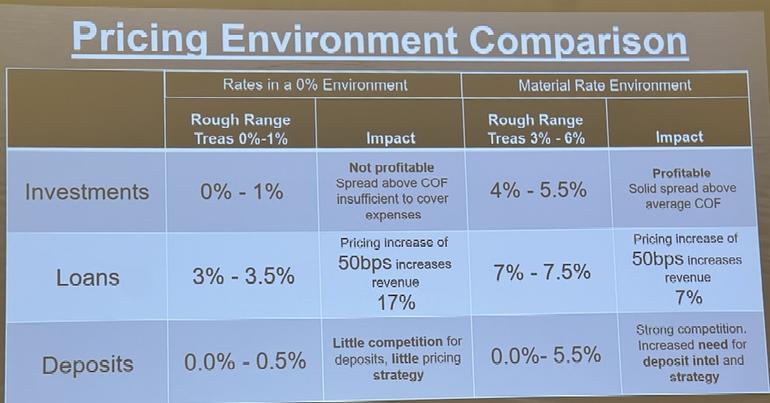
“When you look at cost of funds and see some of what is on the books with investments and loans, that doesn’t feel real good in the current cost-of-funds environment. This can be a little scary,” Zimmerman said. “But, if you reframe it and look at possibilities and what’s available today, new investment yields and new loan yields show current cost of funds isn’t that bad. Those with the wider margins are putting more of this higher-yielding stuff on the books, and how do to that is the billion-dollar question for many of you.”
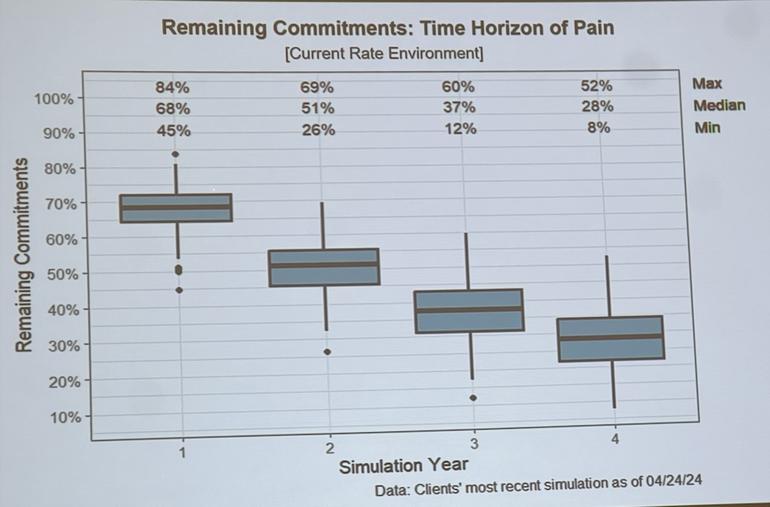
The Time Horizon of Pain
Drawing some laughs from his audience, Zimmerman said CFOs/ALCOs need to be thinking in terms of the “time horizon of pain.” In other words, how long it takes for assets to roll off the books.
In looking to the graphic above, Zimmerman told the meeting, “Those are the averages. Some have a much longer balance sheet. When you are looking at how quickly you are able to take advantage of those higher rates, this becomes a big part of that story.”
To 2024, and Beyond
Johnson said credit unions this year are expected to earn, on average, about 50 basis points. But looking at the balance sheet through a one-year lens is a big mistake, he stressed.
“So often, credit unions look at just one year of their earnings,” he said. “But this session is about margin pressure and strategy. There are some credit unions with strong net worth ratios that are looking to earn next to nothing this year. When you have all this net worth and don’t make ROA, how does it feel? Not fun. You really need to be certain what your strategy looks like and what are some of the trade-offs in pulling back. That’s why it’s important to not just know your earnings in the future year, but future years.
Getting Clarity
Johnson told credit unions the clarity of their unique problem is very important, especially knowing whether it’s a business model problem or is it a timing issue.
“You need to get more clarity on the potential impact of timing,” Johnson said. “The examiners are asking, too, for you to see out a little further. I’d rather be roughly right than precisely wrong.”
Additional Strategies and Advice
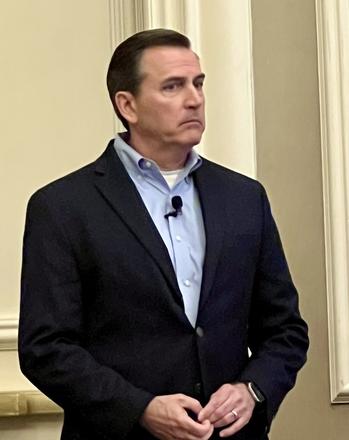
Sean Zimmerman speaking to CFO Council meeting.
Johnson and Zimmerman offered numerous other advice, observations and more for CFOs, including:
Understand the Gears of Your Business Model
Johnson said every credit union should lay out scenarios to see the options to optimize their business model.
“Do you need to adjust your definition of success for this business environment?” he asked. “What you needed when rates were at zero is different from what you need right now. The sooner you actually play it out and see the answers it makes it easier to ask, ‘Do we have more of an issue, or not?’
Strategy Levers
Johnson shared that of the "five levers" available to credit unions, yield on assets was the only lever that got anyone in the room excited. The other four levers are “concerns” for credit union CFOs.
“Credit risk is going up. I’m a little surprised it hasn’t gone up more,” said Johnson. “Just for perspective, how much less is a used Tesla worth today than a year ago? Thirty-five percent. New vehicles are about 30% less. With tax incentives, people buy these vehicles that turns into credit risk a lot of times.”
Johnson noted operating expenses are on the rise with most credit unions in the 5%-9% range.
“When you grow operating expenses 7%, say, and assets are growing 15%, operating expense looks good,” he observed. “When asset growth is near zero and you have 7% operating expense, that is a lot more pressure.”
Non-Maturity Deposits
Zimmerman outlined an example for his audience on how when non-maturity deposits (NMDs) are off by just 5%, it can have some big effects on ROA.
“We are finding most forecasts for this year did a very different NMD growth projection than they did last year,” said Johnson. “(People say) ‘It can’t continue at that pace, can it? I hope it doesn’t.’ But we’re not in the hope business, we are in the clarity business.”
A show of hands among the audience found a common strategy among many CUs that are allowing some of the deposit outflows with a plan to catch it on certificates.
“When you do fast pricing, the year-one impact is tougher. Numbers are information. They are not the decision,” said Johnson.
He pointed out it can be very costly to raise deposit rates 100BPs, especially if the credit union is not growing, and he urged CUs to know their environments and their operating expense.
“This does show why it is important to make sure you are getting solid outcomes from expense decisions,” said Johnson. “This isn’t about being the ‘CF’no’, it’s about understanding really well what you’re going to get out of (an expense decision).”
The KPI on KPIs
On the loan side, Johnson said that what often happens in a credit union is a decision is made to set a loan growth target of 10%, for example. That target then becomes the metric, not the profitability of the loans. To hit the target, a CU will often lower rates, which, as Johnson observed, has the unfortunately effect of helping staff to get a bonus for “hitting goal of making less money.”
“Loan growth that is not priced appropriately can result in less earnings than not growing,” said Johnson. “KPIs of growth without further consideration can hurt.”
Credit unions were again reminded to ensure they are testing all assumptions.
“On the KPIs, one thing we like to say is while understanding the number is important, the formula to remember is ‘WHY> #’,” Johnson said. “Understanding the why is more important than the specific KPI number. One thing I would specifically advise is not to get so caught up in a specific time period. You need to look at it over a longer term and from a wider perspective.”
Know the Flow
Zimmerman said every credit union needs to understand how much of the deposit outflow/shift is due to:
- Inflation-consumer spending more?
- Member moving for higher return inside CU?
- Member moving for higher return outside CU?
- Wealth transfer?
“As you look to wealth transfer, that’s been happening, but it was affected by COVID,” said Johnson. “If you understand where you are leaking money, it helps you with your pricing response. Sometimes, it doesn’t matter how much you pay, you’re not going to retain those dollars. Maybe you want to get your wealth advisory program, if you have one, involved earlier.”
Johnson said CFOs need to track and watch non-maturity deposit growth and maturity deposit growth separately, and not just track total deposit growth.
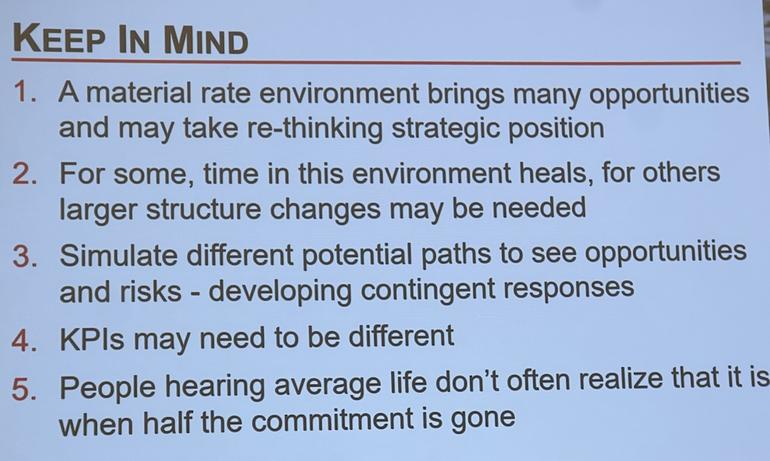
Finally, Johnson urged CFOs to keep in mind the questions outlined below.