

By Ray Birch
TYSONS, Va.—Carefully monitoring member demand, and meeting them in their channel of choice, is how the nation’s third-largest credit union has addressed whether or not to close lobbies—and then when to reopen them.

“We have 47 branches and we closed four of them during this crisis,” said Jamie Gayton, EVP of member operations and global fixed assets at the $25.1-billion PenFed, noting the remaining offices all have remained open, with 19 locations serving members via drive-thrus only. “The four offices we closed were located on restricted areas, like one at West Point where there are no cadets during the pandemic, and another in a hospital where they asked us to temporarily close.”
Running in Reverse
How PenFed has handled branch service during the pandemic—whether closing lobbies to serve members via drive-thrus or keeping offices functioning as normally as possible—is a strategy Gayton said the CU is running in reverse as it reopens lobbies with states lifting stay-at-home orders.
“What we have done is migrate our service to make sure we're meeting the demand at each location and meeting members in their channel of choice,” said Gayton.
That strategy and others are being shared as part of a week-long CUToday.info series on the reopening of credit union buildings and workplaces, a process that as reported makes clear involves far more than disinfectant and social distancing practices. The analysis included in this report is the fourth in the series. Earlier reports are here, here and here.
“When the pandemic hit we monitored demand at each office and when it started falling as people became less comfortable going out to a branch, we first reduced the hours—such as going from nine to five to nine to three and then maybe nine to one. Again, hours were set by demand at each office,” explained Gayton.
If demand for service dropped further at a location, PenFed closed the office on Wednesdays.
“Finally, the next stage of our plan is if branch traffic falls to a certain point, we close the lobbies—but only at locations where we have drive-thrus,” Gayton said.
A Shift to Call Centers
When traffic at offices fell to a certain level, PenFed then shifted some of the branch staff to call center duties.
“We have found that phone calls have become the channel of choice for our members during the pandemic,” said Gayton. “Our call volume grew by 16% in the last month. It has been an easy transition for our branch staff who have moved to taking phone calls—they do the same work they did in the branch, just now over the phone. And they all got up to speed on our phone system quickly.”
Gayton said the approach not only has kept members happy and service levels high during the pandemic, it is a strategy that works well in reverse.
“Now that stay-at-home orders are being lifted across the country, we will take the exact same steps we took to wind down branch service to wind it back up—just go the other way,” explained Gayton.
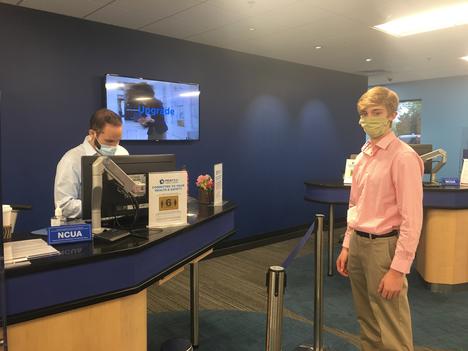
At PenFed's Fort Myer Branch in Virginia, Jamie Gayton's son, Teddy, demonstrates how social distancing is being maintained.
That means at locations where branch traffic begins to pick up, PenFed will first shift staff who migrated to the call center back to the office, reopen lobbies, and then adjust business hours back to normal.
“What we like about this approach is we can turn it on and off,” Gayton said.
Ready to Adjust Again
Gayton emphasized that will make it easy for PenFed to adjust to what is expected to be a changing health crisis—if the country shifts gears after reopening the economy and once again states issue stay-at-home orders.
“As states are starting to reopen, what we're doing is monitoring our member traffic in each of the locations to understand what our members need,” said Gayton.
With PenFed keeping many of its lobbies open during the crisis, Gayton said the credit union has learned things that could help other CUs as they reopen their locations.
In addition to having marked spaces on the floor for members to safely stand in line, stanchions in place, and an employee at the door to limit the number of people inside at one time, Gayton said PenFed staff suggested an effective way to keep members from getting too close to tellers.
“I visit the branches often and I would see some members get up really close to our tellers, forgetting the six-feet restriction. That can be a natural thing to do when conducting a financial transaction,” said Gayton. “An employee in one of our locations suggested placing two stanchions with a retractable belt in place a few feet away from the teller counter. That changed everything. That makes members stand back and reach over the belt to work with the teller (see photo).”
Smiles in Their Eyes
Gayton added what will also make staff more comfortable and less concerned about going to work with open lobbies is strong communication from leadership about what they can expect to experience and confirmation the company is taking every precaution to keep them safe.
“When you're transparent and you explain to your teammates exactly what's needed, why it's needed, and what you're doing to take care of them, that has made all the difference among our staff who have been working in lobbies during the health crisis,” explained Gayton. “I know, I can see it on their faces when I stop in. I tell them that while I can’t see their smiles behind their masks, I see the smiles in their eyes.”