

By Ray Birch
LAKE FOREST, Ill.—It was a record-low year for overdraft revenue among FIs in 2020, reveals a new report that indicates credit unions are not just doing better than banks at responding to the slide but potentially setting up a record year for CU fee income in 2022.
The new report from Moebs $ervices, based on a recent survey of 3,180 financial institutions nationwide, also reveals a concerning trend—more consumers are turning to payday lenders and away from overdrafts due to the pandemic and FI OD pricing.
The Moebs $ervices Annual Report on Overdrafts shows 2020 overdraft revenue among all FIs was $31.3 billion, the lowest total since 2005. The study further shows last year financial institutions tallied the lowest number of OD transactions in 28 years since 1998—and the fewest yearly overdrafts per checking account ever.
Much of the drop in OD performance among FIs, and the growth of payday lending, can be attributed to the “new world” of overdraft pricing and the changing state of checking, according to Michael Moebs, economist and CEO at Moebs $ervices.
“Consumer overdraft behavior has totally changed,” said Moebs. “Banks, credit unions, savings banks and the fintechs need to adjust strategies or see their consumer transaction accounts fade along with a reduction of fee revenue.”
CUs Start to Adjust
Moebs suggested many credit unions are beginning to adjust to the new world of checking and overdrafts, pivoting more quickly than banks.
“Banks and savings banks are clinging to the old world, especially the big banks, while the CUs, especially the big ones, are starting to accept what’s new,” said Moebs. “Also, let’s not forget the financial impact—net interest margins are falling.”
What is happening is many banks and credit unions are treating transaction accounts as a penalty and not as an error, explained Moebs.
“Banks, CUs, savings banks and fintechs, at year-end 2020, were charging penalty prices of $32 for banks, $30 for CUs, $30.50 for savings banks and $35 for fintechs, with the average and median national price $30,” said Moebs. “More important is the average OD Limits offered at the end of 2020 are the same $500 limits offered in 1998. With no increase in overdraft limits in 22 years, the consumer is heavily restricted.”
Moebs said the combination of high price and low supply, as represented by the small $500 limits, is a demand and supply “nightmare” for the average consumer.
“This is why payday lenders both at the state and Internet levels provide almost half of the overdraft business,” he pointed out.
An ‘Acceleration’

Michael Moebs
“The average payday lending fee is $18.25 for $100 advanced,” continued Moebs. “Surveys by the FDIC, CFPB and Moebs $ervices show the normal overdrawn consumer account balance at the end of the day is less than $100. Plus, the $100 payday lender advance is good for 14 days, while typical depositories will not go past seven days and then will often charge another sustained OD fee. Consumers do not want to pay a $35 penalty price for each transaction at a big bank for 24 to 48 hours and then face another charge. The pandemic has accelerated consumers’ rejection of penalty ODs with more people choosing payday lenders for lower price, higher limits and longer payback periods. Overdrafts measured per user has fallen during the pandemic to 2.5 per transaction account per year.”
With that trend leading to a greater risk for financial institutions to lose transaction accounts, Moebs said credit unions are making the most strides in adjusting overdraft pricing.
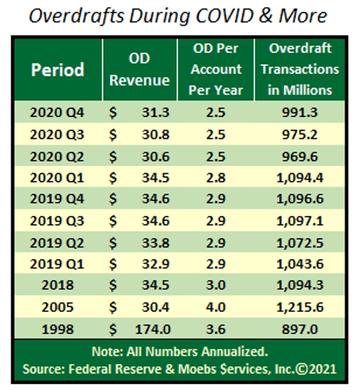
Moebs pointed to the data shown in the table at right, which reveal overdrafts hit their low in the second quarter of 2020 when the pandemic wa starting to take hold.
“Banks, savings banks and fintechs for the last half of 2020 showed 1.75% increase in overdrafts,” said Moebs. “Credit unions are the big leaders, besting their competitors and increasing overdrafts by 4.33% in the last half of 2020. Credit unions should rebound to 2019 OD levels by the end of 2021."
Adjusting Strategies
Moebs said credit unions are adjusting strategies to compensate for net interest margin compression and being overstaffed.
“The larger CUs see this and are offering $25 or less for an overdraft transaction, which they have found gets them more revenue from volume of transactions,” said Moebs. “A year from now CUs will be making more than $7 billion in fees, led by ODs, and this will be an all-time high.”