FT. LAUDERDALE, Fla.–A changing workforce is demanding changes in how credit unions respond as employers, and a CUNA Mutual exec is sharing what that company has learned about “push and pull” factors, why “EVP” is critical, and why one question that often isn’t asked of employees should be.
Speaking virtually to NAFCU’s CFO Conference, Linda Nedelcoff, EVP-chief strategy and HR officer with CUNA Mutual Group, offered a range of insights for credit unions need to be thinking about when it comes to their current and future workforces.
Nedelcoff noted it’s no secret the pace of the changing workforce has accelerated during the pandemic, creating a scenario in which all organizations are facing the same conditions: uncertainty, complexity, rapid change and competition. For those reasons, CUs must also accelerate their responses, she said.
While those conditions aren’t new, Nedelcoff said what is new is the “extremism, the pace behind them, the intentionality behind them and the impact of the trends, which are quite different from what employers have faced up until recently.
“When we think about these conditions and the workforce, I’d like to introduce a term I think is becoming a larger structure about who we are as an organization, and it’s the ‘human experience’,” she said. “The last couple of years have really driven down the understanding the employee is really a human. These are conditions we are facing in our workplaces and that our workforce is experiencing as individuals. These are disruptors and they are stressful.”
Nedelcoff said credit unions as organizations and employers must recognize the landscape is now one of a “human condition crises.”
“When we think about some of those disruptors it’s more than a global pandemic. On the business side, it’s digital acceleration, changing market conditions and rapid innovation. On the talent side it’s attrition, changing skill needs, tight labor markets, and safety concerns.”
The Benefits of Being Clear
Nedelcoff said she believes CUNA Mutual benefitted as the pandemic took hold by being very clear about who it is and then leaning into it. She credited CEO Bob Trunzo with emphasizing transparency, which means not just sharing the good news but sharing when “things are not working out the way we had anticipated,” as well.
As an example, she noted that in 2016 the company underwent what she called “efficiency measures” that led to staffing changes. When CUNA Mutual conducted an employee survey in 2017, “What we heard was, ‘You did this to us, not with us.’ That has spun off this notion of transparency.”
That transparency become critical as the pandemic spread in early 2020 and CUNA Mutual employees were seeing friends and family lose jobs, raising similar concerns inside the company.
“We said, ‘Let’s just take that off the table,’ and very early on we indicated we would not be doing layoffs. That didn’t mean we wouldn’t be looking for efficiencies or innovations or the chance to respond to changing skill needs, but we wanted to be clear from the front about how what they were seeing around us would impact our workforce,” said Nedelcoff . “It was a small step, but it had such a substantial impact.”
The Push Factors
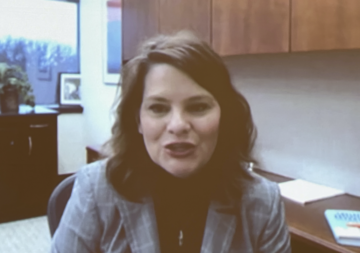
Linda Nedelcoff of CUNA Mutual speaking virtually to NAFCU CFO Conference.
Nedelcoff, who throughout her remarks to the NAFCU meeting stated there is no one singular playbook to follow and that each organization must develop its own, addressed an issue every employer is facing, the so-called “Great Resignation.” It is being driven by several “push” and “pull” factors, she said. The push factors include changing employee expectations, low wages, burnout, poor leadership, lack of opportunity and “misaligned EVP.”
“Nineteen-million U.S. workers have left their jobs since April. Forty percent of the employees surveyed indicate they are seriously considering leaving their job in the next year, according to McKinsey,” Nedelcoff related. “Even more interesting to me is a third of that 40% are willing to do it without a new job in hand. There could be other factors driving that, but nonetheless you have individuals in the workplace saying, ‘I am willing to give up what I know for something I don’t know’.”
As others have also noted, low wages alone are not the reason workers leave jobs, even though it’s what employers often believe. Instead, surveys show employees say the most important factors in job satisfaction are lack of empathy, relationship with manager and a sense of belonging.
Can’t Be ‘Transactional’
“My takeaway is compensation matters--you can’t lag in the marketplace--but compensation is a starting point,” said Nedelcoff. “At the end of the day what employees are watching is if it’s just about compensation, it’s a transactional relationship. The other thing the pandemic has taught us is this huge need by humans to have a social engagement, including with our organizations.
“You know this with your members,” Nedelcoff continued. “What happens if it’s just a transaction? If you can find that transaction somewhere else at a lower price, we make that shift. So, it’s about understanding the relationship around that transaction.”
While a majority of workers have stated they are burned out, the biggest issue in losing employees that is heard “time and time again” is poor leadership, Nedelcoff reminded.
“We’ve heard the phrase ‘people don’t leave their companies, they leave their managers.’ It’s always been a significant factor in pushing people out of organizations. During the pandemic this has existed, but really, really got amplified. For a lot of people, especially those working virtually, their main and sometimes only connection with their organization was their leaders. If that wasn’t being nurtured, it really heightened what pushes people out.”
According to Nedelcoff, what employees are really searching for is the notion of “how can I be a part of an organization and how can I have something more and transform my skills. The beautiful place in which credit unions sit is we are truly, truly mission focused, and we don’t have to go far to hear the stories.”
Misaligned Employee Value Proposition (EVP)
EVP, said Nedelcoff, is all about the engagement and relationship with employees.
“It’s the things that are said and explicit as well as what’s unsaid and more implicit,” she explained. “It goes beyond the transactional relationship. EVP is very unique to organizations. It’s not pool tables and free coffee. Those are artifacts that sit around your EVP. Your EVP is really about your culture, your value system, how it shows up in the benefits you deliver and the commitments you make. If you’re EVP is saying one thing and your behavior or experience is doing another, that is often what will push employees out of an organization.
“Another thing is if you have a different member proposition than your employee proposition,” Nedelcoff continued. “Employees will see a disconnect. They will say, ‘It’s OK for us to invest in this commitment to our consumers but it’s not OK for us to invest in our commitment to employees?’
Spending a little time on your EVP is really, really important for your organizations.”
The Pull Experience
Employees aren’t just pushed out of organizations, they are pulled toward others, according to Nedelcoff, who said conditions that create the pull experience include wellbeing, work flexibility, inclusion and meaningful careers.
Nedelcoff said a big issue is what she calls “turnover on the job, where they are still there but mentally somewhere else.
“We did a survey and about 60% of our workforce said that post-this-period they would like some sort of flexibility moving forward, whether 100% remote or one day per week remote,” shared Nedelcoff. “Very few have said ‘I want to return to that traditional every day in the office.’ I am very, very mindful that different organizations have different structures from ours. I understand the importance of having the people (on-site) who are connecting with the members who are walking into your facilities. I also understand that for credit unions this could create this two-tiered experience between the employees who need to be there vs. those who have some flexibility, and that can create some friction in organizations.”
One potential lubricant for that friction, according to Nedelcoff, is exploring options around job sharing so individuals can spend part of the week working from home in one role and some time working in-person in a member-facing role.
“At the end of the day it really is about what is driving the flexibility,” she said. “There might be other creative ways to lean into that flexibility. What we ‘re finding is most of our workforce is really driven by their personal demands, and they have found their personal demands can be managed by having flexibility in handling them.”
Why Did You Stay?
Nedelcoff said she has long been a believer in getting a better understanding of why employees stay with the company.
“You all have teams. Members of your team got up and went to work. They are engaged and probably passionate. Why do they do that? Why did they pick to do that today in a world where there are all these pull factors?” she asked. “It’s a great question, and I like to ask it. ‘You made a choice today. Why did you make that choice? On days that you struggle, why do you struggle?’”
Nedelcoff said she often reminds her team that the very issues they are dealing with related to employees also apply to members and their experiences. Solving issues for employees can also work to solve issues for members, she added.
Future Proof Employee Experience Strategy
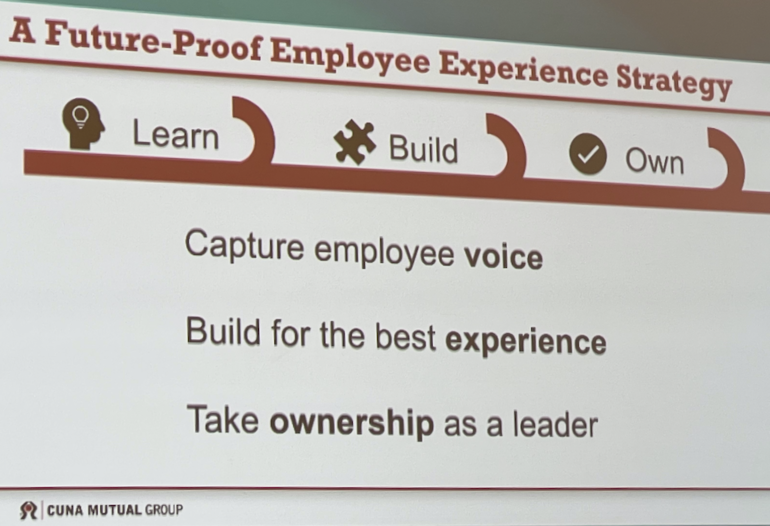
Nedelcoff said CUNA Mutual uses an outside vendor to capture employee voice, which she said is “critical to how we learn.” In capturing employee voice, she recommended building an employee listening approach, trusting the CU’s talent and doing your own research.
In building for the best experience, Nedelcoff said the member experience is found at the intersection of environment and culture, the employee him/herself and moments that matter. To create that, she recommended, “Start small but think radically,” as well as using design-thinking and practicing agility.
Understanding Personas
Nedelcoff said CUNA Mutual is working to understand the various types of personas that exist within the company and is thinking about how to create an experience for those employees at those moments in time.
One example: CUNA Mutual migrated from a near-100% in-person work environment to a near-100% virtual workforce, and is now migrating to having more people in offices at the same time more people are remote. Among the issues it is reviewing are what are the employee expectations? What are the company’s policies?
“The other thing we’re thinking about is the onboarding experience,” she said. “How do we create this engagement and the understanding you are part of something bigger?”
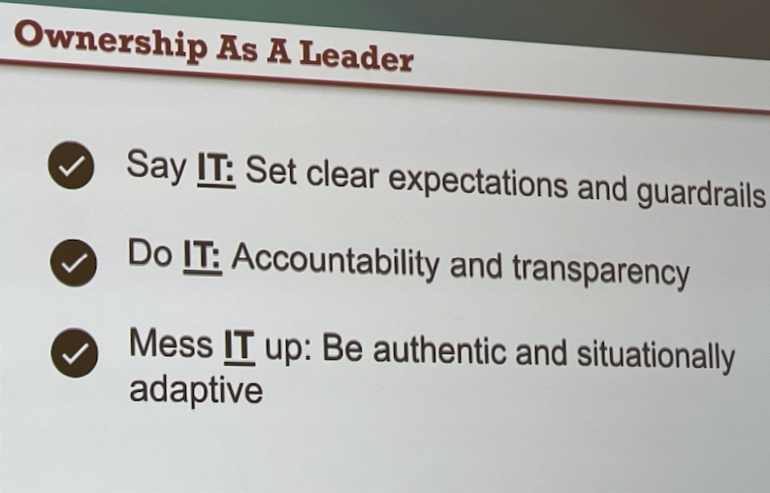
Ownership as a Leader
“We are learning from our experiences. And you know what? Our employees appreciate that. They appreciate that we are figuring it out,” said Nedelcoff.
As credit union execs reconsider their own roles as leaders, Nedelcoff recommended the following additional questions be asked?
- What do I need to change about our current employee experience?
- How am I uniquely positioned in my role to do so?
- What is preventing you from being bold?