

SAN FRANCISCO–When it comes to your brand, above all, a credit union can’t become stale. And it really helps if you have fun along the way and avoid the haters, according to skateboarding legend Tony Hawk.
In remarks to the 25th annual CUNA Marketing and Business Development Council meeting here, Hawk shared his story and the career lessons he has learned—often the hard way–in building an international brand out of beginnings where he hoped to win $150 and there was no professional future in skating.
Hawk, who is now 49, grew up with modest means San Diego with a dad who was in the Navy and a brother who was 13 years older than him and a skater. He borrowed his brother’s blue fiberglass Bahne skateboard one day, and admits there was “no epiphany or angels singing” when he did so. Instead, that came later when he was invited to a local skate park called, fittingly, Oasis.
“And there I saw these guys literally flying out of empty swimming pools, and that was my ‘wow’ moment,” Hawk said. “I did everything I could to learn these techniques. I was scrawny and short and ended up getting hurt a lot, much to my parents’ dismay. I had a concussion. I knocked my teeth out and woke up in an ambulance thinking, ‘Man I got to figure out how to do rock and rolls better.’ I had so many visits to doctors that I literally had a doctor ask me if something was wrong. But I wasn’t afraid to get hurt in the pursuit of progress. That was my lesson.”
Even though his father was commissioner of the local Little League, Hawk said he finally told his dad he didn’t want to play baseball. And he was surprised when his dad actually supported his decision, saying he recognized his son’s passion. “I liked that I could rely on my own success and didn’t have to rely on the team. I never wanted to disappoint the team,” Hawk said.
Developing His Own Style
But Hawk had also taken to skating at an inauspicious time; the sport was dying and skate parks were closing. He finished second to last in his first competition, although in the process he developed a unique style in which he learned to propel himself without reaching down and touching his board, which no one was doing at the time.
“I got a lot of flak for that. People said I was cheating,” said Hawk. “I was already in this outcast activity, and then I was an outcast in this outcast activity, and it felt isolating,” he told the CUNA Marketing meeting. “It was my first experience with haters; it set me up for the future in a good way. I realized I had to believe in myself. Eventually, that style of skating caught on. At at that time the top prize money was $150 and the competitions were few and far between. The best you could hope for was to get your picture in a magazine and get some gear. So, obviously I wanted to go pro and get rich with that $150.”
Hawk would eventually get far richer than $150 from his skating career and the brand he would build.
By age 12, Hawk had gotten good enough to be sponsored by Dogtown Skateboards. By 14, he was a pro, and by 16 he was widely considered the best skateboarder in the world. In the ensuing 17 years, Hawk entered an estimated 103 pro contests, of which he won 73 and finished second in 19. He was the world champion for 12 years in a row.
At the time he turned pro, however, Hawk recalled how “skating was below nerds in school. But it started to grow in popularity. I would fly to Florida for a weekend competition and then fly home and be a ghost in the (high school) hallways. That was the paradox. I didn’t really think it would be a career. Fortunately, I was young and naïve enough to not really care.”
By his senior year Hawk was making enough money and achieving enough fame to appear in movies that, at his father’s behest, he purchased a house that, naturally, became the party house.
The Paradox of Success
“Let’s just say it was rough to get up in the morning to go to school as a homeowner,” joked Hawk. “One week out of high school, I got tapped to do the movie, Gleaming the Cube. It was Christian Slater’s first movie and we taught him how to skate. I was riding that wave and doing really well in competition, so much so I started feeling lonely, as in the cliché lonely at the top. Suddenly, my peers all said he’s expected to win and that turned into the judges waiting for me to make one tiny mistake. It was more like if I didn’t win, I lost, and I hated that pressure. And I took a lot of flak for it from the skate industry, only because of my success.”
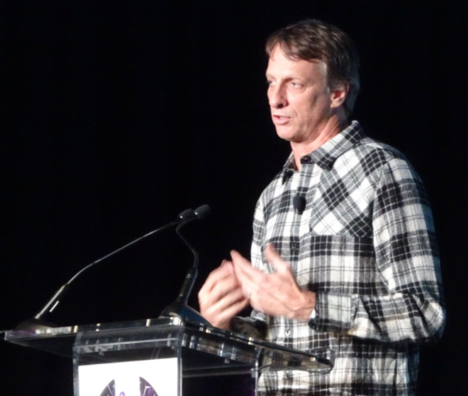
Tony Hawk speaking to CUNA Marketing and BD Council in San Francisco.
Citing the kind of guidance perhaps someone with a credit union might have provided him, Hawk said that at age 19 he lacked a “moral compass” and any understanding at all of what was in the contracts he was signing, in which he granted full I license to use his name any way a company wanted.”
Those contracts led to his name on a lot of “junky” products, including even a roll of toilet paper with his name on it.
The costly lesson for him was one that also applies to credit unions: there is value in maintaining integrity.
“I vowed if I ever had the chance to do anything like this again I would keep control over my name and likeness,” he said. “That was the authenticity I should have been striving for but I was too caught up in the fame.”
After arriving at the top of the skating world, the sport “took a pretty hard decline in popularity,” he related. Royalty checks began to shrink even as he took on another mortgage and had a baby on the way. Hawk said he was even doing three skate exhibitions per day at Six Flags for $100, and budgeting $5 a day for food.
The 'Smart Thing' to Do
“So, I thought the smart thing to do was start my own skateboard company at a time skateboarding was at a low in popularity,” he said. “I just wanted to be in the skate industry and I believed skateboarding would come back. I thought we could establish ourselves with little capital and establish a brand.”
Hawk took out a second mortgage on his home and launched a distribution company, a skateboarding company, signed the top up and coming skaters and began making videos.
“I was learning about video, but also about marketing. They were not Oscar-worthy, but it worked. It created a buzz,” he said. “We were just inching along with staying in business. There were some lean times and we even discussed how we would close shop. But right around that time ESPN had this crazy idea to start an event for extreme sports, the Extreme Games they were originally called. They were not yet the X Games. It was a full experiment of skateboarding, BMX, eco-challenge, bungee jumping. They were just throwing everything against the wall. It felt cheesy, but I knew in my heart if we just stay the course and show our passion, that could shine through all this other nonsense. It was 1995 and it was super-weird; it felt like they were making fun of it at same time they were presenting it.”
At that time his skateboard company, Birdhouse, began to grow, and he also signed a deal with Activision to create a skating-based video game.
Turning Down a Half-Million Dollars
“I signed on immediately. I had to fight to keep my name and likeness. My agent at the time, to his credit, made it happen. They were reluctant, but at the same time they wanted that authenticity with the game,” he said. “We worked on it for about two and a half years…I never thought it would transcend skating.”
Activision offered him $500,000 in advance royalties in exchange for no future royalties, a deal Hawk turned down.
“I was tempted, but at same time Birdhouse starting to take off, X Games was hitting its stride, I had just bought a house, and I said, ‘No, I will let it ride.’ It was absolutely the best financial decision I ever made with my life,” said Hawk. “I knew there was a tipping point in video games and name recognition when the Tony Hawk IV was released, the previous three games were still in the Top 10 in sales. Suddenly, my whole life changed. I had opportunities to do promotions with much bigger brands, like McDonalds and Frito Lay, and I got to keep the final approval over what was done.”
But not everyone embraced his good fortune.
“When you do sponsorships with McDonalds and Frito Lay, you get a lot of hate. I didn’t really care. I knew in my heart I was representing skateboarding well. But it’s hard when the industry you love starts to turn on you.”
A Foundation & The Olympics
Having made his fortune in skating, Hawk explained he created a foundation that sponsors the building of skate parks in cities around the world. In 16 years the foundation has assisted in the building of 600 skate parks, having raised $6 million. He has even led the creation of Skateistan in Afghanistan.
Skating will likely only to continue to grow, especially globally, now that the sport has been added to the 2020 Summer Olympics.
“I have mixed feelings about that,” said Hawk. “The Olympics think they are doing us a big favor, but the reality is I know they need our cool factor more than we need their validation.”
Today, Hawk said he has worked to remain relevant as a brand, especially on Twitter (even though he acknowledged the platform means ignoring the “haters on a much bigger scale”).
“I got on Twitter very early. It’s hard when you are a person and a brand,” he said. “It’s hard to keep it fun. About 10 years ago I was driving to skate one day and I was looking at Twitter and I saw how prolific it was and how well it travels.”
To have fun he often has skateboards hidden in various locations and then drops clues using Twitter on finding them.
“Twitter is a focus group at my fingertips that is very honest and very immediate,” he said.
Advice For Credit Unions
When asked by one person what his advice is for credit unions seeking to stay authentic amid all the competition in the market, Hawk urged CUs to engage with members and try to have fun in social media. He cautioned against sounding like a “big corporate message.”
“That stands out, and I think that’s how I rose above all the other brands and athletes by sticking with it but not being stale,” he said.