

By Ray Birch
LAKE FOREST, Ill.—After a long run at the bottom, deposit interest rates are poised to move higher, one economist is forecasting, citing several factors for the prediction.
“Credit unions should be prepared to protect their share of the more than $4 trillion in deposits that are at stake,” said Michael Moebs, economist and CEO at Moebs $ervices, who believes deposits rates will begin to move higher in December of this year or January of 2022.
What will trigger the increase? Numerous economic factors, explained Moebs.
“The COVID Delta variant is not fully out of the minds of consumers or depository management. The logistics of getting branches, front-line employees, stay-at-home workers in place is a nightmare. Eighty percent of the stimulus funds are in checking, savings and MMDAs, and could leave tomorrow. Consumers want to spend for food, get-togethers, clothes, Christmas presents...a lot of pent-up demand,” said Moebs. “Rates need to move up fast to counter these economic demand elements, which include inflation.”
Moebs said the Federal Reserve is well aware of these pressures.
“Most definitely the Fed will play a role,” he said.
‘The Only Direction is Up’
According to Moebs, the movement of rates in recent years offers some insights into what is likely headed the way of credit unions and other financial institutions.
Moebs urged banks and credit unions to pay close attention to the movement of the “portfolio rate.”
“The portfolio rate is the average of 11 service rates (see chart),” explained Moebs. “Currently, this goes from a three-basis-points average for interest checking to 31 BPs for 60-month CDs. Individual depository rates will vary based on market and financial institution conditions. The high of the portfolio rates is in the spring of 2019 before the coronavirus struck. Today the portfolio rate is 78% off the high. The only direction is up.”
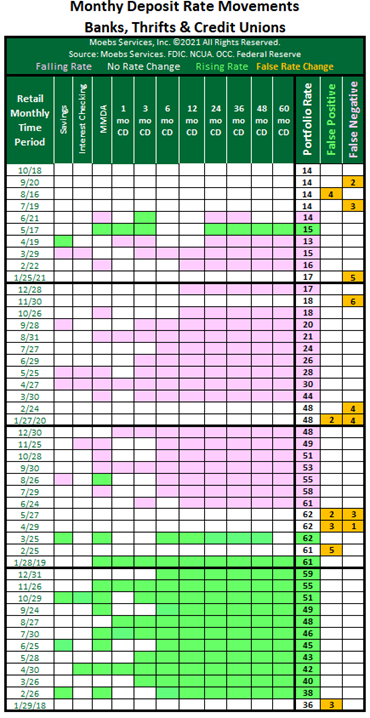
Moebs said credit unions need to be wary of “false rate changes,” where a rate changes one month then reverses course the next.
“For almost four years (see chart) there have been significant transition points, including the state of rates right now,” said Moebs. “In 2021 there was a significant change in May to increase rates, but this was thwarted by four false positives and five false negatives created by the Delta variant of COVID. If the Delta variant subsides and no other COVID irregularities emerge, deposit rates will increase over the holidays or shortly after January 1.”
In 2018, for example, the portfolio rate rose from 36 BPs to 62 BPs in a year, or a 72% increase, noted Moebs.
‘Watch the Competition & Pounce’

Michael Moebs
“The only service to come back to its pre-COVID rate is savings or shares. Interest checking and money market deposit accounts are just one BP each behind,” Moebs said. “CD rates are down by 64% from 2018. CD balances are down 58.6% from pre-COVID amounts and jumbo CD deposits are off by 22.5%.”
Checking balances are up 101.9% from pre-COVID levels.
“This is a historical high since money supply started to be tracked in 1914 and in more detail 1958. COVID stimulus funds are resting mainly in checking, savings and MMDAs,” Moebs said. “There are excess funds of $2.4 trillion in checking alone, with $2 trillion in savings and MMDAs.”
Moebs said it is time for banks and credit unions to protect checking, savings, and MMDAs “at all costs. Crucial rate increases of 25 BPs to 99 BPS or more will be needed in these accounts. You need to be first here. Carefully watch the competition and pounce.”