

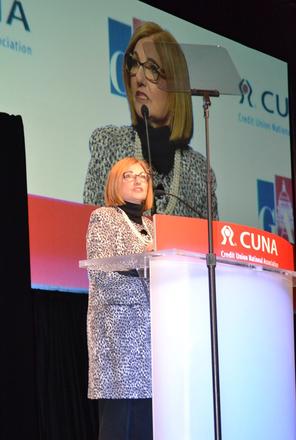
WASHINGTON—Saying that 2015 will be the “year of regulatory relief,” NCUA Chairman Debbie Matz promised the risk-based capital rule will be the last significant safety and soundness rule change from the agency for the foreseeable future—adding that a separate interest rate risk rule (IRR) may not be coming.
Instead, IRR may be addressed through the supervisory process, Matz proposed during CUNA’s Governmental Affairs Conference Monday.
Matz also offered comment on field of membership, removing the limits on fixed assets, permitting asset securitization, and easing member business lending.
NCUA plans to finalize its proposed asset securitization rule to allow larger, qualified credit unions to securitize assets later this year.
“We’ve invited stakeholders to comment on alternative approaches to reasonably account for interest rate risk,” Matz stated. “We are considering an option—to examine for interest rate risk through the supervisory process, rather than proposing another rule.”
Matz invited credit unions to let NCUA know how the agency should deal with CUs exposed to excessive interest rate risk. She also outlined five “new” areas of regulatory relief the agency will work on this year:
Supplemental Capital
Matz explained how “stakeholders” have suggested that under current law NCUA could count certain forms of debt as supplemental capital for the risk-based capital ratio.
“For example, subordinated debt could be issued to non-members and members—but it would be uninsured,” said Matz, noting such a move would require three changes beyond risk-based capital: providing consumer protections; changing the order of NCUSIF payout priorities to recognize that supplemental capital accounts are not insured, and setting prudent standards for CUs to offer subordinated debt to supplement their risk-based capital.
“This includes setting minimum redemption periods to ensure the capital is available to cover losses during times of stress,” Matz said.
As part of “modernizing” risk-based capital, Matz emphasized that she is committed to allowing supplemental capital to be counted in full.
“I am open to proposing rules to accommodate these forms of supplemental capital through regulatory changes,” she said. “The effective dates would coincide with implementation of risk-based capital in 2019.”
Saying not all CUs need to wait until 2019 to benefit from regulatory changes on supplemental capital, Matz said the agency has assembled an internal working group focusing on low-income credit unions that can already raise and count secondary capital.
“The goal is to explore ways to increase access to secondary capital for low-income credit unions—this year. This could include regulatory relief to make secondary capital more attractive to potential investors in low-income credit unions whether federally or state-chartered,” said Matz, adding the agency is prepared to discuss potential legislative and regulatory changes that could benefit all credit unions interested in raising supplemental capital.
“No surprise, there’s lots of interest in this working group,” continued Matz. “To make sure the discussions are inclusive and cost-effective, the group plans to hold a series of conference calls with credit unions and others around the country, starting this month.
“I want to be clear—NCUA can allow certain forms of supplemental capital for both risk-based capital and low-income credit unions. Please understand, for credit unions without a low-income designation, legislation is required to allow supplemental capital to count toward the 7% net worth leverage ratio,” added Matz.
Expanding Fields of Membership
Matz emphasized that CUs should not be required to obtain approval from NCUA each time they want to add a group, saying the goal is to make it easier for FCUs to expand FOMs. “To do this, I’ve created a working group to recommend options for more inclusive fields of membership that will identify obstacles facing credit unions looking to expand. The group will recommend rule changes to provide more flexibility to federal credit unions.”
Matz stressed the agency won’t “wait for Congress. By the end of this year, we’re going to move forward with sensible rule changes within NCUA’s legal authority.”
Removing The Fixed Assets Limit
Saying CUs should be able to prudently and deliberately make decisions about the appropriate level of fixed assets to hold without “needless” red tape, Matz said the upcoming fixed assets limit rule, likely to be proposed at next week’s board meeting, will eliminate the 5% cap on fixed assets.
Permitting Asset Securitization
NCUA plans to finalize its proposed asset securitization rule to allow larger, qualified credit unions to securitize assets later this year.
Easing Member Business Lending
NCUA plans to eliminate the business loan waiver process.
“I understand that requiring a personal guarantee on every business loan can be frustrating and can lose business for you,” said Matz. “The bottom line is—you know your members’ needs better than we do.”