

By Ray Birch
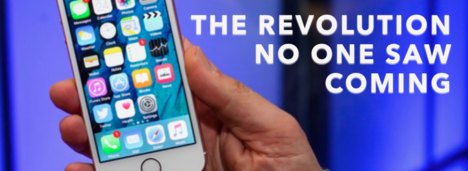
BIRMINGHAM, Ala.—With an impact that rivals or even exceeds inventions such as the printing press and radio, Bill Hardekopf says the revolutionary effects the iPhone has had on banking could not have been predicted when it was introduced 10 years ago.
“There are so many people that handle all of their banking needs today by never going into a branch,” said the CEO of LowCards.com. “It would probably make our grandparents turn over in graves to know just how much money is handled with this little smartphone. To deposit a check remotely, 10 years ago, that was a mind-blowing concept.”
Hardekopf noted that even the size of the device limited consumers’ and financial institutions’ vision for what the phone could become.
Branch In Your Pocket
“Who thought it would be a branch in your pocket? No one,” said Hardekopf. “There are certain inventions that change the world—the printing press and radio come to mind, and now theiPhone and all the smartphones that have followed. It totally changed society.”
The iPhone turned 10 years old in June, and the Apple smartphone and mobile devices that have followed have changed the very concept of how a financial institution—and the services market itself— is perceived. The iPhone has changed the role of the branch by offloading an ever-growing number of transactions, especially payments, to a mobile device, reducing costs and extending the reach of credit unions beyond any fixed geography. But the iPhone, and the devices that have followed, have also meant new competitors often built specifically for the platform, while legacy competitors with deeper pockets are also as close as a click for CU members. To mark the 10-year anniversary of the iPhone, CUToday.info is running a series of stories on a decade of change launched by the iPhone that’s likely unmatched in the history of financial services.
It certainly changed the world for smaller institutions, such as credit unions, which no longer have to consider adding branches to compete with banks to reach current and future account holders, Hardekopf said.
“It leveled the playing field for sure,” he said. “If (consumers) rarely go into a branch, I don’t think they care if they are doing business with a small institution, an online bank or a bank with branches on every corner.”

Bill Hardekopf
Engaging Digitally
But the iPhone, as is the case with devices such as tablets, does present a challenge to engaging with account holders, especially for credit unions, he said. Hardekopf acknowledged that CUs rely on personal service—the warm and friendly touch from a teller or branch manager–as a meaningful differentiator.
“How do you do that now with digital?” asked Hardekopf. “This is something that needs to be addressed.”
He also said that while the smartphone can make it easier for a bank or credit union to reach account holders when there is an issue, simply communicating promotions has become more challenging.
“If people just use their phone to bank, they don’t see that sign in the branch about the new credit card offer. They don’t hear from a teller about that new low auto loan rate. There are just so many things that used to take place in a branch that FIs now have to find a way to migrate over to the phone,” said Hardekopf.
Another challenge ahead is consumer adoption of mobile wallets, according to Hardekopf. Experts have cited the slow move to mobile wallets, something analysts did not predict when Apple Pay debuted.
“Digital wallets have not taken off like we thought they would,” said Hardekopf, who believes the biggest obstacles have been security concerns are one worry, while another factor has also played a big role.
No Way To Predict Future
“It’s just not that hard for me to take out my card from my wallet and use it,” said Hardekopf. “I know the chip transaction takes a little longer, but it is still not inconvenient.”
Hardekopf added that while mobile transactions are safe, he believes waiving a phone over a terminal to pay concerns some about the security of their personal information.
“Plus, if I lose my phone, I don’t want someone to break into it and steal my payment information,” he said.
Hardekopf has been covering the financial services industry since 2001. He admits he was not clairvoyant when the iPhone came along in 2007.
“I guess I don’t have any vision, because I never, ever, would have thought that this little device you hold in your hand to make a call would become what it has,” said Hardekopf. “I had no clue that the way I’d communicate with my kids would not be on a land line and that the phone would become a text-message machine. It would become a portable shopping network. It would replace the bank branch for me. It would change the financial services industry.”