


RALEIGH, N.C.–Jim Blaine. Just saying his name is enough within credit unions to elicit a reaction. Admiration from credit unions that have watched the success and growth of State Employees CU, where he is CEO. Trepidation, from trade groups and others whose feet he has held to the fire. Applause or head-shaking, depending on the outspoken view he has taken on his popular blog.
When Jim Blaine retires as CEO of the world’s second-largest credit union later this year, he will do so after one of the most high-profile careers in the movement’s history—even if he wasn’t one for serving on the boards of state and national trade groups. Instead, over 43 years in credit unions, the man who was named CEO at age 30 oversaw asset growth from $50 million to more than $33 billion; grew branches to more than 250 when many have argued the branch is dead; created a culture that has become a farm system for CU CEOs all over the country; has been blunt in criticizing risk-based pricing, charter conversions and other issues that many have been reluctant to speak out about; has helped to create the unique-funded SECU Foundation, which has poured millions of dollars into housing, education and healthcare in North Carolina, and most recently essentially caused the biggest change in CUNA’s structure since its inception.
In this, the first of a two-part series, Blaine shares with CUToday.info thoughts on his career, NCUA, what small credit unions can do to compete, and more.
CUToday.info: Why did you decide to retire?
Jim Blaine: There are a lot of reasons. But the most apparent: They say 60 is the new 40. That may be true, but 80 is not the new 50. So I need to move on. The organization is in good order. The fiscal year ends June 30. And I turn 67 soon. I don’t want to die at my desk.
You should always have an orderly transition within an organization, and we have gotten to a transition point. We have gotten a lot of things done in the last four to five years, and the credit union is at a great point.
I have always been working on projects that are three to five years down the road. At some point you have to stop and let someone else do that. Also, it has been pointed out to me that I announced my retirement the day after (NCUA Board Chairman) Debbie Matz left. There is no connection and you can’t prove that.
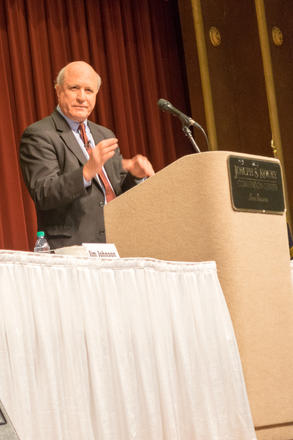
CUToday.info: In your blog, Jim Blaine on Credit Unions, NCUA has regularly been a target. Do you feel you have in some ways been a watchdog over the agency?
Blaine: No. You had asked me if I left anything undone. I have several more months until my successor is chosen. One goal I have is to address in my blog reform at NCUA, and being more direct about that—stating why that is important, why all of us need to get active in addressing rebuilding NCUA into a strong agency and one that is a true partner with credit unions. I think we have lost that.
I think NCUA is in disarray. I think a strong independent agency is very critical to credit unions and we don’t have that now. If we don’t all work on getting the agency where it needs to be, I think it will be taken away. That would be a huge loss.
CUToday.info: Do you think NCUA Board Member Mark McWatters wants to roll NCUA into the FDIC?
Blaine: From what I have heard him say, no. I think the longer he stays there, the better he understands how important an independent agency is for cooperatives. If you listen to him, he has started to raise questions. It has been framed as criticism of Ms. Matz. I don’t think it is. It is independent commentary on what he is seeing the agency do and not do, and how it does things. I think he has become a great voice for reform.
If there was a personality difference with he and Ms. Matz, with that out of the way, maybe it’s the best time in long while to move forward. I could see Mr. (Rick) Metsger—who is politically astute and who has been on the board of a credit union, had couple years at the agency—working together with Mr. McWatters to do some positive things.
The most crucial thing credit unions need to work on is not whining about the agency. It’s not about trying to weaken the agency. It’s about trying to make it stronger, more transparent and more effective. A weak agency is what we apparently have at this point.
I realize that if you read my blog, you would think I am anti-NCUA. I am the biggest pro-NCUA person around. I know that would surprise a lot of people. The humor and the irony in the blog maybe get in the way of people seeing that.
CUToday.info: How did you become involved in CUs?
Blaine: Right out of college I was working as a brick mason and my dad told me I needed to get a real job. So he sent me to Job Services and the lady I interviewed with said that I looked like someone who would make her a loan and that she would send me to the credit union for a job.
I was 23 in 1973. I went to SECU in Fayetteville. I had no idea what a credit union was. But I have been here ever since. We had $50 million in assets then, so not a small credit union at that time.
I began as a loan officer and then I took the assistant general manager’s in Raleigh about a year later after it was offered to me a couple times. I became the CEO in 1979. I had just turned 30 years old a couple months earlier. I firmly believe that had I been 29 at that time the credit union needed a CEO, I would not have been hired.
CUToday.info: Were you prepared to be a CEO, especially at that age?
Blaine: No. I don’t think anyone ever is. I did not have strong financial knowledge—I was a Russian history major in college. I was very young and not experienced with people.
But in being young there is great value in that you are willing to try anything. Yet there is also value in experience, in that you know you tried things before and they did not work.
When I started as CEO I was convinced that credit unions could solve a lot of economic problems for people and I liked that.
CUToday.info: At $33.3 billion today, SECU, compared to most other credit unions, is an asset outlier. What led to that growth?
Blaine: A combination of things. There are a number of ways a credit union can be organized, or oriented, depending on the needs of the members. And there are a number of successful models. But again, the model should be driven by the needs of the membership. That can vary depending on where you are located, the economic level of the membership, and the services you offer.

There is no question that the working man and woman in North Carolina have not been served well by the for-profit financial institutions here. I have nothing against the for-profits, but a plumber or a teacher do not necessarily have great finance skills.
As a credit union we are these people’s advocate. We take the risk out of banking. They know they can come to SECU and get the best deal available regardless of what they know, how they look, or how much they have or don’t have. We don’t risk price. If people understand that they are treated fairly and not taken advantage of they will beat a path to your door. And, the working man and working woman charge the most, which makes it easier for the credit union to grow.
And when you always look out for your members, they become your best advertising.
CUToday.info: You have a huge branch network for a credit union. Will SECU ever back away from that strategy as mobile and video technology simply become the norm?
Blaine: You phrase that question incorrectly. It is not an “either/or” question. We have branches, a website, mobile, contact center, bill pay, ATM network . . . Very few consumers use a single channel.
It is important to our consumers to have all the alternatives. That is something the Ally Banks do not have. We have a very sophisticated mobile solution and it is our fastest area of growth.

But we also have branches in every community if you need to have an important conversation with us and you don’t want to do that electronically or over the phone.
Long range, if you go entirely mobile, we think that won’t work. From what we have learned, we think people will always need a branch. We see that today; people forget their passwords, they don’t recall what they did on mobile, and they want to talk to someone.
Our contact center is our branch system. Instead of putting up a 400-desk building, we have put these call center jobs in our branches. The data lines are already there. Our branch staff are always answering calls from around the state, and they are doing it with a North Carolina accent, which our members like—they are not speaking to someone in another state. Our branch staff know what the weather is locally, they know our members, they can pull up immediately who you are and what your last transaction was . . . There is a lot of value in that.
In part two of this interview, Mr. Blaine shares his thoughts on managing people, his reputation for developing management talent, and why he’s not outspoken.