Debbie Matz, NCUA Chairman
ALEXANDRIA, Va.—Just-released data shows that loan growth at federally insured credit unions in 2014 climbed to the highest level since 2005.
According to numbers released by NCUA, membership, assets, deposits and net worth saw continued positive growth in the fourth quarter of 2014. Net interest margins held steady from the previous quarter and were slightly higher than at the end of 2013.
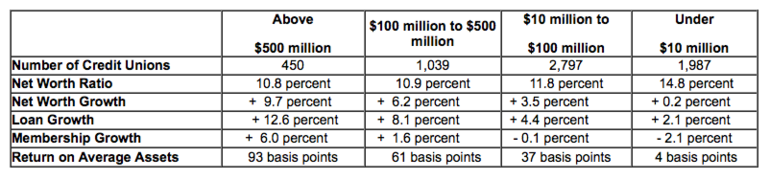
But those are overall industry numbers, and a troubling trend continues for credit unions in that while all CU asset categories saw loan growth in 2014, it is the largest credit unions that are seeing the largest growth. And the smallest credit unions even saw slight declines in membership growth, as the data below show.
“2014 was a very productive year for America’s credit unions,” NCUA Board Chairman Debbie Matz said. “As economic growth stimulated loan demand, credit union loans met the needs of millions of members, strengthened their communities and created jobs that will further boost the economy. Loan growth also helped credit unions reduce reliance on long-term investments to generate income. However, credit unions must remain prepared when interest rates rise.”
Among the year-end numbers, as reported by NCUA:
- Outstanding loan balances at federally insured credit unions grew 10.4 percent between the end of 2013 and the end of 2014, the largest year-over-year percentage increase since the end of 2005. Total loans reached $712.3 billion.
- Loans grew across asset sizes and in every major category.
- Total first mortgage loans outstanding reached $292.2 billion, up 2% from the previous quarter and up 8.8% from the fourth quarter of 2013. Fixed-rate first mortgage loans represented 59.6% of first mortgage loans outstanding at the end of 2014, NCUA said.
- Second mortgage loans reached $72 billion, up 0.7% from the previous quarter and up 2.3% from the end of 2014.
- New auto loans grew to $86.3 billion, up 4.8% from the previous quarter and up nearly 21% from the fourth quarter of 2013.
- Used auto loans increased to more than $143.7 billion, up 2.4% from the previous quarter and up 12.8% from the fourth quarter of 2013.
- Net member business loan balances grew to $51.7 billion, up 2.8% from the previous quarter and up 12.4% from the fourth quarter of 2013.
- Non-federally guaranteed student loans grew to $3.1 billion, up 2.7% from the previous quarter and up 20.1% from the fourth quarter of 2013.
- Payday alternative loans outstanding grew to $37 million, up 16.0% from the previous quarter and up 36.2% from the fourth quarter of 2013.
- Loan growth lifted the overall loans-to-shares ratio to 74.9%, the highest level since the end of 2009.
NCUA noted that federally insured credit unions moved away from long-term investments during 2014. Over the course of the year, only investments with maturities between one and three years increased.
Total investments dropped to $276 billion at the end of 2014, a decline of 3.5% from the end of 2013. NCUA said investments declined in all categories except those with maturities of one to three years, which increased 11.8% from a year earlier, to $99.7 billion. Investments with maturities greater than 10 years dropped 21.6% from the end of 2013, to $5.6 billion.
Other year-end data:
- Membership in federally insured credit unions grew by more than 551,000 in the fourth quarter of 2014 and by three-million for the year. Membership reached a new high of 99.3 million at year-end.
- The number of federally insured credit unions fell to 6,273 at the end of the fourth quarter, 77 fewer than at the end of the third quarter, a decline of 1.2% in the quarter and 4.3% for the year.
- Federally insured credit unions’ return on average assets ratio stood at 80 basis points at the end of 2014, a slight decline from the previous quarter but two basis points higher than at the end of 2013.
- Year-to-date net income was $8.8 billion in the fourth quarter of 2014, an increase of $648 million, or 8%, from the fourth quarter of 2013.
- The aggregate net worth ratio was 10.97% at the end of the fourth quarter, up 20 basis points from the end of 2013 and the highest level since the third quarter of 2008.
- The vast majority of federally insured credit unions remain well-capitalized, with 97.7% reporting a net worth at or above the statutorily required 7.0% leverage ratio. At the end of the fourth quarter of 2013, 97.2% of credit unions were well-capitalized.
- Asset growth in 2014 outpaced growth over the previous 12 months, with total assets reaching $1.12 trillion. Total assets grew by $60 billion, or 5.7%, for the year.
- Overall, share and deposit accounts at federally insured credit unions rose $11.7 billion during the quarter to $951 billion, compared to $910 billion at the end of the fourth quarter of 2013. Rate-sensitive money market accounts held steady through the year, NCUA said.
- Delinquency and net charge-off ratios for federally insured credit unions held steady from the end of the previous quarter and improved since the end of 2013. The delinquency ratio fell to 0.85% from 1.01% at the end of 2013. The net charge-off ratio held steady during the fourth quarter at 49 basis points year-to-date, a decline of seven basis points from the end of 2013.
- The percentage of loan charge-offs due to bankruptcy in 2014, 19.3, fell 112 basis points below the end of the fourth quarter of 2013.
- Federally insured credit unions with more than $500 million in assets continued to lead in most performance measures in 2014. With $781 billion in combined assets, these 450 credit unions held nearly 70% of all total assets at the end of the year. They also reported a higher return on average assets than credit unions as a whole.
- Credit unions with assets of less than $10 million recorded higher net worth ratios and higher loan growth than they reported in 2013. These credit unions rebounded from the end of 2013 in return on average assets but saw membership decline.