

ALEXANDRIA, Va.–NCUA held a budget briefing here at which two members of NCUA’s senior staff and seven people from the CU community offered their views, with one CU CEO saying his own CU spends more time justifying proposed expenditures than does the agency itself.
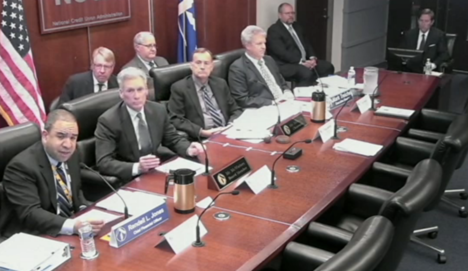
NCUA CFO Rendel Jones speaks to NCUA budget briefing.
But the hearing may change some of that sentiment. It was the first budget briefing hosted by NCUA in years and lasted more than two hours. At issue was the agency’s 2017-18 budget, why it continues to grow as the number of CUs declines, and what future budgets might look like.
Both NCUA board members stressed in their remarks that the point of the hearing was to provide greater transparency around the budget—an issue that has been championed by Board Member Mark McWatters—and that they alone would make decisions related to the budget.
Prior to various parties sharing their thoughts on the NCUA’s budget, both NCUA Chairman Rick Metsger and McWatters shared their views. McWatters voted against the NCUA budget the two times the issue has been before him while he’s been on the board, but as he made clear in his remarks that “no” vote was not related to the amount of money the agency had budgeted.
Here’s a look at what was said during the briefing, which ran two hours and 15 minutes.
NCUA Chairman Rick Metsger
Metsger said that since being named chairman in June of 2016 he has sought greater input from stakeholders in the credit union community regarding the agency’s budget. He said he has sought to make the hearing more valuable than budget hearings the agency has held in the past that consisted of “pie charts” and a brief time for comment from parties that had not previously seen the budget figures.
“We have provided 78 pages of details on the budget, representing each of 22 offices and funds,” said Metsger. “No other financial services regulator does that.”
Metsger emphasized, however, as did McWatters later, “We will listen to comments from stakeholders, but the board and board alone will set the budget. This is not a referendum. We have a fiduciary responsibility to the share insurance fund and to U.S. taxpayers.”
Board Member Mark McWatters
Noting he had dissented on two previous NCUA budgets, McWatters said he did so for three reasons:

Mark McWatters
“One, since we are using other people’s money, credit union money, we should be more transparent about how we are using that money. It’s been a difficult process over the last two years, and we have put a TON of data on our website. Surprisingly, there have been precious few clicks on that information. People have asked for transparency, it’s a good thing, but perhaps people don’t really want it.
“Two, I thought it would be important to have a budget briefing where we as board members could hear from the public, not just trade groups, for their comments on the budget. These are not comments intended to tell us how to save money on paper clips and pencils. I’m looking for creative ideas, perhaps ideas we have missed. Maybe we’re not the smartest people in the room on every aspect of the budget, so if you have a clever idea, I want to hear that.
“The third reason II dissented was the overhead transfer rate. It wasn’t transparent. I’ve spent 30 years in tax law, some of it complex. When I looked at the overhead transfer rate, it made my head hurt. It’s difficult to understand and took a long time to try to get a feel for it. We are working on a new overhead transfer rate. That doesn’t mean it’s an overhead transfer rate everyone in this room will like, but hopefully one you will understand.”
McWatters noted in closing that his dissent has not been about “ranting about the size of the budget. It was about transparency. That’s one thing people miss. I’ve said in my two dissents that this agency should have the confidence to increase the budget to hire more people if that’s what we need to do to keep the credit union community safe and sound.”
NCUA Executive Director Mark Treichel
Treichel pointed to the changing demographics of credit unions, noting as the agency has frequently that CUs of more than $500 million in assets hold 62% of member share, and 73% of all assets in credit unions.

Mark Treichel
He said complex services offered by more complex credit unions now require more examiner time, and that while the number of credit unions overall is declining, the time needed to supervise is growing.
He said that the consolidation of credit unions has meant greater distances between CUs and that has led to an increase to 30,000 hours the time examiners spend traveling.
The increased complexity, he said, also means more time in training, which has helped to increase costs.
Treichel called the frequent comparison made between the budgets of NCUA and FDIC is an “apples to pineapples” comparison, since the FDIC’s receivership budget is not factored in, while it is included in NCUA’s budget. When the receivership budget figures are included in FDIC’s budget, said Treichel, “it speaks for itself, and our costs are slightly below (FDIC’s).”
Treichel said that over the next two years NCUA will reduce full-time equivalent employees by 47 positions, all due to attrition.
Rendell Jones, CFO, NCUA
Jones said the NCUA budget of $299.2 million includes 1,230 FTE equivalents and is a $2.8 million reduction from 2016. He said the big drivers of the budget remain pay, benefits and travel, which account for 82% of NCUA’s expenditures.
It is increasing its spend around cybersecurity, technology, enforcement, and litigation, he said. Like several others, he said the investments in technology are aimed at reducing costs in the future by making NCUA more efficient.
Dan Berger, President, NAFCU
Berger told the briefing that “NAFCU’s primary concern surrounding the budget process is that the bottom line is ever-increasing while the industry has seen a significant decline in the overall amount of credit unions. With the proposal under discussion today, NCUA is considering raising the budget for the ninth year in a row.”
Berger noted that at an estimated $313.1 million, the proposed 2018 budget represents a doubling of NCUA’s budget in only a decade. “Given the overall improvement of the economy since the Great Recession and the vastly increased health of the financial industry, NCUA should be decreasing its expenditures instead of merely trying to slow their rate of growth,” said Berger.
“This type of budget growth is unsustainable and unjustified,” said Berger. “Fewer credit unions should mean a smaller budget. NCUA justifies its budget increases by pointing to industry asset growth, however, determination of the budget should not hinge on this factor alone. Size does not equal complexity. NCUA should be striving to achieve economies of scale and cost-savings from the reduced number of credit unions requiring examinations and decreased range of asset concentration. This should decrease the agency’s operating budget and free-up additional NCUA resources.”

Dan Berger
Berger said that while the 2018 budget shows a decline in full-time employees, other offices are “substantially increasing their costs, particularly in the form of travel expenses. In fact, four offices submitted budget requests with double-digit increases in their travel costs, without any apparent explanation.”
He urged the board to review the procedures used at the eight offices that requested an increase of more than 5% in either the 2017 or 2018 budget to determine whether they truly employed a cost-saving approach.
Finally, Berger said NCUA should take greater advantage of the extended exam cycle for all well-run, low-risk credit unions and go “one step further” and evaluate and report upon the estimated cost savings of extending at least an 18-month exam cycle to all well-run, low-risk credit unions above $1 billion.
In addition, he called on NCUA to implement a “more transparent and objective appeals process,” saying a “lack of exam consistency is one of the most common complaints submitted to the exam flexibility working group…NAFCU believes that NCUA should more closely consider the implementation of an independent appeals process. Such a process will ensure timeliness, clear guidance and fairness – free of examiner retaliation, perceived or real. Ultimately this process will lead to an improved and more efficient- and less-costly exam.”
The full text of Berger’s oral testimony can be found in CUToday.info’s The Gov here.
Paul Gentile, President, Cooperative Credit Union Association
Gentile called on NCUA to spend more time on its examination flexibility initiative, and also questioned the $15 million NCUA has budgeted in 2017 and 2018 for capital expenditures. Of that, about $8 million in 2017 is for NCUA new Examination Supervision Solution, which is designed to replace its current AIRES solution. In addition, said Gentile, there are also significant expenditures around capital projects, all of which he said adds up to a “robust number.”
“I think credit unions would support a robust number if we knew where this is going forward,” he told the NCUA board.
He said if credit unions were confident this would get them further down the path toward remote examination and less frequent exams, there would likely be strong support for the budget increase.
Lucy Ito, President, National Association of State Credit Union Supervisors (NASCUS)
Ito offered three “key points” around the NCUA budget and, not surprisingly, addressed the Overhead Transfer Rate the agency uses to transfer funds from the NCUSIF to fund what it says are costs related to state-chartered credit unions. For 2016, $213 million of NCUA’s $299 million budget is funded by the OTR.

Lucy Ito, NASCUS
In her comments, Ito called for:
- Greater transparency required for the OTR. “Greater transparency, we believe, will be a big step to adopting an OTR that is easier to understand and more equitable to both state and federal charters,” she said. She noted that – in accordance with a legal analysis commissioned by NASCUS – the OTR should be subject to formal notice and comment under the Administrative Procedure Act. “NCUA’s sister federal bank regulatory agencies—FDIC, OCC, and the Fed—all publish their proposed assessments in the Federal Register for public comment pursuant to the APA. So should NCUA,” she said.
She also urged the board not to delegate its OTR implementation authority to NCUA staff. “The OTR is important. The credit union system deserves better than to have NCUA leadership delegate away its important responsibility of budgetary oversight and its fiduciary responsibility to the fund.”
- Clearer separation needed between NCUA's chartering authority, insurer functions. “Today, there is a potential conflict of interest within the agency unless these functions are internally separated,” Ito said. “Obviously, there are budget considerations for separating the two functions within the agency. However, if separated, credit unions would know exactly what costs are associated with running the chartering and prudential supervisory agency and what costs are associated with administration of the insurance fund.”
- State regulator representation on the NCUA board – and larger membership. “NASCUS continues to support enhancing the NCUA board’s deliberative process by increasing its size from three members to five, with one seat reserved for a person with experience as a state credit union regulator,” she said. “Clearly, these are changes that require acts of Congress. In fact, there is at least one proposal in Congress calling for a five-member NCUA board. We suggest this here to underscore the benefits that could result. We know that expanding the board by two seats will have an impact on the agency’s budget.” She said that NASCUS has analyzed those costs and estimates that (based on the approved 2016 NCUA budget of $291 million) each additional board seat would cost approximately $979,000, for a total of just under $2 million – an increase in the agency’s budget (for 2016) of less than 1% (0.67%). “This slight increase is clearly not material,” she said.
Ito’s entire statement can be found here.
Mike Schenk, VP-Economics and Statistics, CUNA
Schenk said CUNA feels the NCUA budget to be “deeply concerning.”
It’s reasonable to expect operating expenses for any regulatory agency to increase in times of economic stress,” he said. “On the other hand the crisis and the overwhelming majority of problems it created are behind us and have been for several years. Assets in problem case credit unions showed a six-fold increase between 2007 and 2010, but that has declined nearly 80% since that time.”

Mike Schenk
Schenk said the NCUA budget continues to “increase substantially in the face of these improvements,” and has even increased four times faster than the rate of inflation.
After comparing NCUA’s budget trends to those of FDIC, Schenk said, “Comparing NCUA data to FDIC data overall is not an apples-to-apples comparison. But I’m fairly confident that while the percentages will be significantly different, the overall conclusion will be the same. The NCUA’s budget has increased and increased more quickly than peer comparison.”
Schenk said it “seems reasonable” to expect a decline in examination-related expenses of 25% over the next five years.
“What credit unions would like to see is more evidence that the agency is approaching budget decisions with as much rigor, detail and caution as they use when proposing budgets within their own institutions,” said Schenk, “and more evidence the agency has a laser focus really on keeping costs down as it strives to become a world-class regulator.”
Mark McWatters, NCUA
Although it sounds “contrarian,” McWatters said he might suggest “we spend some money now on this virtual examination program. This is something that might pay dividends to the agency in a few years.”
Rick Metsger, NCUA
Metsger raised a question with one of the panelists.
“Mr. Schenk, you made the statement that we have so many fewer troubled credit unions now and that isn’t reflected in corresponding decline of staff. Isn’t it the job of a regulator to have staffing adequate to prevent future troubled credit unions rather than to clean up after institutions that have gotten into trouble?”
Scheck: “I would generally agree with that. The credit unions I’ve talked to would say we just went through a crisis that no one in this room has lived through, but is it necessary to have that same level of staffing to prevent failures in the future.”
Metsger: “You say our budget is up 45%. I don’t subscribe to the fact it’s apples and oranges either. I just want to clarify that where you start on statistics can show different things. You state that since 2010 our budget is up 45% and the FDIC budget is down 45%. But that ignores the fact the FDIC budget went up huge amounts in three years prior to that. If you look at it that way, NCUA took a much more measured approach. It’s about having the right assets deployed in the right places in the right amount. I think we’ve worked very hard to do that.”
Bill Raker, CEO, Firefly Credit Union, Burnsville, Minn.
Raker said he believes the not-for-profit basis of credit unions and their structural differences should put them into a different light with their regulator. He said credit unions have an aversion to excessive risk taking, and that many institutions like his were relatively “unscathed” during the Great Recession, “while the banking industry teetered on complete collapse.”

Bill Raker
“When considering interactions with credit unions and by extension the costs related to those interactions, I believe fundamentally we need to acknowledge that the incentive structure of banks and credit unions is quite different,” said Raker in his remarks during the hearing.
Raker said all of the regulatory costs being loaded onto credit unions have affected their abilities to serve current and future members, with little benefit.
“In this regard, while I believe the NCUA budgeting process has been greatly enhanced, I strongly believe NCUA needs to focus on managing costs more aggressively than these distributed materials suggest,” he said. “A focus on reducing cost burdens imposed on credit unions is imperative. Serious questions and concerns remain as to why the agency’s budget continues to expand, especially in light of credit unions’ increasingly strong financial health and efforts, often at the direction of examiners to contain their own operating costs.”
Raker said he would like to see more context provided around issues such as why it has budgeted for 810 examiners and whether that is the right number.
“It seems my credit union spends more time justifying proposed expenditures than does the agency,” said Raker. “Credit unions need this commitment if they are to maximize service to members and reach more potential members.”
Sean Gaven, SVP/CFO, American Airlines FCU, Fort Worth, Texas
Gaven said he was centering his comments around “trying to help us as stakeholders to understand the alignment between the numbers presented and the valuable initiatives and strategic goals that the agency has put forward.”
Gaven said that one of the greatest challenges credit unions face is the “cumulative effect” of so many rules and regulations from so many agencies.
“The frequency with which new and revised regulations and supervisory guidance has been promulgated in recent years and the complexity of those requirements has been staggering for the industry,” he told the briefing. “As CFO, it’s painfully obvious to me these changes all come with upfront costs, no matter the size of the institutions.”
Gaven said his research into NCUA’s flexibility initiative seems to indicate it could mean a need for roughly one-third fewer examiners, which will reduce costs for both NCUA and credit unions themselves.
Gordon Sam, Board Member, Pearl Hawaii FCU
Sam said that his review of the NCUA budget seemed to indicate some sings in costs from region to region. He said by his calculations, the cost per employee ranged from a low of $164,000 annually to a high of $178,000, based on the 2018 budget. He urged NCUA to release more information around regional costs.
Mark McWatters, NCUA
Where is there room for movement in the NCUA budget? McWatters said it can be found in examination, personnel costs and travel.
“Cutting an examiner here and there may help a little bit, but it doesn’t help a lot,” he said as the briefing closed. “The virtual examination process could be an answer.”