

By Ray Birch
MADISON, Wis.—Borrowing before loan rates get even higher, and spending are squarely on the minds of many consumers right now, and that combination is leading to a liquidity crunch and ALM pressures for many credit unions, according to one CU economist, who is offering some advice on how best to respond.
The reversal that has taken place on many credit union balance sheets—and quickly—has been a surprise to many CEOs, CFOs and ALCO members within the movement, whose organizations not that long ago were looking for ways to effectively respond to just the opposite—how to respond to rising deposits that came flooding in during the pandemic due to stimulus funds, eroding their net worth ratios in the process.

Steve Rick, chief economist with CUNA Mutual Group, told CUToday.info the developing scenario for many credit unions is clear, and it may continue to be a challenge for CUs for a year or more.
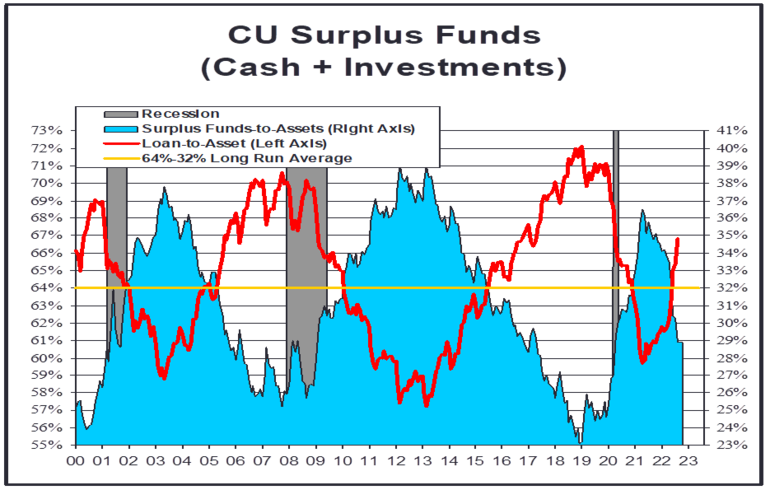
“As of August, the credit union surplus funds as a percent of assets stood at 29%, below 32% which is the long run average,” explained Rick. “So, credit union liquidity is now below its long-run average.”
Addressing the chart (below), Rick pointed out the red line (the loan-to-asset ratio) is the mirror opposite of the blue (surplus funds to assets).
“As of August, this ratio (loan-to-asset) stood at 67%, above the gold line of 64% which is the long run credit union average,” said Rick.
Fastest Growth Since 1980s

Steve Rick
As CUToday.info has been reporting, in its own analysis, CUNA recently pointed out that 2022 continues to be a year in which credit unions are experiencing the fastest lending growth since the 1980s. That growth is broad-based, the trade group said, with very strong, double-digit growth in mortgages, automobile loans and unsecured loans.
Moreover, CUNA pointed out asset quality remains very high, with both delinquency rates and charge-off rates near historical loans. CUNA Mutual’s own analysis, as reported in the monthly Trends Report authored by Rick, has been telling a similar story.
Rick emphasized that the liquidity crunch is the result of a simple equation--loan balances are currently growing at a record breaking 17%, while deposit growth is only 6%.
“Consumers are in the borrowing state of mind, and spending some of their excess savings that came along with three COVID-19 stimulus checks,” Rick said.
Market Conditions to Continue
He expects the pressures many credit unions are feeling may persist.
“This tight liquidity situation will be here for the next two years, as loan growth exceeds deposit growth,” he said.
Many CUs have been responding, pursuing different strategies to relieve some of those pressures, as CUToday.info has reported. In Washington, for example, Department of Commerce CEO Evan Clark has emphasized the importance of pricing deposit rates near top of market while avoiding offering well-below market pricing on lending products.
“Some credit unions face even tighter liquidity positions than what we see from the averages,” said Rick. “They are forced to raise deposit interest rates to prevent deposit runoff or to attract new funds. Some may even raise their loan rates in an effort to slow loan demand. Also, with interest rates moving up, the value of their investment portfolios are falling.”
A Word of Caution
Rick cautioned any credit union CFO from selling investments that are “underwater” in order to fund rising loan demand.
“This is making the liquidity crisis worse,” he explained. “So, CFOs are waiting for existing investments to mature and then using those funds to lend out in auto, home equity and credit card loans.”
What other strategies does Rick advise?
“Pricing of deposits is going to be a critical asset-liability management decision going forward,” said Rick. “Many credit unions are lagging their deposit interest rates behind the rising market rates in an effort to control their cost of funds. Credit unions are seeing their yield-on-asset ratios jump as investment yields jump and loan rates head up. This should boost credit union net interest margins during the next couple of years.”
A New Scenario for Many
For all CU leaders it has been some time since they have had to respond to a rising rate environment and for many, it may be the first time they’ve ever encountered anything other than flat, low rates. The change in the market—with higher rates ahead as the Federal Reserve continues to push up its benchmark Fed funds rate as it seeks to tame inflation—is also occurring at a time many Baby Boomer CFOs, CEOs and others are retiring.
All of that adds up to what Rick said will make for challenges ahead for many.
“Today’s rapid interest rate rise is the fastest in modern history,” Rick said. “The Federal Reserve has so far raised short-term interest rates three percentage points in seven months. Back in 1994-95, it took the Federal Reserve 14 months to raise short-term interest rates three percentage points. And the Fed isn’t done yet—expect another 1.5-percentage-point increase by March 2023. CFOs today are facing a difficult choice: Invest longer term to take advantage of higher long-term interest rates, or invest short-term—and get lower yields—to make sure funds are maturing to help fund future loan demand.”
More in this series: