By Ray Birch
LAKE FOREST, Ill.—It’s time credit unions leverage one advantage they have and revamp checking rewards programs, because two major players—Walmart and BofA—are coming after their business, says one analyst.
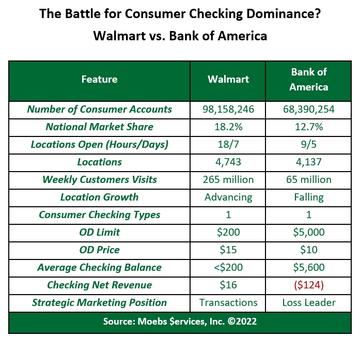
Michael Moebs, economist and CEO at Moebs $ervices, notes Walmart—with nearly 100 —and BofA—with nearly 70 million—collectively hold 31% of the checking market, and their shares continue to grow.

Moebs said CUs must rethink their checking rewards offerings to focus on debit swipes—not only to compete with these big threats but to retain and attract younger checking members and build deeper relationships.
“Fee revenue is essential for community banks and credit unions, since this is a large part of net income. Yet, interchange is vital for Walmart to maintain profitable checking,” Moebs told CuToday.info. “Fee revenue from lending is also important for profitability to BofA, along with interchange to reduce cross-selling expense.”
Leveraging One CU Advantage
Moebs suggested smaller depositories “use interchange against both Walmart and BofA.”
“While Discover, Capital One, and others give back a portion of interchange to their customers, use interchange as a fee-refund vehicle,” he recommended. “Community banks and credit unions could accumulate part or all of their interchange to reduce consumer loan fees. Fees for auto and home loans can be reduced by the interchange credit from the use of debit cards. The more debit cards are used and interchange credit accumulates, a consumer could buy a car, home, or offset overdraft fees and potentially not pay a penny in fees. Walmart and BofA are unable to follow because they need the interchange and fee income to be profitable.”
Moebs said it is clear when analyzing what Walmart and BofA are doing with checking is that each is carving out a segment of the market that is not competing with the other, but rather taking checking business from other depositories.
Moebs said the two beheamouths have contrasting approaches to their checking offerings.
“Walmart has almost 30 million more checking accounts than BofA,” explained Moebs. “Every Walmart account is consumer. BofA has over 500,000 business accounts and is second only to Chase Bank. Interestingly, BofA has only 606 fewer locations than Walmart, although Walmart is open seven days a week, with more hours. Additionally, Walmart has four times the in-person traffic, yet BofA has much more rigorous digital banking.”
The Key Differences
Moebs said the key differences between the two checking giants lie in service design.
“In service design, each has only one account, making it simpler to open and maintain,” explained Moebs. “But the similarities in design model stops there.”
Walmart’s average checking balances are less than 3% of BofA’s, which is $5,600 on average. BofA’s limit on overdrafts is 25 times larger than Walmart’s, and its overdraft price is one-third less than Walmart’s.
“The bottom line tells the story. This is where Walmart and Bank of America go their separate ways,” said Moebs.

Michael Moebs
For Walmart, checking is a way to get interchange revenue, so each consumer checking is profitable. For BofA, checking is a loss leader to get auto, mortgage, credit card, and home equity business, as well as small business loans, Moebs said.
“Add it all together and the relationship is profitable. Walmart doesn’t cross-sell other financial services,” Moebs noted.
Which is Right?
Which approach is right?
“They both are,” said Moebs. “Every service or product sold at a Walmart makes money. Bank of America checking begets other financial services, so the consumer household is profitable. BofA’s checking is not profitable because it takes labor to cross-sell other services.”
Moebs said community banks and credit unions lose as checking users migrate to Walmart’s “transaction marketing” or Bank of America’s “relationship marketing.”
Moebs insisted community banks and CUs must recognize this is not a battle for dominance of national checking market share between two checking giants.
“This is a battle for transaction dominance, or interchange revenue, for Walmart, and a separate battle by Bank of America for dominance in household financial services—two battles each siphoning business from community banks and credit unions,” he said.