

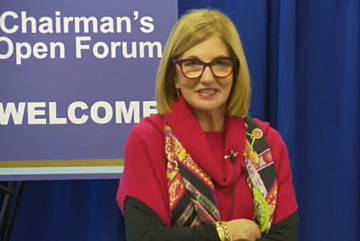
NCUA Chairman Debbie Matz
ALEXANDRIA, Va.–During an Open Forum hosted by NCUA’s board and senior management, questions were posed regarding RBC calculations, the exam cycle, and changes to the 5300, plus more.
NCUA Chairman Debbie Matz led the discussion, with fellow board members Rick Metsger and Mark McWatters also on hand for the event at the agency’s headquarters here. The meeting was also live-streamed.
Here is a look at the questions that were asked and the responses given:
Q—John Farmakides, CEO, Lafayette FCU, Kensington, Md.: In terms of RBC risk-weights, can we see the detail on the comparison between how single-family mortgages are treated under the NCUA system vs. the way it is done in the banking system? In our calculation, there is a huge disparity.
Larry Fazio, director of Examination and Insurance, NCUA: In the RBC calculation, what we call residential real estate loan, regardless of whether owner-occupied or not, it is risk-weighted as a real estate loan. That is identical to the other banking agencies, with one nuance: we also take into account concentration risk. So when (real estate) exceeds 35% of total assets, on the amount above that there is additional risk weighting. When we ran how many credit unions were affected by the additional incremental risk weight threshold, less than 10% of complex CUs were affected.
Q—Farmakides: In terms of the securitization reg, where do we stand on that?
Lara Rodriguez, deputy general counsel, NCUA: I don’t have any specifics about timing of the reg. We have received about 18 comments. There are a few issues that staff is working on, and then it is up to the board.
Q—Farmakides: When can we expect to see something on personal guarantees? It’s become extremely competitive in our market and we are not closing deals in this area like we used to.
Matz: I have heard that. When we will finalize the rule, I can’t tell you, but we’re hoping it will have an earlier implementation period.
Fazio: In the meantime you can get a blanket waiver from the region.
Q—Farmakides: Last week there was another article about the U.S. Postal Service getting into financial services. What is the agency’s position on that?
Matz: The agency doesn’t have an official position on it. We might have the staff look into it and do some research on it. But unless Congress asks us, we probably won’t weigh in.
Q—Andy Price, senior director-advocacy and counsel, CUNA: You have taken on numerous issues to provide reg relief, yet one of the largest burdens remains having to go through an annual exam. I’m wondering if you have softened your stance on 18-month exam cycle?
Matz: As we have discussed, we have done a great deal on reg relief. I think it would be somewhat irresponsible of us to have all this reg relief and not see how it is working in the field. We need to give it time to make sure we haven’t done anything or that credit unions aren’t implementing it in a way that affects safety and soundness. I want to make sure you don’t misunderstand that we’re not saying no, I just don’t think this is the right time.
Fazio: We appreciate that when you go through an audit and an exam it affects your operations. But there are challenges in going through an 18-month cycle. We have already taken steps to shrink the scope of exams for small credit unions and narrowed that focus. We have tried to make that more efficient. But it’s important with the limited segregation of duties at smaller credit unions that there is some presence from us. The largest CUs are rapidly evolving in terms of their balance sheets and the complexity of their product and service mix, and we have to stay in touch with what is going on there. We are working on how we can improve the exam experience for the medium to large-size institutions. That relates to the technology in the exam process itself. AIRES is way past its lifecycle. We have a secure portal coming that will improve the amount of planning that can be done before we are on-site. We’re planning to adopt more sophisticated portfolio analytics. The goal is to shrink the on-site portion of the exam.
Q—Sharon Lindeman, VP-regulatory and advocacy, California Credit Union: One suggestion we have is partnering with state supervisory agencies in some sort of formal agreement to alternate those exams, which would help with both our state assessments as well as the NCUA budget.
Matz: For CUs over $250 million we do joint exams with the state every year.
Fazio: There are a couple of ways to think about that. Already, anytime we do an insurance review for state-chartered, federally insured credit unions, our goal is always to do it jointly. It’s not always 50/50. We have a framework for how we approach that. As the insurer we have some fiduciary duty to have some sampling of federally insured CUs. If we switched to an alternating cycle, which I know the FDIC does in states with which they are comfortable, you’d have a 50/50 sort of split. By doing this jointly is it already a 50/50 split. I don’t know that it would change the dynamic, but it is something we have discussed with state examiners.
Q—Lindeman: A question raised by one of our members during a Hike the Hill had to do with the Payday Alternative Loans and the requirement the member be a member for 30 days before they can get the loan. When we are trying to help the community we are trying to help people who need immediate cash. So we hope you’ll consider removing that requirement.
Matz: That is something we will take into consideration. When we implemented that rule we gave it a lot of thought and did a lot of research. We had a concern that a lot of FIs were giving a payday loan and then never seeing that person again. There was a really high rate of default.
Q—Bill Hampel, chief economist and chief policy officer, CUNA: This question has to do with the judgment that examiners will have to exercise. Our members are concerned with the FASB rule that is coming with loan losses, and being required to hold a higher loan loss (figure) than they once did. That means that CUs’ capital levels will look lower than they once did, not because reality has changed but accounting rules have changed. So will examiners after this new rule is in effect look at the capital adequacy of a credit union somewhat differently?
Fazio: On CECL, if FASB does adopt this, and we expect them to, we do expect to see an increase in ALLL. Under the statute net worth is defined as retained earnings, and that we cannot change. As a result when you expense it the net worth ratio will come down a little bit, or a lot. So we will obviously put some guidance out to examiners and we will make it clear as part of the capital analysis if that is the only reason for the capital decline that is not something to worry about. What we can’t change is if it causes CUs to fall below the thresholds for PCA category. We will have to take action as required, but could also take into consideration (the higher loan loss figure) in the net worth restoration plan.
Q—Hampel: The other issue with examiner judgment is that our members really appreciate the direction of the MBL rule. What it has created, however, is the requirement to come up with their own policies on what are safe and sound commercial lending policies, which then have to be blessed by an examiner. Several of our CUs, based on their experiences with examiners and examination of MBL policies, are concerned in some instances that examiners may come to really different decisions about appropriateness of a policy.
Matz: We appreciate that. It is a sea-change for our examiners, too, which is why there is a long implementation period and why there will be extensive training on this. There is also a lot of angst among examiners about having this new responsibility. It’s a lot easier to go through a checklist than it is to go through a framework and have to use judgment.
Fazio: I agree. We are going to put out pretty extensive guidance to examiners. Within that guidance we are going to create some guideposts, if you will. The credit unions that are currently involved in business lending have policies in place and we are comfortable with, or we would have taken action. The delta will be those that are new to it or that might change their policies.
Q—Hampel: One suggestion we have is that early on in the process there be opportunity for a second opinion in the event of a disagreement. This is going to be a learning process for both sides in this process.
Matz: If there are systemic concerns, we want to know about it. We encourage feedback.
Q—Prescott Ford, Balance Sheet Management Services, Hauppauge, N.Y.: I have dedicated my career to ALM and interest rate risk. I do think the new RBC rule requires additional guidance. Is there a timetable?
Fazio: We have been rethinking our approach on interest rate risk for about two years now. We have done a lot of outreach and data collection. We have met with all the ALM vendors, we have met with registered investment advisors, we have done a ton of research on this subject. My goal is to do two things: to bring all the guidance into one place, instead of disparate guidance. And to use all this research we have been tapping into to update the content of that guidance. We are pretty far along in that process at this point. We are going to beta-test some new procedures and techniques in Q1 in 2016, and hope to have new guidance sometime next year. I think what you will see in one goal is to really narrow our focus on interest rate risk. Most CUs don’t have much risk. There are a handful of outliers that have too much, and we want to focus on the ones with elevated risk and what are potentially terminal levels of IRR. This will also improve the exam process.
Ford: I know there are some in the agency and the industry that have looked for and desire a bright line to use in the measurement of IRR. I am personally of the position that a bright line can exist accurately. It’s just too complex. Also a concern I have with the change in definition of a small CU to under $100 million might need to be some clarification that they still need to manage IRR.
Q—Michael Emancipator, senior regulatory affairs counsel, NAFCU: Is there more guidance on what examiners are looking for in cyber-risk?
Tim Segerson, deputy director, NCUA Office of Examination and Insurance: Going forward we have been working together with the (other federal) agencies to develop a tool and to raise awareness within the financial industry to really understand the scope of what is happening out there. Five years ago there was nothing like what is occurring today, and five years from now it’s going to be even worse. The goal was to get the cybersecurity assessment tool out into the industry. The FFIEC partners are also doing this for service providers, as well. For us we have engaged in a large amount of outreach and have visited 30 states so far to do training. We are spending the rest of this year and about half of next year to thoroughly train the examiners on the assessment tool and we are going to incorporate that structure into our examination process, with a goal somewhere around mid year next year. Part of this is in response to the GAO audit that the all the agencies need to collect more information on threats and risk.
Q—Farmakides, Lafayette FCU: I would like to see a composite index on all CUs’ cost of funds on a quarterly basis. It would be a huge, huge help for us.
Matz: That’s the first time I’m hearing of it but it’s something we would look into.
Q—Chris Anuswith, VP-risk management, ABNB FCU, Chesapeake, Va.: With FOM, will we know anything about the FOM modernization effort before January, when we storm the hill in Richmond?
Matz: Yes.
Q—Anuswith: With the overhead transfer rate, in the past it has been lower than what it is now. Do you have a goal for the rate?
Matz: We don’t have a goal on the OTR. It’s a formula, and it is extremely complicated, but there have been two outside evaluations that have validated the methodology. We are indifferent to the (OTR).
Fazio: A criticism in the past was that it was too arbitrary. So we came to what makes the most sense methodologically. We are not shooting for a number, we’re shooting for a fair method, and the number is what it will be.
Q—John McKechnie, Total Spectrum, Washington, D.C.: Now that you’re finished with the rulemaking on RBC, are there any early thoughts on implementation and potential changes to the 5300 and training.
Fazio: The RBC changes do affect the call report. So we are at a point where we want to rethink the entire call report, both in terms of the content and the approach to filling out the call report. We are going to kick off a process next year that will include credit unions and we will be taking a look at it with a fresh set of eyes. What don’t we need anymore? What do we need to add? We’re going to do a holistic approach to the call report by early next year. The other thing we’d like to do is one of the underlying technologies that needs to be updated is CU Online that is based on technology that is not supported anymore. As a result, we are going to take the opportunity to change the experience. The current call report is designed to fill out information on a paper page. But in electronic format you can get more of a guided experience. So if you are not doing certain activities you will not even see those things. I think we can do a lot with reorganizing the content and changing the way the interface works with the way you fill it out.
The secure portal we hope to have up and running next year will allow credit unions and examiners to share information us another way to improve the exam experience.