

JACKSON, Miss.–HOPE Credit Union here will be among the recipients of funds from a $100-million plan by Netflix to invest in Black lenders. HOPE Credit Union has received a $10-million deposit in the form of what the credit union calls a “Transformational Deposit.”

Sources told CUToday.info they are hopeful the move by Netflix will spur similar partnerships between other large companies and Community Development Credit Unions (CDFI), as organizations across the U.S. seek to put action behind their words regarding ending racism.
HOPE CEO Bill Bynum said the investment by Netflix is putting money where it can do the most good.
“Are we going to create opportunities for all or just the privileged few?” asked Bynum, referring to the need for greater support to be given to communities of color and low-income areas. “When you have a Fortune 500 global leader saying it’s time to step back and do things differently, to prioritize investing in those front-line institutions that will drive change where it’s needed most, we think that others will take note...I think we are at a historic moment in this country and how we respond will determine what kind of country we will be.”

Bill Bynum
In each Deep South state served by HOPE, the credit union reported that for every dollar in net worth held by white households, Black households hold between 10 and 20 cents.
“Through Transformational Deposits, HOPE imports funds into these capital-starved communities to make business, mortgage and consumer loans and provide other financial services that build wealth and foster economic mobility,” said the credit union, which has grown to $309-million in assets since being chartered in 1995.
HOPE Credit Union is the only depository institution in several communities it serves in the Mississippi Delta region. Transformational deposits are designed to import capital into what are often referred to as banking deserts, due to their lack of financial services, Bynum said.
Supporting for 2,500-Plus
Over the next two years, Bynum said the CU estimates the Netflix deposit will support financing to more than 2,500 entrepreneurs, homebuyers and consumers of color.
“Left unchecked, America’s unsustainable racial wealth gap will get even wider,” said Bynum. “On a per capita basis, financial institutions owned or led by people of color are the most effective way to fuel economic mobility and prosperity for people and places from which wealth has been extracted for generations. If other companies followed Netflix’ example, hundreds of billions could be invested toward closing debilitating opportunity gaps that create division and limits America’s immense potential.”
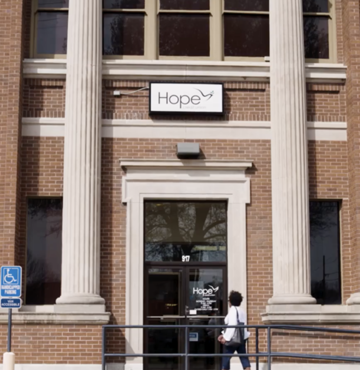
Hope CU
FDIC data show roughly six out of 10 people living in the service area of Black-owned banks are Black, in contrast to six out of 100 for banks that are not Black-owned.
Netflix announced it plans to deposit approximately 2% of its holdings, or about $100 million, with institutions such as HOPE Credit Union. It will start with $35 million, split two ways: financing a new fund, the Black Economic Development Initiative, that will invest in black financial institutions; and banking with the Hope Credit Union.
Netflix already spreads its cash among about 30 banks worldwide, according to the New York Times.
‘They See the Importance’
Bynum told CUToday.info Netflix reached out to HOPE less than two months ago.
“They told us they see the importance of investing in places that have been underinvested in for a long time,” he explained. “Places that don’t receive enough ready access to capital as others.”
Bynum noted that if HOPE CU had 100% of the deposits from Itta Bena, Miss.—a majority Black Mississippi Delta town with a poverty rate is 42% and median household income is $20,417—it would only gather just over $1 million in deposits.
“So, instead of using local savings and checking accounts we often have to import brokered deposits, which are at a higher cost that share certificates,” Bynum explained. “As a result our cost of funds is much higher than most other financial institutions. With this transformational deposit—a two-year certificate at 10 basis points—we dramatically lower our cost of funds. This strengthens our balance sheet and provides liquidity to make more mortgage loans to first-time homebuyers, make more small business loans, and help people stay away from payday lenders. It’s a very impactful deposit that allows us to help lot more people.”
Just the Beginning
Pablo DeFilippi, SVP of membership and network engagement at Inclusiv, believes the Netflix deposit with HOPE CU is just the beginning of more of these types of partnerships with CDFIs/minority depository institutions (MDI) and large organizations.
“This is a huge recognition of HOPE and for other CDFIs and MDIs,” said DeFilippi.

DeFilippi believes the Netflix investment was sparked by all the racial unrest in the U.S. following the killing of George Floyd at the hands of Minneapolis police officers.
“Every major company in the U.S. is trying to figure out how they can go beyond their statements about ending racism and take some action,” DeFilippi said. “They want to do something that shows they are serious about driving some real change.”
DeFilippi noted the focus on diversity, equity and inclusion (DEI) has ramped up significantly over the last year among credit unions. But what has been needed is some sort of national spotlight.
“The DEI conversation among credit unions has grown,” noted DeFilippi. “We now have the DEI Collective; there is much more discussion about becoming more diverse among credit union leadership…But now this is something happening for credit unions at a national level.”
CDFIs as a Platform
Moreover, DeFilippi said, there has been significantly more conversation nationally about CDFIs becoming a platform to inject capital into minority communities.
“There is Starbucks and other large companies looking at CDFIs as a mechanism to do that,” he said. “We hope this Netflix investment will open up the d

Pablo DeFilippi
oor for other investments with CDFIs and mission-driven credit unions.
“And who would not invest in HOPE—what a great name,” continued DeFilippi. “The name is so powerful—you can say HOPE is coming to town every time the credit union opens up a new branch.”
For more information on the Transformational Deposit program at HOPE, go here https://www.hopecu.org /transform.
A video produced by the Wall Street Journal about Hope Credit Union can be found here.