

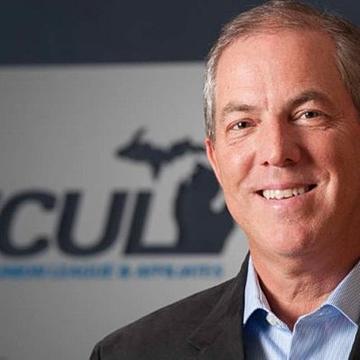
David Adams, MCUL
By Ray Birch
LIVONIA, Mich.—Just as Save to Win is designed to teach low-income members to put money away a little at a time so it builds, the program itself started small and has grown—poised to expand across several states.
Save to Win, also known as prize-linked savings—a term eventually coined following the launch of the program by the Michigan CU League in 2009—lets members open small-dollar CDs and then add money each month. It also enters account holders into an annual drawing for a large grand prize.
David Adams, chief executive of the Michigan Credit Union League and CEO of the league subsidiary CU Solutions Group, which manages Save to Win, talked to CUToday.info about a program that was launched during the recession—at a time, he reminded, when Americans needed to find ways to save.
“We now have 58 credit unions offering Save to Win in five states,” said Adams. “There are other states that have the enabling authority that are in various stages of implementation. Our vision is to use prize-linked savings authority, that has to conform with state gambling laws, to help credit unions effectively promote savings, primarily to members who are not currently good savers.”
Prizes Vary
Adams explained that the prizes vary by state, and that in addition to the grand prize, each credit union can offer additional prizes, such as monthly drawings.
“We have 28 credit unions in Michigan, eight in Nebraska and seven in Connecticut that currently have access to 1,864 prizes totaling $105,000,” continued Adams. “In North Carolina, nine credit unions participate, and this year 318 prize winners will win $45,000. And in Washington State, six credit unions will make 104 prizes available totaling $25,000. So, this year, about 2,286 people will win a total of $175,000 in prizes.”
Since Save to Win’s inception, more than 50,000 members have purchased small-balance CDs—often $25—and saved over $100 million. And 14,000 people have won a prize out of the $1.6 million that has been paid out since 2009.
“We are hopeful that we can work toward one day seeing 1,000 credit unions on this program, providing incentives to save to millions of members,” said Adams. “Although the savings balances will be small, the impact on lives will be big. We have also found that 82% of first-time Save to Win savers continue to save. That’s a great metric.”
Crediting the Filene Research Institute and Doorways to Dreams for the original concept, Adams said when the league took the program and ran with it, that he never thought it would become as large as it has, with the potential to grow even further.
Supports CU Social Mission
Adams said Save to Win’s appeal is supporting credit unions’ social mission, giving back to the community and teaching people how to save. “It’s not a program that’s about making money, but it does boost a credit union’s image, often attracting a great deal of local media attention.”
Adams said a small hurdle the program has faced, particularly during the recession when lending was tough, is CUs being flush with cash.
“So not as many credit unions have been looking for programs that bring in deposits,” said Adams. “But again, this is a program that is about the social mission, so it works for a CU that is 100%, or 10%, loaned out.”
Adams said the league has carefully taken steps with Save to Win. “We piloted it with eight Michigan credit unions, and then we changed the model. In the first year, for instance, there was a grant that provided for the prize pool. And later the league had to step in and commit a certain amount of money, about $100,000 a year.”
Since then, CU Solutions Group has modified the annual subscription that CUs pay to participate.
“We have had to allow for credit unions to add their own prizes; we had to work on the technical interface and the rules, as there are a lot of issues from state to state with regard to gambling laws, even though this is not gambling—at no time is one cent of members’ money at stake,” said Adams.
After six years, Adams said CU Solutions Group is ready to take the program to the “next level.”
Standardizing The Program
The vision includes expanding to more states, standardizing the program, making Save to Win less costly to administer and potentially increasing the prize pool, and eventually reaching many more members with a program that will do them good, said Adams.
In that vision, the program becomes self-sustaining, said Adams, a Save to Win “imperative,” which will happen as more states and more credit unions come aboard and the program centralizes.
“We are currently not covering our costs,” said Adams. “But by increasing scale we will increase cost savings, reduce operation expense and then make a small margin as the administrator, that is our objective. I am not sure of the magic number, but we need to get a few hundred credit unions using Save to Win.”
Did Adams in the early days of Save to Win have the same vision he has today for the program?
“No. But we did not go into this with the notion of scaling it up, as much as we wanted to come up with something that would be sustainable and attractive to any credit union, whether they need deposit money or not,” explained Adams. “When I do media interviews with national press, who don’t know credit unions that well, I often get asked why banks don’t do this. My answer is because credit unions are not trying to make money at this. They want to encourage people to be smart savers.”