

MONTREAL, Quebec–A panel of regulatory and political experts offered updates on everything from risk-based capital, the “Sen. Warren effect,” NCUA transparency, what’s going on with the CFPB, and more here during NAFCU’s annual meeting and convention here.
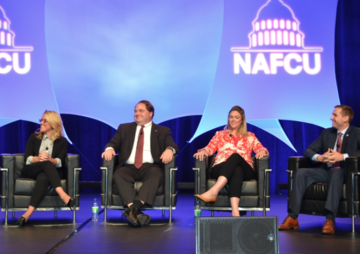
From left, Alicia Nealon, Brad Thaler, Jillian Pevo and Dan O'Brien.
Hosted by NAFCU SVP/General Counsel Carrie Hunt, who said the political and regulatory game is “real and the stakes are high, but we wouldn’t have it any other way,” the panelists included: Alicia Nealon, director of regulatory affairs; Brad Thaler, VP of legislative affairs; Jillian Pevo, director of legislative affairs, and Dan O’Brien, director of political affairs.
Below is a look at a portion of the Q&A:
Hunt: A topic we have addressed on the regulatory side that has taken most of our time is risk-based capital. Where are we with that?
Nealon: Risk based capital has dominated our conversation for the past 18 months. NAFCU opposes this rule and has encouraged its complete withdrawal. Chairman (Debbie) Matz has said she wants to finalize the rule by Dec. 15. Board member (Mark) McWatters has brought an important perspective and has questioned the rule’s legality, and questioned the cost effectiveness. This rule, if it goes through, is going to be burdensome and costly. When it goes final and in what form may depend on the composition of the board. Chairman Matz’s term expired in April.
Hunt: On the legislative side, NCUA has been very vocal about our support for the “Stop and Study” bill (related to NCUA’s RBC proposal). What’s happening on the Hill?
Thaler: We worked with Congress last week to introduce the “Stop and Study” legislation that would require NCUA to stop moving forward with the rulemaking process, study the issue further, report back to Congress, and give it time to look at the issue and review any recommendations from NCUA, before NCUA could move forward. This continues what we’ve seen for the past 18 months with Congress getting involved in this issue. This remains on Congress’ radar. It has lawmakers’ attention.
Hunt: Jillian, you’ve taken a strong lead on getting that risk-based capital legislation introduced. Tell us about some of the personal conversations you’ve had.
Pevo: I think this is a good example of all politics being local. There is concern on Capitol Hill about how it might constrict capital and affect lending. I think the sponsors of the bill are excited about it and will promote it. There are thousands of bills in Congress, so you really need someone to champion it. We expect them to send a ‘Dear Colleague’ letter and to seek additional sponsors.
Hunt: Why is this necessary for it to be a bipartisan bill, and what is it like having the GOP in control of both houses of Congress?
O’Brien. In the Senate, the GOP doesn’t have a veto-proof majority, so any legislation introduced needs to have bipartisan support to move forward and pass. Having a grassroots efforts from credit unions and engaging with Congress on why the Stop and Study bill is important is necessary to move this forward.
Hunt: What about member business lending? The proposal has been released on MBL hopefully it will provide some operational relief. But will it really provide true relief and what else can we do to make it a better regulatory environment on MBL?
Nealon: There are two moving pieces here. The first is the statutory cap and the second is the waiver provision. The current regs require very prescriptive rules that are not required by statute, and this proposal would strip those out. Under the proposal every credit union could set its own standards. It will require credit unions to have a much more robust commercial lending policy. NAFCU is still carefully examining the proposal to see just how much relief it will really provide. We are optimistic. Under the current prescriptive standards and with the required personal guarantee, we’ve heard from CUs saying they are often unable to give a borrower a loan because they have to go to NCUA for a waiver. So we’re hopeful.
The first ball is the statutory cap, so we would have to go to Congress to get that cap raised. But NAFCU is convinced NCUA has the authority to provide relief to credit unions under that cap, including to CUs that have a history of providing member business loans.
Q: We see the Independent Community Bankers of America is upset over MBL, and they continue to be opposed.
Thaler: The banking trades vehemently oppose any effort to raise the MBL cap on Capitol Hill, making this a very sensitive issue in Congress, which doesn’t want to have to choose between the two sides. But we have been successful in Congress in getting bills introduced that would provide certain exemptions from the cap. There are a number of bills out there that are gaining support. But we also tried to talk to the leadership in Congress about putting pressure on NCUA to use the authority we believe they already have in the FCU Act to provide relief. We recognize that getting legislative relief could take a much longer time.
Hunt: Jillian, tell us more holistically about reg relief.
Pevo. We recently saw Sen. Shelby move through his committee a fairly significant regulatory relief package. But it’s a real uphill climb. You need 60 votes in the Senate to do anything. The Elizabeth Warren effect is very real.
Hunt: What is the Sen. Warren effect?
Thaler: Sen Warren is the architect of the CFPB and was the first unofficial head of the CFPB after the Dodd-Frank Act was passed. Now she is a senator from Massachusetts and a member of the Senate Banking Committee, and even though a junior member of the minority party, she is still one of the most powerful members of the Senate. She has a lot of followers whom she can mobilize to go after senators who do not support her position or whom she feels vote against consumers. A number of Democrats in Senate are worried that Elizabeth Warren could even come out and challenge them. They don’t want to get on her bad side. With the CFPB being her child, a lot are worried over being seen as doing anything that might weaken it.
Hunt: If you had a crystal ball and could really predict what we might potentially see happen this fall in legislation, what would you say?
Thaler: I think there is a path forward for some sort of reg relief for community institutions. The Democrats have put forth a proposal that is counter to Sen. Shelby’s legislation, and there’s not everything in there that we want, but I think there will be some common ground. More than likely with the Republican majority we will see some sort of regulatory relief being produced. But it’s likely to be a long, drawn-out process.
Hunt: Talk for a little bit about the effect of the presidential election upon our efforts?
O'Brien: There are only 501 days until the next election. President Obama is not on the ticket. It is a wide-open election. There is a lot of time for candidates to make their cases. If you live in an early primary state or a swing state you will be getting lots of visits and attention. Three senators are running for president, which means they will be away from the Senate and will not be there all the time to be at votes or at hearings. The presidential election in 2016 is going to have a large impact on getting legislation to move forward. And Chairman Shelby is up for election too, and while he is likely to win, there are term limits on the chairmanship, so the Democrats could likely be back in charge in 2016.
Hunt: Let’s talk about the CFPB. I do think we have made some progress in getting them to understand how credit unions operate.
Nealon: Overdraft has been on the CFPB’s rulemaking agenda for three years. But for three years we’ve seen rulemaking on overdraft pushed back. There are two reasons: the CFPB does not have the legal authority to do what it wants to do, which is to set a hard cap on overdraft fees. The second reason is the Bureau does not have consumers on its side in this conversation. Consumers love overdraft. So they can’t get consumers to go on the record and talk about how evil overdraft is. But the Bureau has been very active under UDAP and Reg E with enforcement of what it believes are unfair or deceptive overdraft programs. In April the CFPB took its first enforcement action under the EFT Act against Regions Bank for failure to obtain opt-in on overdraft. That led to a $56-million fine, $48 million of which is to be repaid to consumers. I don’t think that the Bureau is going to do a rulemaking this year due to (Small Business Regulatory Enforcement Act), which requires it to convene a panel to assess the impact of potential rulemaking. It has not convened that panel, so timing-wise it just isn’t possible to get that done before early 2016. But the Bureau is in major data collection mode right now, getting information from the major data processors. To me they are still trying to decide what they are going to do, and how to justify what they are going to do.
Hunt: What about leadership of the CFPB and being led by a single director or a board?
Thaler: There is standalone legislation to change the CFPB to a five-person board or commission. That bill has bipartisan support, with some Democrats on it, so that is a positive sign. We think there is a good chance that legislation could be marked up and pass the House and be sent over to the Senate. Keeping this as a simple bill helps it to move forward. When the CFPB was originally proposed it was proposed as a commission, modeled on the Consumer Product Safety Commission. There is also are recognition that the next president will get to appoint the next director. If it’s a Democrat it’s likely to be along the lines of Director Cordray. If it’s a Republican, that person will likely stick a little closer to a more limited role. So as we get closer to the election, each trying to hedge their bets, you get a commission with five members that would likely stay closer to the center.
Hunt: The CFPB has grown astronomically. Alicia, what has been your experience in working with the CFPB, as it’s the staff that are the ones really doing the work?
Nealon: Here’s a fun fact. The CFPB has the highest turnover rate of any government agency, so the staff is not that constant there. I think the CFPB’s agenda is a bit politically directed, because Director Cordray has the strong support of Sen. Warrern. He knows she will thwart any attempt to limit his power or his reach.
Hunt: What about the frustrating issue of data security? Let’s talk a little bit about the legislative front?
Thaler: Legislatively, breaches such as Target and post-Target breaches have gotten the attention of Congress. We’ve seen bipartisan bills in both the House and the Senate that are pretty strong. We’ve worked to introduce legislation that would take Gramm-Leach-Bliley standards that FIs currently operate under and extend those to other organizations, such as retailers. The retailers are obviously not happy about it and have been fighting it. A lot of members of Congress remember the interchange fights of a few years ago and they do not want to relive that. But as breaches occur and consumers are impacted the pressure is on them.
O’Brien: NAFCU has been at the forefront of calling for changes. It’s exciting to see that we do have the Data Security Act of 2015 in both sides of Congress. On the grassroots and advocacy front it’s very important for credit unions to weigh in on this legislation. NAFCU has two grassroots pages that will take you just two minutes to send a letter. Next week is the July 4 recess and members of Congress will be back in their states, so continue to urge them to move the legislation.
Hunt: I’m going to talk about footnotes. When NCUA testified before Congress earlier this year they put a little footnote in their testimony about NCUA wanting third-party vendor authority?
Thaler: The agency has mentioned that seeking third-party vendor authority is one of their legislative priorities, which is really regulatory over-reach. They have gone to Capitol Hill seeking authority to go to CUSOs and other vendors to take a look under the hood and see what’s going on. When we talk transparency, this would likely cost money. They have guised this under the couch of cybersecurity, which are key words on Capitol Hill. This is an authority they have been seeking for a number of years, and the reasons for the authority have usually changed with whatever the hot buzzwords are of the day. The good news is that members of Congress realize this isn’t really regulatory relief and there’s not strong appetite to give them this authority.