

By Ray Birch
LAKE FOREST, Ill.—New data from the first quarter of 2020 includes a surprise—overdraft transactions among all financial institutions increased 4.8% year over year to $34.5 billion, even though the coronavirus pandemic was already hitting the economy.
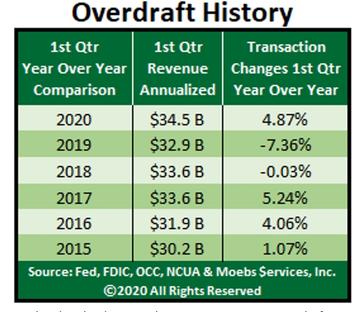
That is the conclusion of a Moebs $ervices study that also does not expect another overdraft boon during Q2.
Michael Moebs, economist and CEO at Moebs $ervices, called the Q1 results surprising, noting bank OD revenue climbed while credit union overdraft usage fell slightly.
Moebs emphasized the results were unusual—not only due to the climb in a quarter in which those kinds of spikes are not normally seen because of the typical OD usage drop-off following holiday spending, but also due to the fact the health crisis began to wreck the economy late in the quarter.
‘Most Unusual’
“First quarter results are finally here,” said Moebs, noting the delay was due to NCUA data being released late. “Year-to-year OD transactions increased 4.8%, while OD price stayed the same. This is the most unusual first quarter results since we started tracking overdrafts in 1983. Layer on this the impact of the financial crisis caused by COVID-19, and these results are extraordinary.”
The key question is will the first quarter OD behavior continue?
“We learned in the Great Recession that overdraft revenue usage fell almost 20% during that period,” explained Moebs. “Consumers do not want to pay fees in an economic crisis—they hunker down and watch their pennies to avoid overdrawing. So, with the pandemic affecting the economy for the entire second quarter, CUs, banks and thrifts will see a downturn in OD revenue in Q2, we expect.”
Point of Elasticity
Moebs emphasized that first quarter transactions were expected to fall and, as a result, overall overdraft revenue was also expected to decrease.
“The Moebs OD Study points out 2019 and 2018 had decreases in transactions and reduced revenue due to price increases by banks and credit unions in both years. The point of elasticity in overdraft pricing has finally been reached,” noted Moebs. “And that point is $30 per OD transaction, and the decrease in volume for 2019 and 2018 proves this.”
Moebs called the overdraft usage increase at banks and decrease at CUs during Q1 “uncharacteristic.”
Moebs said banks got an overdraft boost in Q1 from small business checking accounts, as businesses began to struggle and had a greater need to use overdrafts. “Credit unions do not have as many business chec

Michael Moebs
king users as banks, but they are now getting after this business.”
A Precedent
Moebs said there is precedent for overdraft behavior during a financial crisis.
“In the Great Recession, starting in 2008, overdrafts were shunned by the consumer to avoid paying fees. Yet the economic crisis resulted in substantial unemployment and financial hardship for consumers and business,” said Moebs. “In the Great Recession overdraft revenue fell 19.6% over four years from 2008 thru 2012. In this period of time banks and thrifts were hardest hit.”
Using the Great Recession as a guide, Moebs $ervices predicts consumers will avoid using overdrafts during the coronavirus crisis, with OD volume and revenue expected to decline.
A Potential Exception
But there could be an exception to the forecast should FIs make changes to their overdraft pricing, noted Moebs.
“In the four years, 2008-2012 of the…Great Recession, bank OD prices rose swiftly to $30 a transaction, while credit unions maintained their $25 price,” he said. “The result was an increase in market share by credit unions from 13.8% to 18.2%, or a 32% increase over four years. What this shows is an overdraft price decrease will increase volume driving up revenue while helping the American consumer weather the economic storm caused by the coronavirus.”